

Entity SEO is the practice of optimizing content around identifiable concepts, people, organizations, and products, and the verifiable relationships between them, so search engines and AI systems can identify exactly what you're talking about and cite it with confidence. The payoff shows up two ways: your pages start ranking for a wider spread of related queries, and AI tools like Google's AI Overviews or ChatGPT start pulling your content into their answers instead of a competitor's. The sections below walk through the mechanics, the implementation steps, and the diagnostics that tell you whether it's working.
Table of Contents
- What Is Entity SEO and How Is It Different From Keyword SEO?
- How Do Search Engines and LLMs Actually Use Entities?
- How Do You Build an Entity SEO Strategy Step by Step?
- Which Tools Diagnose and Validate Entity Signals?
- What KPIs Actually Prove Entity SEO Is Working?
- What Mistakes Undermine an Entity SEO Strategy?
- How Does Executive Edge Authority Engine Put This Into Practice?
- Where to Verify Entity SEO Guidance Yourself
- The Part of Entity SEO Everyone Gets Backwards
- A Managed Path if You'd Rather Not Build This In-House
- Sources
- FAQ
What Is Entity SEO and How Is It Different From Keyword SEO?
Keyword SEO treats a search term as a string of text to match. Entity SEO treats it as a reference to a real, identifiable thing, and search engines figure out which thing. That distinction sounds academic until you see it in practice: a page optimized for the keyword "apple" has no way to signal whether it means the fruit, the tech company, or the record label. A page built around the entity "Apple Inc." carries attributes (founded 1976, headquartered in Cupertino, produces the iPhone) and relationships (competitor of Samsung, subsidiary brands like Beats) that remove the ambiguity entirely.
Entity-based SEO shifts the optimization target from exact-match phrases to identifiable concepts and the connections between them. That's the core of what people mean when they say entity based seo or entity-based seo. It's not a rebranding of keyword research. It's a different unit of meaning.
For marketers, this plays out across a few practical entity types:
- Brand entities: your company itself, its founders, its locations, its official social profiles.
- Product or service entities: a specific offering with its own attributes, pricing tier, and use case.
- Topical entities: concepts your brand is authoritative on, like "entity optimization" or "local SEO citations."
- Person entities: authors, executives, or spokespeople tied to your content.
When an entity is clearly defined and consistently referenced, one well-built page can surface for dozens of related searches instead of chasing one keyword at a time. That's the multi-query lift entity clarity produces, and it's the reason entity SEO for experts increasingly means building systems, not single pages.
How Do Search Engines and LLMs Actually Use Entities?
Google's Knowledge Graph assigns canonical IDs to real-world entities, drawing heavily on structured sources like Wikipedia and Wikidata. Once your brand or product has a stable identity in that system, Google can rank your pages across a broader range of related queries because it already knows what you are and what you're connected to.
Behind that sits natural language processing. Feed a page through the Google Natural Language API and it returns a list of detected entities along with a salience score for each one. Salience measures how central that entity is to the text. A blog post about "invoice software" that scores low salience on its own product name is a page trying to talk about too many things at once.
Large language models extend this logic further. When an AI system composes an answer, it favors sources where entities are unambiguous and verifiable, because ambiguity is exactly what erodes citation confidence. This is the mechanical reason clean entity signals now double as knowledge graph SEO signals.
You can see the output of this pipeline in a few familiar places:
- Knowledge panels that pull structured facts about your brand into the right rail of search results.
- AI Overviews that synthesize an answer and link back to a small set of trusted sources.
- Featured snippets that lift a direct, entity-clear answer straight from your page.
Diagnostic snapshot: running a page through the Natural Language API and getting a salience score under roughly 0.1 to 0.2 for your primary entity is a strong signal the content is diluted across too many unrelated topics. That's the single fastest health check available before you touch a line of copy.
How Do You Build an Entity SEO Strategy Step by Step?
This is the part most guides skip. Understanding entities is the easy half. Wiring them into a real content system is where teams stall.
-
Map your pillar entities first. Pick one to three entities that define your business (your brand, your flagship service, your core topical authority). Don't try to map everything at once. Confirm whether each already has a Knowledge Graph presence, and if not, build the sameAs links (Wikipedia, Wikidata, LinkedIn, Crunchbase) that give search engines something authoritative to point to.
-
Build the hub-and-spoke structure. Each pillar entity gets a hub page. Supporting "spoke" pages cover related subtopics and link back to the hub using descriptive, entity-rich anchor text rather than generic phrases like "click here." Hub-and-spoke content planning strengthens topical authority because it shows search engines exactly how your pages relate to one another and to the central entity.
-
Fix the on-page fundamentals. Your H1 and the first 100 words should name the primary entity plainly, not dance around it with synonyms. Use consistent, canonical naming for your brand and products across every page, no shortened variants on one page and full names on another.
-
Add structured schema. At minimum, mark up Organization schema on your homepage, Article schema on blog content, and Product schema on service pages. A basic pattern looks like this:
{
  "@type": "Organization",
  "@id": "https://eepartnergroup.com/#organization",
  "name": "Executive Edge Partner Group",
  "sameAs": [
    "https://www.linkedin.com/company/executive-edge-partner-group"
  ]
}
The @id field gives you a stable anchor other schema on your site can reference, and the sameAs array is what ties your entity to external, authoritative profiles.
-
Wire the internal links deliberately. Every spoke page should link to its hub, and hubs should cross-link to sibling hubs when the entities genuinely relate. Retrofitting internal links onto old content is often higher leverage than writing anything new. A 30/60/90-day topic cluster rollout gives small teams a realistic pace for this.
-
Prioritize by impact, not ease. Start with the pages that already rank on page two, not the ones that are easiest to edit.
Pro Tip: Keep a single spreadsheet listing every entity name exactly as it should appear, site-wide. Fifteen minutes building that reference document prevents months of naming drift across your content team.
Which Tools Diagnose and Validate Entity Signals?
Three checks catch most problems before they hurt rankings.
Run your key pages through the Knowledge Graph Search API to see whether your brand or product already has a recognized entity ID and how confident Google is in that match. A missing or low-confidence result means you need stronger sameAs signals, not more content.
Run the same pages through the Natural Language API to check salience. If your target entity isn't scoring near the top of the returned list, the page is unfocused, regardless of how well it reads.
Tools like TextRazor, Semrush, or Ahrefs surface which entities competitors are already associated with and where your content overlaps or falls short, since Semrush and Ahrefs both track entity-level visibility as part of standard topical research.
| Tool | What it checks | What a red flag looks like |
|---|---|---|
| Knowledge Graph Search API | Entity recognition and confidence score | No entity ID returned, or low confidence match |
| Natural Language API | Entity salience within a page | Primary entity salience below ~0.1 to 0.2 |
| validator.schema.org | JSON-LD syntax and sameAs formatting | Parsing errors or broken sameAs URLs |
| TextRazor / Semrush / Ahrefs | Related entity overlap vs. competitors | Competitors ranking for entities you never mention |
Finally, run every schema block through Validator before publishing. It catches malformed JSON-LD and broken sameAs links, the kind of small error that quietly makes an entire structured data effort invisible to search engines.
What KPIs Actually Prove Entity SEO Is Working?
Track these in order, because they surface at different speeds:
- Salience delta: run the same page through the Natural Language API before and after optimization; a rising salience score on your primary entity is the earliest signal.
- AI citation checks: manually query AI Overviews, Perplexity, or ChatGPT with questions your content answers and note whether you're cited.
- Knowledge Panel appearances: track whether your brand or key products start triggering a knowledge panel.
- Cluster-level visibility: watch rankings across your entire hub-and-spoke set, not just the hub page, since a healthy cluster lifts spoke pages you never directly optimized.
- Behavioral signals: click-through rate and time on page tend to improve as content becomes more topically coherent, though this lags the technical signals by weeks.
Expect salience and schema fixes to show up within two to four weeks. Cluster-level ranking gains and AI citation pickup typically take longer to materialize and compound as more spoke pages go live.
What Mistakes Undermine an Entity SEO Strategy?
The most common failure is entity stuffing, cramming a page with tangentially related entities to look comprehensive, which dilutes salience on the entity that actually matters. A close second is inconsistent naming: calling your product one thing in the H1, another in the schema, and a third in the footer confuses the very disambiguation signals you're trying to build.
Mismatched schema types cause quieter damage. Marking a service page as Product schema when it should be Service, or leaving sameAs links pointing to outdated profiles, weakens the trust chain without throwing an obvious error.
- Avoid adding entities to a page "for coverage" if they aren't genuinely central to the content.
- Standardize naming in one reference document and enforce it across every content owner.
- Match schema type to actual content type, and re-validate after any redesign or CMS migration.
- Assign a single owner for entity governance so drift gets caught at the editorial review stage, not six months later.
Pro Tip: Treat your entity map like a style guide, not a one-time project. Revisit it every quarter, because product launches and rebrands are exactly when naming drift creeps in.
How Does Executive Edge Authority Engine Put This Into Practice?
Most businesses understand the theory here and still don't execute it, because entity SEO takes ongoing editorial discipline most internal teams don't have bandwidth for. That's the gap Executive Edge Authority Engine is built to close.
The platform, authored under David Domm's editorial guidance, converts a business owner's real expertise into podcast episodes, blog articles, video, and short-form content, all wired together with consistent entity naming and schema from the start rather than patched in later. That consistency is what local citations and consistent NAP data reinforce for brands with a physical presence, which matters directly for the local companies and service professionals the platform serves.
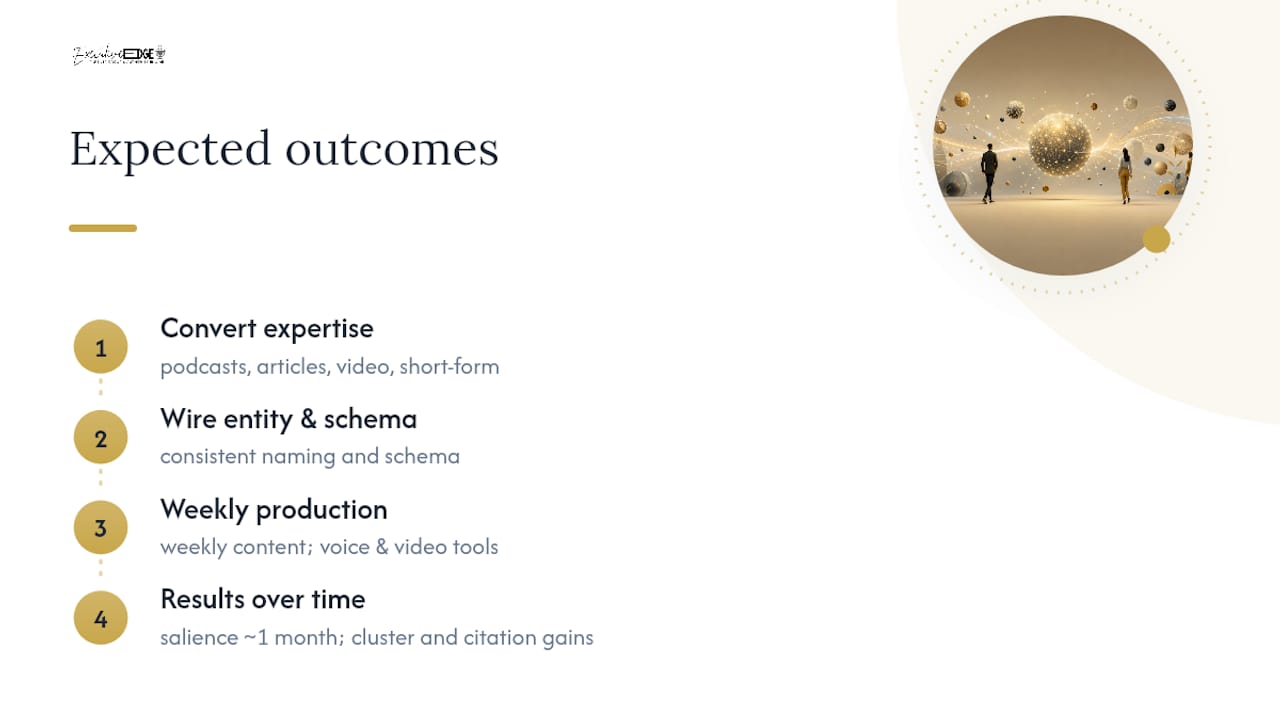
Realistically, teams following a structured entity rollout tend to see initial salience and schema improvements within about a month, with cluster-level and citation gains building from there. This is something we see consistently with businesses in Tyler and East Texas that have spent years building real-world reputation but never translated it into structured digital signals.
What the platform actually delivers includes weekly content production wired into a single entity and schema framework, voice and video tools that can scale a founder's expertise without demanding hours of new recording each week, and AI-driven distribution built for both traditional search and generative answer engines.
Where to Verify Entity SEO Guidance Yourself
For hands-on validation, schema.org's documentation covers every markup type referenced above, and its validator checks your JSON-LD before it goes live. For strategic depth, Search Engine Land's entity SEO guide and Semrush's entity-based SEO breakdown are worth bookmarking as the field keeps evolving alongside AI search.
The Part of Entity SEO Everyone Gets Backwards
Most teams treat entity SEO as a technical bolt-on: add some schema, link to a Wikipedia page, call it done. That's backwards. The hard part is editorial, deciding which entities actually deserve to be central to your content, then enforcing that decision consistently across every page a marketing team touches for the next two years.
The conventional advice oversells schema markup as a silver bullet. Schema helps disambiguation, but it doesn't manufacture authority that isn't there. A page with perfect JSON-LD and no genuine topical depth on the entity it claims to represent will still lose to a competitor with messier code and real expertise.
If you take one thing from this guide, prioritize the entity map before the schema. Decide what you're actually the authority on, name it the same way everywhere, and only then worry about markup. Teams that reverse that order end up with technically perfect pages that search engines still can't quite trust.
— David Domm
A Managed Path if You'd Rather Not Build This In-House
Everything above is buildable internally with a spreadsheet, a schema validator, and a disciplined content calendar. But most business owners don't have a spare content team, and hiring one is a slower, more expensive route to the same outcome. Executive Edge Partner Group exists as the done-for-you alternative: instead of assembling entity maps, schema templates, and a publishing cadence yourself, you get a managed system that handles it on your behalf every week.
The platform is built for business owners, consultants, attorneys, medical professionals, and local service providers who want the authority and visibility gains of entity SEO without becoming full-time content producers. It combines weekly podcast production, blog content, video, and AI-driven distribution into one consistent entity framework, the exact discipline this article just walked through, executed for you instead of by you.
If your business could use structured, entity-consistent content going out every week without adding headcount, see how Executive Edge Partner Group's authority system works and get a sense of what a managed rollout would look like for your brand.
Sources
- Entity SEO: The definitive guide
- Entity-Based Search in the LLM Era: How Google Structures and Interprets Entities - MLforSEO
- Schema
FAQ
What Is an Entity in SEO?
An entity in SEO is any identifiable person, place, organization, product, or concept that search engines can recognize and connect to related attributes and other entities, rather than treating it as just a text string.
What Is an Example of an Entity in SEO?
A company like Executive Edge Partner Group is an entity, complete with attributes (location, services, founding details) and relationships (industry, clients, partner organizations) that search engines can map through structured data and sameAs links.
What Are the 4 Types of SEO?
SEO is commonly broken into on-page SEO, off-page SEO, technical SEO, and local SEO; entity SEO isn't a fifth separate category but a layer that strengthens all four by clarifying exactly what your content and brand represent.
What Is Entity Building in SEO?
Entity building is the process of establishing and reinforcing a clear, consistent identity for your brand or topic across your own site and external sources like Wikidata, LinkedIn, and industry directories, so search engines and AI systems recognize it confidently across every mention.