

The fastest path to personal brand authority is a clear signature idea paired with a repeatable content system that turns one strong piece of evidence into assets across video, long-form writing, and social. Content Marketing Institute data shows more marketers are shifting budget toward video and thought leadership for exactly this reason, and Google Search Central backs the same principle from the search side: people-first content wins. Pick one channel and publish your signature piece this week.
Table of Contents
- 4 practical steps to build personal brand authority
- Channel mix: where to invest for authority faster
- A repeatable system that scales authority without full-time content work
- Measuring authority: KPIs and trust signals that matter
- Building real relationships, not just an audience
- Using networking and collaboration to build authority faster
- Handling feedback and criticism without losing credibility
- Legal and ethical considerations in personal branding
- What successful personal brand authority looks like in practice
- What actually moves the needle
- Executive Edge Authority Engine: a done-for-you path to authority
- Sources
- FAQ
4 practical steps to build personal brand authority
Most people trying to build authority skip straight to publishing without deciding what they actually stand for. That produces a lot of content and very little recognition. The order below fixes that.
- Define your signature idea and audience. Write a one-line positioning statement and a two-sentence value promise that says exactly who you help and how.
- Create pillar evidence. Build a case study or long-form article that documents a real result and teaches the method behind it, not just the outcome.
- Publish consistently on a primary channel. Choose video or long-form writing as your anchor format, based on where your audience already spends time, then use a secondary channel to amplify it.
- Build social proof loops. Capture client outcomes as they happen, request testimonials while the win is fresh, and pursue media or guest-podcast spots that put your name next to your evidence.
The order matters more than the volume. A single strong case study, distributed well, outperforms a dozen generic posts because it gives people a reason to remember you.
Pro Tip: Write your positioning statement before you record anything. If you cannot say who you help and how in one sentence, no amount of content will fix that gap.
Channel mix: where to invest for authority faster
Not every channel earns authority at the same speed. Content Marketing Institute's 2025 benchmarks found that 61% of B2B marketers planned to increase video investment and 52% planned to increase thought-leadership investment, a strong signal that these two formats carry more weight with audiences and platforms right now than short-form posting alone.

The rule for picking a primary channel is simple: go where your audience already spends time, not where content is easiest to make. A consultant whose clients watch YouTube before hiring should not default to a text newsletter because it is faster to write.
Once you have a primary channel, repurposing extends its reach without extra research or recording:
- A long-form interview or recorded talk becomes a podcast episode.
- The podcast episode gets cut into three to six short clips for social platforms.
- Key quotes and insights become a LinkedIn article.
- The core argument becomes an SEO-optimized article on your own site.
For a leader with five hours a week to spend on this, a workable split is roughly three hours on recording or writing the pillar asset and two hours on distribution and engagement. More detail on why video authority content compounds over time is worth reading if video is your likely primary channel.
A repeatable system that scales authority without full-time content work
The leaders who build authority without burning out are not creating more. They are turning one input into many outputs through a structured workflow instead of starting from a blank page for every platform.
- Record once. A single 90-minute session, structured as an interview or a solo talk on one topic, becomes the raw material for a week or more of content.
- Apply editorial governance. Use a brief template before recording, a review step before publishing, and a consistent author byline and author page on your site to establish who is speaking and why they are credible.
- Let AI handle the mechanical work. Transcription, research pulls, and first-pass editing are reasonable places for AI assistance. Google's guidance on generative AI content is clear that automation without added human value risks running afoul of scaled-content policies, so keep a person responsible for the final framing and claims.
- Repurpose on a set cadence. One session should reliably produce one long article, one long-form video, and roughly six short clips, published across two to three weeks rather than all at once.
Tools that support this kind of AI-driven content amplification can cut hours from the production side, but the judgment about what to say still has to come from the person building the brand.
Pro Tip: Batch your recording sessions monthly instead of weekly. It is easier to protect one long block of focused time than four short ones.

Measuring authority: KPIs and trust signals that matter
Authority is not a feeling, it is a set of numbers that move over time. Track three categories:
- Visibility: organic sessions, search impressions, and video watch time.
- Engagement: article read depth, comment quality, and repeat viewers or subscribers.
- Business outcomes: lead volume, inbound speaking invitations, and media mentions tied back to specific content pieces.
Content Marketing Institute's benchmarking work found that top-performing content teams measure outcomes like these rather than raw publishing volume, then adjust the program based on what actually moves the needle.
Trust signals matter as much as traffic. A visible author byline with a real bio, case studies with verifiable results, and third-party citations all reinforce the "Who" and "Why" behind your content, which Google's people-first content guidance treats as central to how content earns trust. If you use generative AI anywhere in your process, keep human review in place and disclose it where it affects the reader's understanding of the source.
Expect incremental wins by month three (early engagement, a handful of inbound messages), clearer visibility gains by month six, and measurable business outcomes such as qualified leads or speaking invitations by month twelve.
Building real relationships, not just an audience
Authority built on broadcasting alone erodes over time. The professionals who sustain it treat their audience as a set of relationships worth maintaining, not a number to grow.
That starts with responding to comments and messages personally, at least often enough that people notice a real person is behind the account. It also means asking your audience direct questions in your content rather than only delivering answers. A short poll, a call for stories, or a direct question at the end of a video signals that you want a conversation, not just views.
Consistency of voice matters here too. If your written content sounds analytical but your video persona is casual and joking, people sense a mismatch and trust drops. Pick a tone that reflects how you actually talk to clients and keep it steady across formats.
The strongest relationship-building move is simple: follow up. When someone comments with a real question, answer it in detail, sometimes even as its own future piece of content. That loop, where audience input becomes new material, is what separates a brand people follow from one they occasionally see.
Using networking and collaboration to build authority faster
Solo content builds a following. Collaboration builds credibility, because it puts your name next to people your audience already trusts.
Guest appearances on established podcasts or YouTube channels expose your ideas to an audience you have not built yet, and the association itself signals that other credible people take you seriously. The same logic applies in reverse: inviting respected voices onto your own content lends your platform weight it would take longer to earn alone.
Co-authored articles, joint webinars, and panel appearances work similarly. Each one is a small act of vouching, and audiences pick up on that faster than they pick up on a well-written bio.
Industry associations and local business groups offer a lower-friction version of the same strategy. Speaking at a regional conference or contributing to a trade publication puts your expertise in front of a room or readership that already has a reason to pay attention. For professionals working with a smaller or more contained local network, that visibility can matter more than a viral social post, because it reaches the specific people most likely to hire or refer you.
Handling feedback and criticism without losing credibility
Public visibility invites public criticism, and how you respond to it becomes part of your brand whether you plan for that or not.
The instinct to delete or ignore negative feedback usually backfires. A thoughtful, calm response to a fair critique shows more credibility than a flawless track record with no visible disagreement at all. When someone raises a legitimate point, acknowledging it directly and explaining your reasoning or correcting course builds more trust than defending a position that does not hold up.
Bad-faith criticism is different and deserves a different response: a brief, factual reply or no reply at all. Arguing with someone who is not engaging honestly rarely changes their mind and often just extends the visibility of a complaint that would otherwise fade.
The professionals who handle this well tend to have a simple internal rule: respond to substance, not to tone. A harshly worded but accurate critique gets a real answer. An accurate but harsh critique still deserves a factual response rather than a defensive one, since the audience watching is judging your reaction as much as the original comment.
Legal and ethical considerations in personal branding
Building authority through content comes with obligations that are easy to overlook when the focus is on growth.
Claims about results, credentials, or client outcomes need to be accurate and, where relevant to your industry, compliant with advertising or professional conduct rules that apply to attorneys, medical professionals, and financial advisors in particular. A testimonial or case study should reflect what actually happened, not an exaggerated version of it.
Using AI tools to draft or edit content is common practice, but it raises questions about disclosure and originality that vary by platform and industry. Google's guidance on generative AI content treats large volumes of automated content with no added human value as a policy risk, separate from any legal question, so keeping a documented editorial review step protects both your credibility and your search visibility.
Voice and video cloning technology, increasingly used to scale content production, raises its own consent and disclosure questions. Using a cloned version of your own voice or likeness for your own content is a different matter from using someone else's without clear permission, and the line between the two should stay obvious to your audience at all times.
What successful personal brand authority looks like in practice
The professionals who build durable authority almost always share one trait: a specific point of view they return to repeatedly, rather than a rotating set of generic topics.
A consultant who publishes one detailed breakdown of a real client project, then turns it into a podcast conversation, a handful of social clips, and a written case study, builds more recognition than one who posts broad industry commentary every day. The specificity is what makes it memorable and shareable.
Content Marketing Institute's research on thought leadership makes a related point: programs that succeed treat thought leadership as a defined point of view backed by a distribution plan and real measurement, not as an open-ended content bucket. The professionals who stall out usually have the opposite problem: plenty of content, no clear stance, and no way to tell if any of it is working.
What actually moves the needle
The pattern shows up constantly: the professionals who build real authority are the ones who commit to one distinct point of view and keep showing up with evidence for it, not the ones who chase every format or platform trend. Consistency beats cleverness here almost every time.
For business owners in Tyler and East Texas, we see this pattern often. The ones who build a reputation locally and beyond usually have a clear system running in the background, not a constant scramble to post something new. A done-for-you production model changes the math for busy leaders because it removes the tradeoff between running a business and showing up consistently. That tradeoff is what stops most authority-building efforts before they gain any traction at all.
— David Domm
Executive Edge Authority Engine: a done-for-you path to authority
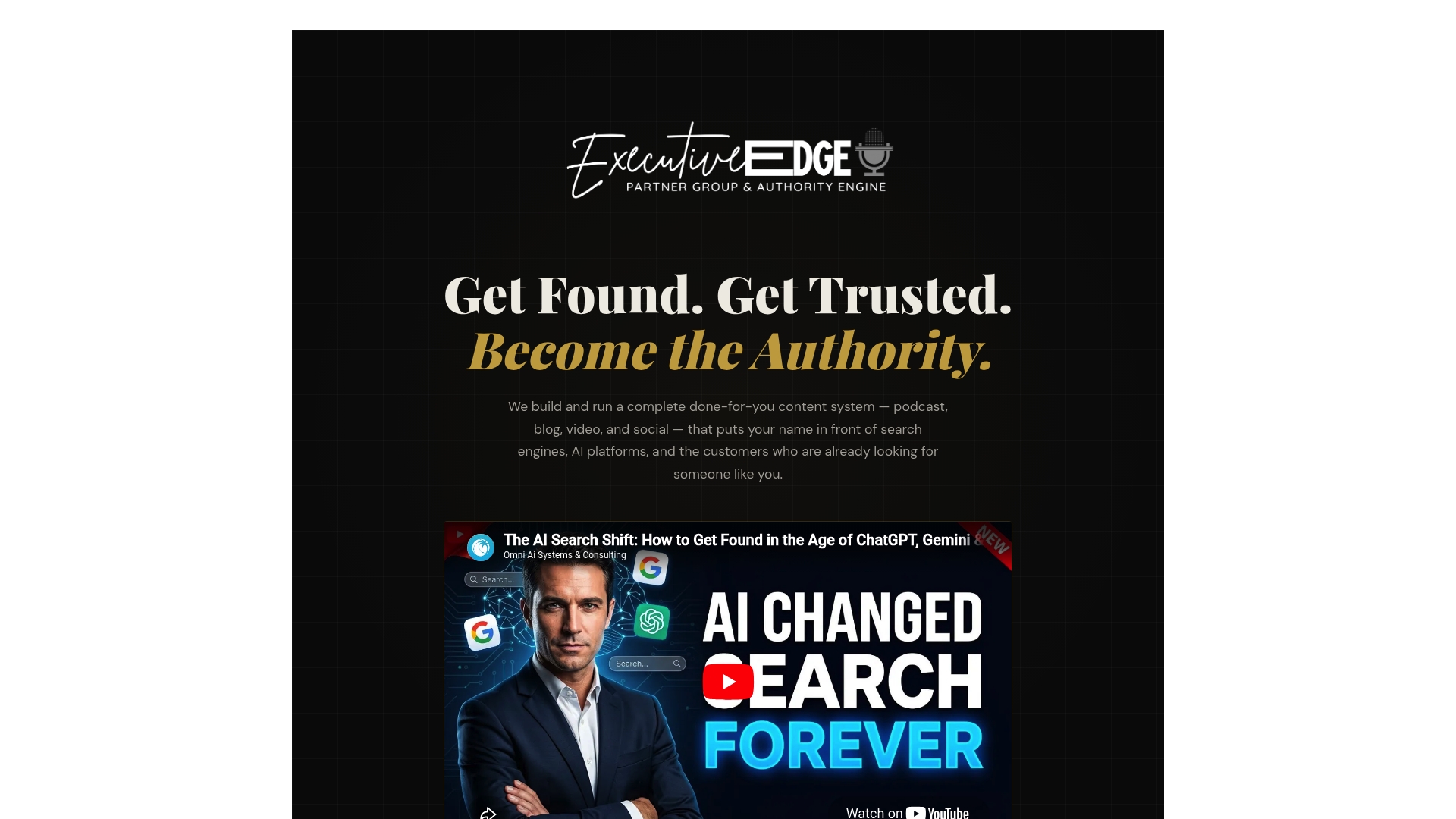
Everything in this article works. It also takes real time to execute well, which is the exact problem Executive Edge Authority Engine's Authority Content System was built to solve. The system produces weekly multi-channel content from a single recording session, including podcast episodes, video, short clips, and blog articles, supported by editorial governance to ensure review before publishing.
This fits particularly well for:
- Executives and consultants who have the expertise but not the hours to write, film, and edit weekly.
- Local service providers, real estate professionals, and attorneys who need consistent visibility without hiring an in-house content team.
- Any professional who has tried content marketing before and stopped because the production load was not sustainable.
If a managed, hands-off system sounds like the right fit, you can see how the Authority Content System works and what a single recording session produces.
Sources
Google's people-first content guidance explains what search rewards. Content Marketing Institute's 2025 benchmarks show where budgets are shifting. PROJECT-JTH covers practical leadership technology worth a look.
- B2B Content Marketing: 2025 Benchmarks & Trends — Content Marketing Institute
- Creating helpful, reliable, people-first content — Google Search Central
FAQ
What are the 7 pillars of personal branding?
Definitions vary across sources, but common versions include authenticity, consistency, a clear niche, visibility, credibility, networking, and value delivery. The core idea across all versions is the same: know your point of view, show up reliably, and back your claims with real evidence.
What are the 5 A's of personal branding?
This framework is not standardized the same way across sources, so treat any specific five-word list with caution. Most practical versions revolve around awareness, authenticity, authority, audience, and amplification, which map closely to the steps covered above: define your idea, build evidence, and distribute it consistently.
What is the 3-7-27 rule in branding?
There is no widely documented or standardized "3-7-27 rule" tied to a credible source, so treat any specific version you encounter with skepticism. Focus instead on proven content strategies backed by research.
What are the four C's of personal branding?
Common versions include clarity, consistency, credibility, and community, though the exact wording varies by source. In practice, these translate to knowing your positioning, showing up on a regular cadence, backing claims with proof, and engaging with the people who follow your work.
How long does it take to build personal brand authority?
Expect early engagement signals within the first three months, clearer visibility gains around six months, and measurable business outcomes like qualified leads or speaking invitations by the twelve-month mark. The timeline depends heavily on consistency and the strength of the signature idea behind the content.