
A business podcast works when it's built as a consistent authority and lead generation system, not a side hobby squeezed between real work. Experienced teams have watched this play out across dozens of client engagements: shows with a defined job, a repeatable production process, and a clear conversion path outperform shows that just chase downloads. Edison Research's Infinite Dial data backs the audience opportunity. What separates results is the system behind it.
Table of Contents
- Business Podcast Strategy Overview: Job, Audience, and Pillars
- Episode Planning and Content Mapping to the Funnel
- Production and Workflows to Stay Consistent
- Distribution and Discoverability: Podcast SEO and Repurposing
- Measurement and ROI: Metrics That Matter
- When to Stay DIY and When to Go Done-for-You
- Building Authority Without Becoming a Full-Time Producer
- Sources
- FAQ
Business Podcast Strategy Overview: Job, Audience, and Pillars
Before you record a single episode, pick one primary job for the show: authority building, lead generation, or community around your brand. Trying to do all three at once is how most business podcasts lose focus by episode ten.
Edison Research found that 68% of Americans aged 35 to 54 listened to a podcast in the past month, and overall listenership sits at all-time highs. That age band lines up almost exactly with the decision-makers most service businesses, consultants, and local brands are trying to reach.
Once you know the job, build three or four content pillars that map directly to what your business sells and what your audience struggles with. A financial advisor might run pillars on retirement planning, tax strategy, and client Q&A. A contractor might run pillars on project cost breakdowns, homeowner mistakes, and behind-the-scenes builds.
Set an editorial calendar around those pillars with a fixed cadence, weekly or biweekly, plus one seasonal theme per quarter. Then track KPIs that actually reflect the job you picked:
- Email signups from episode-specific lead magnets
- Booked discovery calls tied to a podcast CTA
- Website visits from show notes and repurposed clips
- Referral or "I heard your podcast" mentions in sales conversations
Episode Planning and Content Mapping to the Funnel
Different episode formats pull different weight in your funnel. Interview episodes build reach and borrowed credibility from a guest's audience. Solo episodes build direct trust in your voice and expertise. Client case study episodes prove results to people already close to buying. Q&A episodes catch objections before they become deal breakers.
Entrepreneur's guidance on building a loyal podcast audience makes a point worth repeating: treat the show like a product, with a deliberate structure rather than whatever topic feels interesting that week. Every episode should carry exactly one conversion-focused call to action, backed by a lead magnet that matches the topic.
A simple 3-month map might look like this:
- Month one: pillar on client pain points. Episodes are mostly solo and Q&A. CTA points to a free checklist.
- Month two: pillar on process and expertise. Episodes lean on case studies. CTA drives to a booked strategy call.
- Month three: pillar on industry trends. Episodes bring in guests. CTA promotes a webinar or downloadable report.
Pro Tip: Batch your topic ideation once a quarter instead of weekly. Block two hours, list 20 episode ideas against your pillars, and you'll never stare at a blank outline again.
Production and Workflows to Stay Consistent
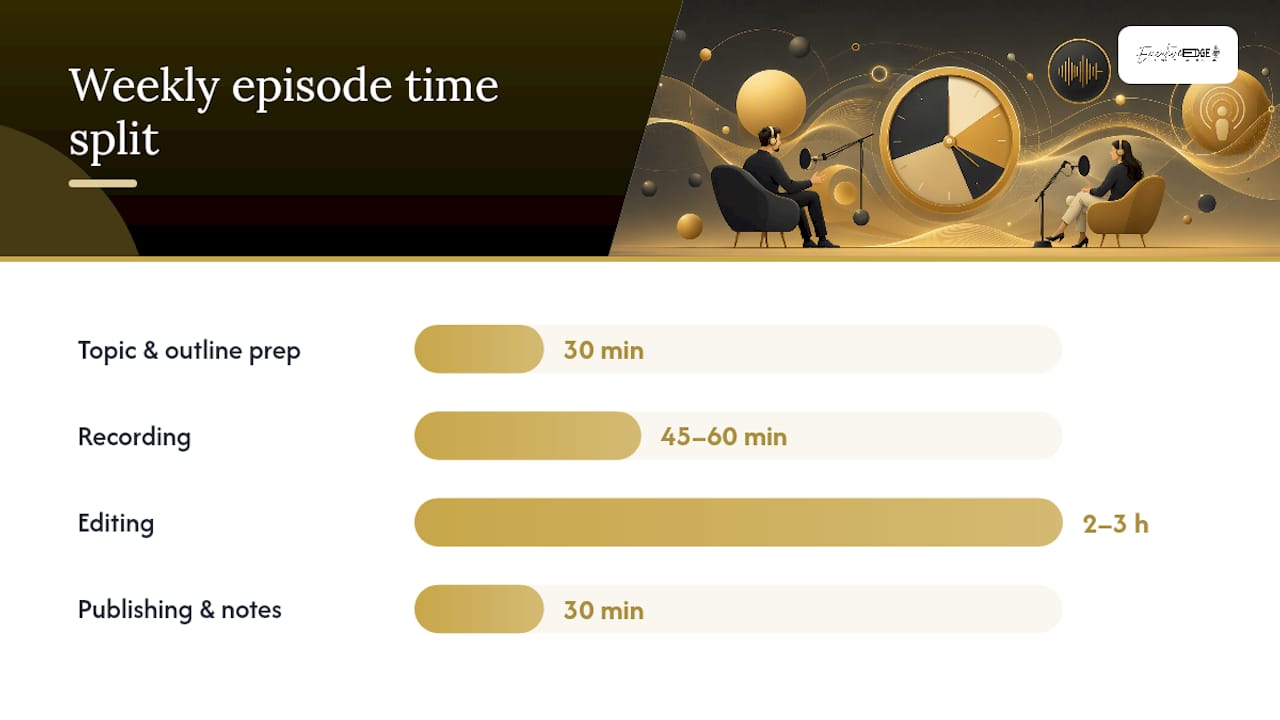
Consistency, not polish, is what kills most business podcasts. A realistic weekly workflow looks something like: 30 minutes for topic and outline prep, 45 to 60 minutes recording, two to three hours editing, and 30 minutes for publishing and show notes. That's a half day of work most owners don't have.
You have three broad ways to staff it:
- Do it yourself: lowest cost, highest time cost, best when you're testing whether podcasting fits your business at all.
- Fractional specialist: you hire an editor or producer piecemeal; cheaper than full service, but you're still managing the calendar and quality control.
- Done-for-you system: highest cost, lowest time investment, best once you know the podcast works and you need it running every week without fail.
AI tools now speed up transcription, rough-cut editing, and clip generation dramatically, which is genuinely useful for turnaround time. The catch: AI can accelerate the mechanics, but it can't replace your judgment on tone, guest chemistry, or which three minutes of a 45-minute conversation actually matter. Human oversight is what keeps a podcast sounding like you instead of a template.
A basic production checklist: confirm guest and topic a week out, record with a backup audio track, edit against a standard intro/outro template, publish with keyword-rich titles, and schedule repurposed clips before the episode goes live.
Distribution and Discoverability: Podcast SEO and Repurposing
Getting found matters as much as getting recorded. Add a keyword extension to your show name (think "The Retirement Planning Podcast" instead of just your name), and write episode titles that state the specific problem solved, not just the guest's name. Show descriptions should front load the topic and include natural search terms in the first two sentences.
Repurposing turns one recording session into a week of content:
- Clip two or three moments into short vertical video for social platforms
- Transcribe the full episode into a blog post and an email newsletter
- Pull one quote or stat into a graphic for LinkedIn or Instagram
- Send show notes with the lead magnet link to your email list
The IAB and PwC project U.S. podcast advertising revenue will grow to nearly $2.6 billion by 2026, with video podcasts and programmatic distribution driving much of that growth. That's a signal worth acting on: publishing video versions of your episodes and distributing across more platforms isn't optional polish anymore, it's where the audience and ad dollars are moving.
Guesting on other shows and cross-promoting with complementary businesses remains one of the cheapest ways to reach a new, warm audience. A partner like SocialGrove can help manage the social side of repurposing if that piece keeps sliding down your priority list.
Pro Tip: Pitch yourself as a guest on three shows for every one guest you book. Being the guest is often a faster authority-building move than growing your own downloads early on.
Measurement and ROI: Metrics That Matter
Downloads are a vanity metric. Email signups, booked calls, and marketing-qualified leads tied to a specific episode are business metrics, and they're the ones worth building a dashboard around.
Adobe's survey of business owners found 78% said their podcast met or exceeded ROI expectations, with an average 38% revenue increase attributed to the show. That number only happens when measurement is built in from episode one, not bolted on after the fact.
- Track at 30 days: publishing consistency, early download trend, social engagement
- Track at 90 days: email list growth, lead magnet conversion rate
- Track at 180 days: booked calls and closed revenue attributed to the podcast
Set up a unique link or promo code per lead magnet so you can trace a sale back to a specific episode. If six months of consistent publishing isn't moving any of these numbers, that's the signal to change the format, not abandon the channel. Our podcast analytics guide breaks down which numbers to watch first.
When to Stay DIY and When to Go Done-for-You
DIY buys you control and low upfront cost, but it costs your time every single week, and time is the resource most business owners can least afford to spend on editing audio. A done-for-you system costs more upfront and trades some control for speed and consistency you can actually count on.
The clients who benefit most from a managed system are service businesses, consultants, and local brands with real expertise but no bandwidth to produce content weekly. This pattern is commonly seen with business owners in various local markets, including areas like Tyler and East Texas.
— David Domm
Building Authority Without Becoming a Full-Time Producer
An Authority Content System was developed around one problem: business owners have the expertise but not the hours to turn it into weekly content. One recording session, guided by a support team, becomes weekly podcast episodes, video, blog articles, and social content across every major channel.
The system includes weekly podcast production, multi-format publishing, AI-assisted editing and voice cloning, and content performance tracking, all done after that single intake session. It fits professionals, consultants, and local brands who want authority-building results without hiring a producer, an editor, and a social manager separately.
If you want a podcast strategy that runs itself after the first recording, visit the Authority Content System page to see how an engagement works and get a plan built around your business.
Sources
- IAB / PwC US podcast advertising revenue study 2024
- Edison Research — The Infinite Dial® 2026
- Adobe — Business podcasts (survey findings)
- Entrepreneur — How to grow a loyal podcast audience
FAQ
How Long Should a Business Podcast Episode Be?
Most business podcasts run around 20 minutes, long enough to cover one topic with depth but short enough to hold a commuting listener's attention. Interview episodes can run longer; solo strategy episodes usually work better shorter.
How Many Episodes Before I See Results?
Give a consistent weekly schedule at least 90 days before judging results, and 180 days before judging revenue impact. Adobe's survey found businesses averaging a 38% revenue increase attributed to podcasting, but that comes from sustained, not sporadic, publishing.
What Does the Executive Edge Authority Content System Cost?
Pricing for the Authority Content System is available on the Executive Edge Partner Group site after a consultation, since scope depends on the channels and cadence a business needs.
Do I Need Expensive Equipment to Start?
No. A decent USB microphone, a quiet room, and free or low-cost editing software cover most business podcasts at launch. Investment in better audio and video gear makes sense once the show proves its ROI and you're ready to scale production.
What Are the Legal Basics I Need to Know?
Get a signed release from every guest covering how their voice and likeness can be used and distributed. Clear music licensing before using anything beyond royalty-free tracks, and avoid making unverified claims about competitors or products on air.