

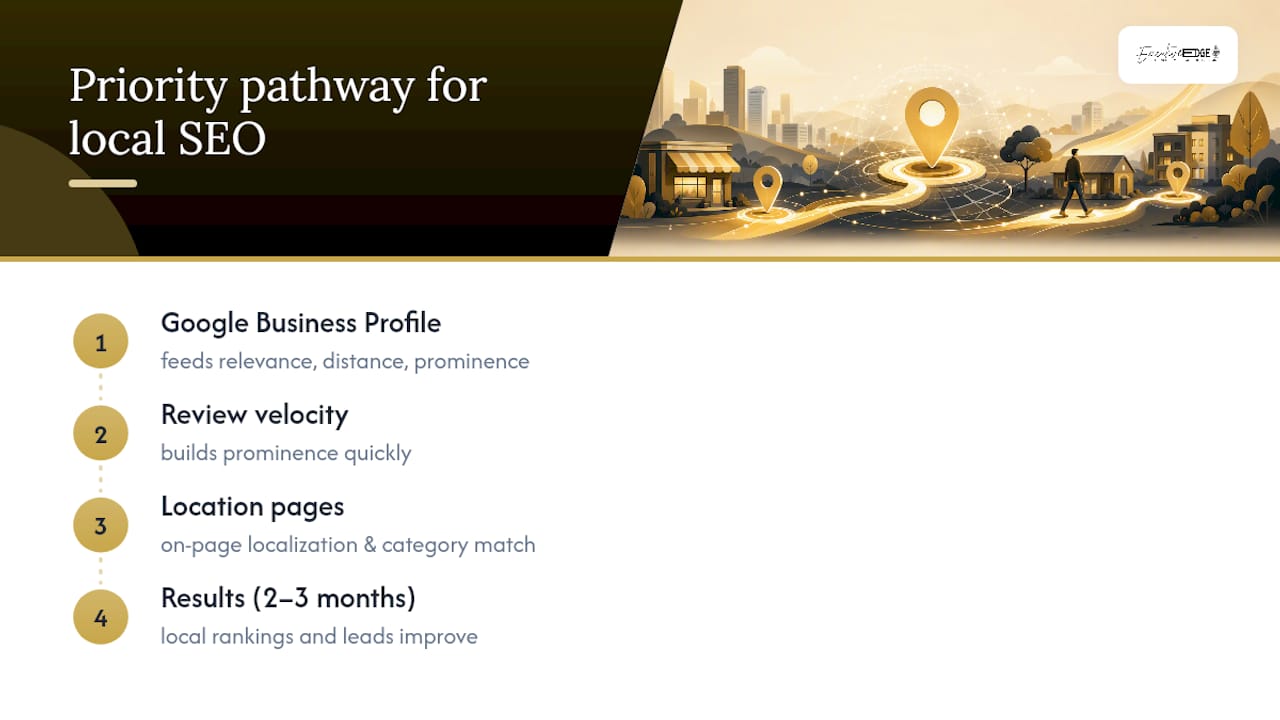
Fix your Google Business Profile completeness and primary category, build steady review velocity, and publish real location pages before touching anything else. Profiles that move from a low completeness score to fully built out show up in the top 10 roughly three times more often, with an average 19-position jump. Expect visible movement in GBP metrics and reviews within 2 to 6 weeks, and organic ranking gains within 2 to 3 months.
Table of Contents
- Local SEO for Services: What to Prioritize First
- High-Impact Checklist You Can Run This Week and This Quarter
- Step-by-Step GBP Optimization for Service Businesses
- How to Build Review Velocity That Actually Moves Rankings
- Build Location Pages That Prove You Actually Serve the Area
- The Schema and Metadata Signals AI and Google Use to Confirm You
- Citation Audit and NAP Consistency: A 3-Step Cleanup
- Improve the Behavioral Signals Google Watches After the Click
- What to Expect on Timeline, Results, and Cost
- What We See Go Wrong (and How We Fix It)
- Where the Conventional Local SEO Advice Falls Short
- How Executive Edge Authority Engine Handles This for You
- Sources
- FAQ
Local SEO for Services: What to Prioritize First
Most service business owners try to do everything at once, which is exactly why nothing improves. The data points to a clear order of operations, and it starts with your Google Business Profile, not your website.
Local rankings run on three inputs Google names explicitly: relevance, distance, and prominence, and a complete, accurate Business Profile feeds all three. Layer on the fact that category match, review velocity, and on-page localization now carry most of the ranking weight, and the priority order writes itself: GBP first, reviews second, location pages third. Everything else, including link building and broader content, works better once those three are solid.
This matters more for service businesses than for retail. A plumber or a divorce attorney doesn't have foot traffic to fall back on. Local search is often the entire lead pipeline, which is why local SEO for services deserves a different playbook than generic SEO advice built for e-commerce sites.
High-Impact Checklist You Can Run This Week and This Quarter
Assign these to a real person with a real deadline, or nothing happens. Here's the sprint, broken into what to do now versus what to build over the next quarter.
- Week 1: Claim and verify your GBP (or confirm it's verified), correct your primary category, upload at least 10 real job photos, and fix any NAP mismatches on your own website.
- Weeks 2 through 6: Launch an SMS-based review request flow, publish 1 to 3 location or service-area pages, and schedule GBP posts twice a month.
- Ongoing, quarterly: Run a citation audit, roll out schema markup, and start outreach for local links and chamber or association partnerships.
Track progress in GBP Insights and Google Analytics 4: watch impressions, website clicks, direction requests, and call volume. If those four numbers aren't moving after six weeks, something in the sequence above got skipped.
Step-by-Step GBP Optimization for Service Businesses
Every empty field is a missed relevance signal.
Start with verification. If your profile isn't verified, nothing else matters until it is. From there, work through the fields in this order:
- Complete your website URL, hours, phone number, and a full services list with unique descriptions for each.
- Choose one precise primary category. "HVAC Contractor" beats "Home Services" every time, because a vague category dilutes your relevance for the searches that actually convert.
- Add 2 to 3 supporting secondary categories that reflect real services you offer, not aspirational ones.
- Attach starting prices where you can. Google increasingly surfaces this data directly in search results.
- Upload 10 or more recent job photos and commit to a monthly upload schedule going forward.
- Set your service-area settings accurately if you're a service-area business without a public storefront.
The GBP completeness index research is worth internalizing: moving from a 0 to a 5 on that scale correlates with a near-19-position average gain. That's not a marginal tweak. That's the difference between page one and page three.
Pro Tip: Set a recurring calendar reminder to add three new job photos every two weeks. Stale profiles lose freshness signals faster than most owners realize.
How to Build Review Velocity That Actually Moves Rankings
Total review count used to be the metric everyone chased. It's not anymore. Steady weekly review velocity and fast response rates now separate businesses that rank from businesses that don't, regardless of how many reviews they've stacked up historically.
A realistic target is 3 to 10 new reviews per week depending on your size and job volume. That sounds aggressive until you build the right system:
- Ask in person immediately after the job, then follow up with an SMS review link within the hour, while satisfaction is fresh.
- Route feedback through a quick private survey first. Route low scores to a support conversation instead of a public review request.
- Automate a reminder text 24 hours later for anyone who didn't respond to the first ask.
- Respond to every review, positive or negative, within 48 hours. Response rate itself functions as a ranking and trust signal.
When customers leave reviews, a natural mention of the service and city helps, but never write or edit reviews for customers, and never offer incentives tied to a positive rating. Ask for honesty, not five stars.
Pro Tip: A short, specific reply beats a generic "thank you" every time. Naming the actual job in your response reinforces relevance for anyone reading it later.
Build Location Pages That Prove You Actually Serve the Area
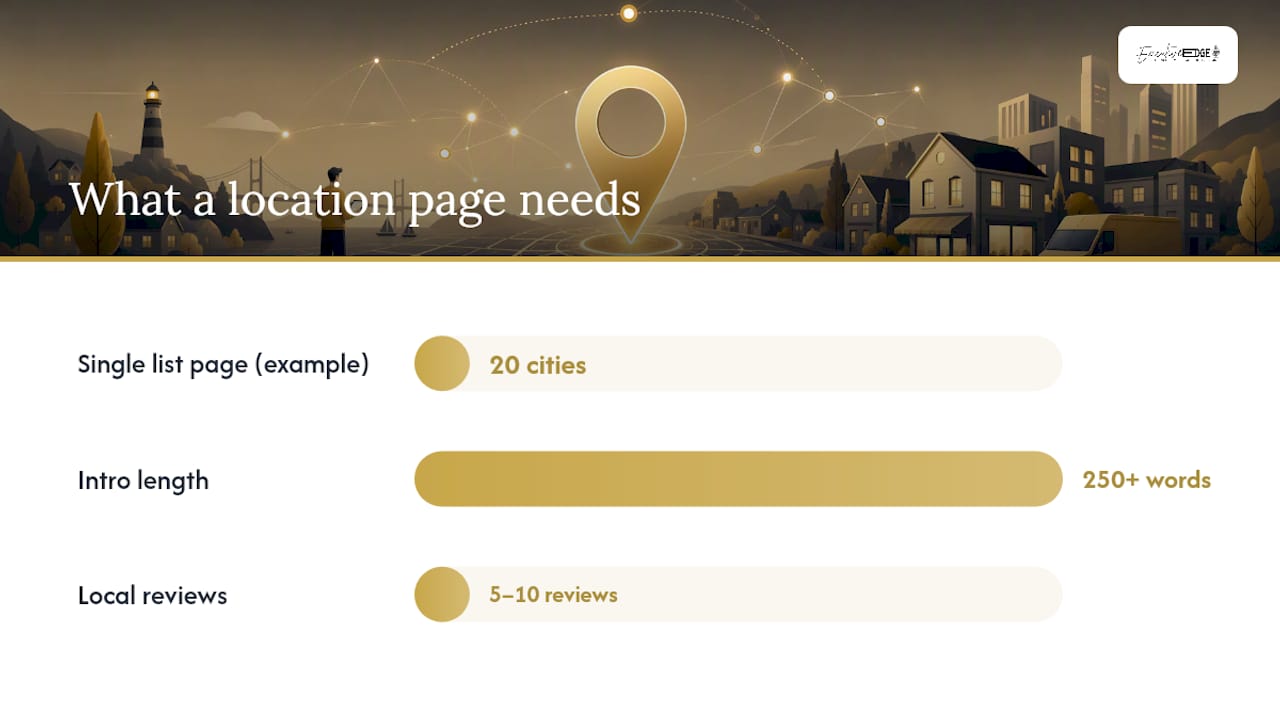
A single "Areas We Serve" page with a list of 20 city names does almost nothing for rankings. It reads as thin content because it is thin content. The alternative, sometimes called the spiderweb strategy, is one unique page per service-location combination: HVAC repair in one city gets its own page, distinct from HVAC repair three towns over.
Each page needs to earn its place. Here's what belongs on it:
- An H1 that pairs the service and the city by name, not a generic headline.
- A 250-plus word intro that references actual neighborhoods, landmarks, or ZIP codes, not boilerplate copy swapped with a find-and-replace city name.
- Real photos from jobs completed in that area, plus 5 to 10 reviews specific to that location where you have them.
- An embedded map, a clear click-to-call button, and a direct appointment or quote link above the fold.
- Schema markup identifying the business, the service, and the service area.
Mobile matters more here than almost anywhere else in your site. Most local searches happen on a phone standing in a driveway or a parking lot, so page speed and a thumb-reachable call button aren't nice extras. Internally link these pages from your homepage and main service pages, and use canonical tags carefully if you operate multiple locations, so Google doesn't treat near-duplicate pages as the same content competing against itself. A local SEO content strategy built around this structure tends to outperform a flat service list by a wide margin.
The Schema and Metadata Signals AI and Google Use to Confirm You
Search engines and AI answer tools both need structured confirmation of who you are and where you operate. Schema markup is how you hand that to them directly instead of hoping they infer it correctly from prose.
Title tags should read like a real headline a person would click, with the service and city worked in naturally, never stacked keyword after keyword. An H1 that mirrors that same pairing reinforces it without repeating the exact phrase word for word.
Focus schema implementation on these types first:
- LocalBusiness, using the most specific subtype available (Plumber, DentalOffice, LegalService) rather than the generic parent type.
- Service schema on each service page, describing what's offered and where.
- FAQPage schema on pages where you've written genuine, useful Q&A content.
- AggregateRating and Offer schema where you have real review data and pricing to back it up.
This markup is part of how AI Overviews and other generative search tools decide whether to cite you as a source. A page that structurally confirms "this business does X service in Y city" is easier for a model to trust than one that only implies it in paragraph text.
Citation Audit and NAP Consistency: A 3-Step Cleanup
Inconsistent name, address, and phone number listings across the web quietly undermine every other effort on this list. Fixing them is tedious but mechanical.
- Export your current citations first, using a citation tool or a manual search across the major directories, so you know what's actually out there.
- Normalize your exact NAP format (suite number style, phone format, business name spelling) and correct your top 10 to 15 listings before chasing anything else.
- Log every fix and set a quarterly recheck. Directories change ownership and re-scrape data more often than people expect.
Once the core listings are clean, niche industry directories and chamber of commerce memberships are worth the modest cost, mainly for the local relevance they carry rather than raw link volume. Local links from chambers and industry bodies now outweigh generic high-authority links that have nothing to do with your trade. Ten accurate, relevant citations beat fifty scattered ones every time.
Improve the Behavioral Signals Google Watches After the Click
Once someone finds your listing, what they do next feeds back into how Google ranks you going forward. Clicks, calls, and direction requests are all measured, and all improvable.
- Upload real photos of your team, your vehicles, and actual completed jobs, not stock imagery. Profiles with authentic job photos consistently pull higher engagement.
- Post to GBP roughly twice a month with a mix of offers, completed projects, and seasonal reminders relevant to your trade.
- Add UTM tags to your booking or contact links so Google Analytics can show you exactly how many leads originate from your profile versus organic search.
- Run small four to eight week tests: swap your primary GBP photo, change your CTA button text, or adjust post frequency, then compare the Insights data before and after.
Pro Tip: Change one variable at a time. Testing a new photo and a new post schedule in the same window makes it impossible to tell which one moved the needle.
What to Expect on Timeline, Results, and Cost
Set expectations honestly, because local SEO doesn't move on the same clock as paid ads. Clients and teams both need to know what happens when.
- 1 to 6 weeks: GBP completeness and review velocity shift first. Expect movement in Insights data (impressions, clicks, direction requests) before you see ranking changes.
- 2 to 3 months: Location pages, schema rollout, and citation cleanup start contributing to organic visibility.
- 6 to 12 months: Local link building and consistent brand mentions compound into durable authority that's harder for competitors to replicate quickly.
Doing this yourself costs time, not money, but it's real time: expect several hours a week sustained over months. A managed retainer with an agency typically runs from a few hundred to several thousand dollars a month depending on scope, and the tradeoff comes down to whether your time is better spent on billable client work or on managing citations and review flows yourself.
What We See Go Wrong (and How We Fix It)
The same three mistakes show up in nearly every service business audit we run: a half-finished GBP profile, review requests that happen sporadically instead of systematically, and a website with one thin "service area" page instead of real location content. None of these are hard problems. They're neglected ones.
A contractor client came to us with a verified but barely-filled GBP, four total reviews, and zero location pages. Within 12 weeks of completing the profile, launching an SMS review flow, and publishing three location pages, their direction requests and call volume both showed a clear upward trend in GBP Insights.
These is something we see consistently with East Texas businesses around Tyler: strong reputations built over years of quality work, undercut by a digital presence that hasn't kept pace. The Executive Edge Authority Engine exists specifically to close that gap without requiring the owner to become a part-time marketer.
Where the Conventional Local SEO Advice Falls Short
Most local SEO guides treat every tactic as equally important, which is why so many business owners end up with a scattered to-do list and no real progress. The evidence doesn't support that. GBP completeness and review velocity carry outsized weight compared to almost everything else on a typical checklist, and yet they're often the first things left half-finished because they feel less technical than schema markup or backlinks.
The bigger blind spot is timeline expectations. Owners hire an agency or start a DIY push expecting ranking movement in two weeks, get discouraged when it doesn't happen, and abandon the effort right before the location pages and citation cleanup start compounding. Local SEO rewards consistency over intensity. A modest, sustained review request system run for six months beats an aggressive one-time push that fizzles out.
If you're deciding what to fix first, fix the profile, then the reviews, then the pages. Everything else is secondary until those three are handled.
— David Domm
How Executive Edge Authority Engine Handles This for You
If the checklist above feels like a second full-time job on top of running your business, that's the exact gap Executive Edge Partner Group was built to close. Instead of you learning schema markup and chasing review requests between service calls, the Executive Edge Authority Engine handles GBP optimization, review system setup, location page content, and ongoing local content production as one managed system.

Onboarding starts with a GBP and citation audit, then moves into building your review request flow and drafting your first location pages, typically within the first few weeks. From there, you get a consistent content and posting schedule instead of sporadic, whenever-there's-time updates. If you have the hours and the patience to run the DIY checklist above yourself, do it. If you'd rather hand it to a team that does this daily for service businesses, including several right here around Tyler, Texas, visit the provider's landing page to learn about the onboarding process and typical first 90 days.
Sources
For the ranking data behind the GBP completeness recommendations, Search Engine Land's analysis of 1.8 million profiles is the clearest source available. For the official rules straight from Google, its Business Profile help documentation explains relevance, distance, and prominence directly. For a broader 2026 ranking factor breakdown, this local SEO ranking factors overview is useful reference material. For step-by-step task guidance, Semrush's local SEO explainer and Denver County Web Design's GBP optimization guide both offer practical how-to detail worth bookmarking.
- What 1.8 million Google Business Profiles tell us about local SEO success
- How Google determines local rankings (Google Business Profile Help)
- Google Business Profile Ranking Factors 2026 | Local SEO for Service Businesses
FAQ
How much do local SEO services cost?
Managed local SEO retainers commonly range from a few hundred to several thousand dollars a month depending on scope, competition, and how many location pages and citations need work.
Is SEO dead now with AI search tools?
No. AI Overviews and answer engines still rely heavily on structured data, complete business profiles, and schema markup to decide what to cite, which means local SEO fundamentals matter as much as ever.
How do I get started with local SEO for my service business?
Start by claiming and fully completing your Google Business Profile, choosing the most specific primary category available, and launching a consistent review request system before building out location pages.
What is the 80/20 rule in local SEO?
Applied to local search, it generally means a small set of actions, GBP completeness, review velocity, and accurate primary category, drives most of the ranking impact, while lower-priority tasks like extensive backlink outreach contribute comparatively less early on.