

A local content hub is a centralized system of pillar and location pages built to establish topical authority while giving every service area its own unique, discoverable content. Multi-location service brands, local franchises, and content strategists managing several markets are the ones who need it most. If you're publishing scattered blog posts and separate city pages with no connective structure, you're leaving rankings and leads on the table.
Table of Contents
- What Makes a Local Content Hub Different From a Blog or Scattered Location Pages
- Types and Models of Local Content Hubs (Pick the Right One for Your Scale)
- Why Local Content Hubs Move Rankings and Revenue
- Building the Hub: A Step-by-Step Framework
- Governance: Who Owns What in a Multi-Location Hub
- Measuring Whether Your Hub Is Working
- How Executive Edge Authority Engine Builds Local Hubs in Practice
- What Most Local Content Hubs Get Wrong
- Get a Managed Local Content Hub Without Hiring a Content Team
- Sources
- FAQ
What Makes a Local Content Hub Different From a Blog or Scattered Location Pages
A blog is a stream of disconnected posts. A local content hub is a deliberate architecture: one pillar page owns the broad topic, cluster pages answer supporting questions, and location spokes handle geography. Every piece links back to the pillar and sideways to related content, which is the mechanic behind the hub-and-spoke topic cluster model that search engines reward for showing comprehensive coverage.
Most businesses skip straight to "location pages" without a pillar holding them together. That's why so many city pages read identically with the town name swapped out. A real hub prevents that by giving each spoke a job: answer one local intent, then route traffic upward to the authority page.
You need this structure when:
- You operate in three or more service areas or locations
- Your current pages compete with each other in search results instead of supporting one another
- You have enough recurring expertise (services, FAQs, community involvement) to sustain 10+ pages of genuine substance
If you're a single-location shop with one city to rank in, a simpler site structure often works fine. The hub model earns its complexity once geography multiplies.
Types and Models of Local Content Hubs (Pick the Right One for Your Scale)
Not every hub looks the same, and picking the wrong model wastes months of production effort. Content Harmony's research documents five distinct approaches, and four matter most for local and regional brands.
- Classic hub and spoke. One pillar page, several cluster pages, and location spokes that all link back to the center. This is the standard model for multi-location service businesses, contractors, medical practices, and law firms with 3 to 50 locations.
- Content library. A tagged, searchable archive of assets, guides, videos, downloadable resources, grouped by topic and filterable by location or service. Libraries fit organizations with high content volume and a CMS that supports robust taxonomy, think regional healthcare systems or multi-state franchises.
- Topic gateway. A search-first landing page that acts as a directory, routing visitors to the right local resource based on intent. Gateways work well when you have dozens of narrow sub-topics and want one entry point instead of forcing users to guess which page applies to them.
- Content database. A faceted-search system, common for community resource directories, event listings, and locator tools where users filter by category, date, or neighborhood.
For a marketing team of one or two people managing five locations, the classic hub and spoke is almost always the right call. It's the easiest to build in WordPress or most standard CMS platforms, and it doesn't require faceted search infrastructure. Content libraries and databases make sense only when your CMS can actually support the tagging and filtering they demand. Choosing a gateway or database model without that backend in place usually ends in a half-built directory nobody maintains.
Why Local Content Hubs Move Rankings and Revenue
Search engines reward comprehensive topical coverage over isolated pages, and a hub is the clearest way to demonstrate it. When cluster pages and location spokes link back to a central pillar, that internal structure signals depth on the subject, which improves the pillar page's odds of ranking for competitive, higher-volume terms.
The business case goes beyond rankings. Multi-location brands that let corporate content and local pages compete for the same queries dilute both. Search Engine Land's analysis is blunt about this: corporate should own the broad topic hub, while local pages stay narrow and unique. That division stops your own pages from cannibalizing each other in search results.
There's also an early-funnel benefit most local businesses ignore. Informational cluster content, the "how does X work" and "what to expect from Y" pages, attracts backlinks and research-stage visitors that a commercial service page never will, and that link equity lifts the entire hub's authority for the local queries that actually convert.
A functional local silo generally needs a minimum of 8 to 12 pages to show real topical depth. Fewer than that, and you're signaling thinness, not authority.
Building the Hub: A Step-by-Step Framework
Start with the topical map, not the writing. List every service you offer, cross it against every geography you serve, and mark where genuine search intent exists. This is the topical-map-first discipline that keeps you from duplicating thin pages just to check a box.

Once the map exists, settle your URL strategy. Subfolders (/locations/tyler-tx/) generally outperform separate subdomains for internal linking clarity and crawl efficiency. Build one template for the pillar, a second for informational cluster pages, and a third for location spokes, each with mandatory fields the writer can't skip.
Location spokes fail when they're generic. Force uniqueness by requiring, on every spoke:
- A local testimonial or case reference specific to that market
- Named community partnerships, sponsorships, or events tied to that location
- Local imagery, not stock photos
- A message or bio from the local team member or franchise owner
Search Engine Land's reporting on multi-location duplication is clear that these unique local signals are what separate a real page from a templated one search engines eventually deprioritize.
Internal linking rules matter as much as the content itself. Each pillar should link down to every cluster and spoke; each spoke should link up to the pillar and sideways to at least two related spokes, using descriptive anchor text rather than "click here." A minimum viable hub looks like one pillar (1,500 to 3,000 words, since pillars work best when they set scope rather than try to answer everything), 5 to 8 informational cluster pages, 2 commercial pages, and 2 to 3 location spokes to start. Publish on a fixed cadence, weekly or biweekly, rather than in bursts.
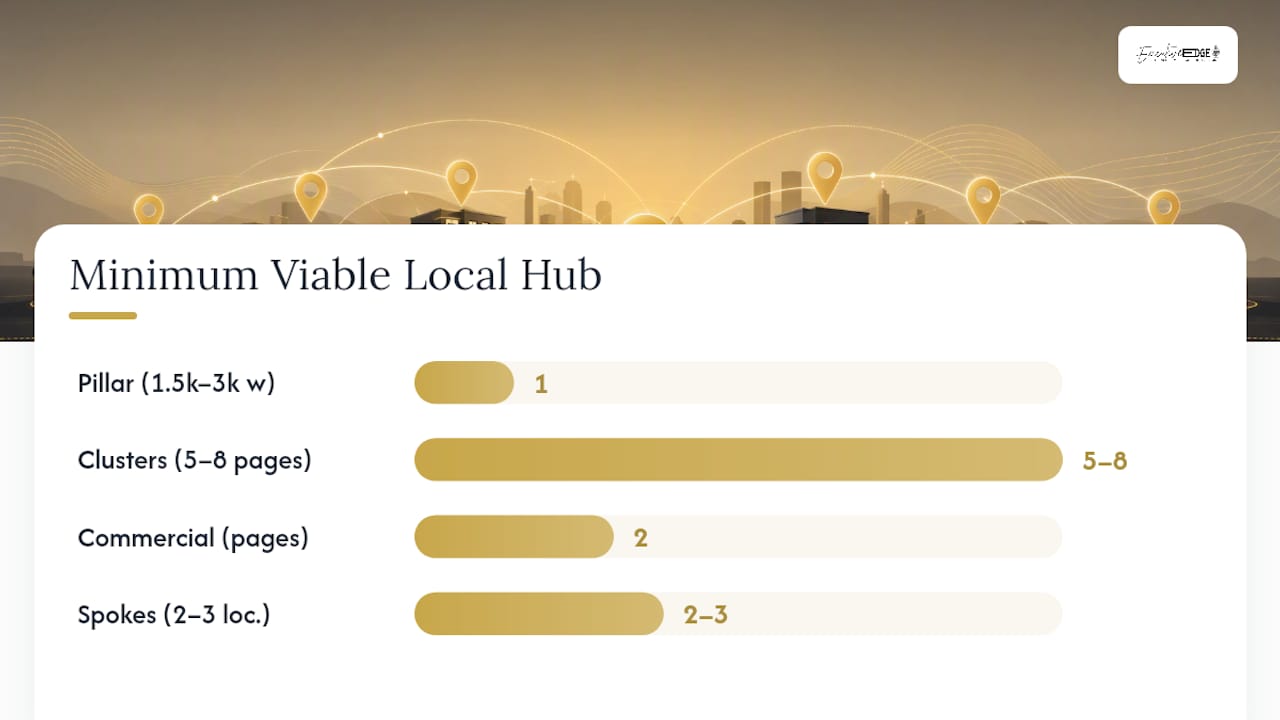
For teams building this in phases, a 30/60/90-day rollout gives structure to what otherwise turns into an open-ended backlog.
Pro Tip: Write the internal-linking map before you write a single page. Decide which spoke links to which cluster page in a spreadsheet first. Retrofitting links after fifteen pages are live takes three times longer than planning them up front.
Governance: Who Owns What in a Multi-Location Hub
Clear ownership prevents the single most common hub failure: corporate and local teams both publishing content that targets the same query.
- Assign the pillar to corporate or the central marketing team. Broad, high-volume topic pages should never be duplicated at the local level.
- Give local teams or franchisees ownership of their own spoke, with a required uniqueness checklist before anything publishes.
- Run every location page through an approval workflow that checks for duplicate boilerplate against other spokes in the hub.
- Enforce technical controls, consistent NAP (name, address, phone) data, LocalBusiness schema markup, canonical tags pointing to the correct spoke, and breadcrumbs that reflect the hub's hierarchy.
- QA every spoke against a short checklist before launch: unique testimonial, unique imagery, local schema present, internal links to at least two related pages, no copied paragraphs from another location.
This ownership split, documented clearly by Search Engine Land, is what stops corporate and local content from competing for the same rankings. If you skip this step, you'll spend a year producing content that quietly fights itself in search results.
Measuring Whether Your Hub Is Working
Track a small set of KPIs rather than drowning in vanity metrics. Organic visits to the pillar page, local-pack impressions for your target markets, and conversions attributed to hub content are your primary indicators. Watch engagement signals too, time on page and whether visitors click deeper into related spokes tells you if the internal linking is actually guiding people, not just existing.
| Metric | What it tells you | Typical review window |
|---|---|---|
| Pillar organic visits | Whether the hub is gaining topical authority | Monthly, trend over 90 days |
| Local-pack impressions | Visibility for geography-specific queries | Monthly |
| Internal click-through rate | Whether spokes and pillar reinforce each other | Bi-weekly |
| Index coverage and crawl depth | Technical health of the hub structure | Monthly |
| Conversions from hub pages | Revenue impact | Monthly, trend over 90 days |
Most hubs need 60 to 90 days before pillar rankings start moving meaningfully, and longer in competitive metro markets. Once the pillar and first few spokes show consistent lift, that's your signal to scale, add more location spokes, expand the cluster set, or increase publishing cadence.
How Executive Edge Authority Engine Builds Local Hubs in Practice
Executive Edge Partner Group runs this exact process for clients who don't have a marketing department to execute it. The workflow starts with intake and a topical map built around the client's services and geography, then moves into a single recording session that becomes the raw material for weeks of output.
From that one session, Executive Edge Authority Engine produces:
- Podcast episodes and short-form clips for social distribution
- Blog articles structured as pillar and cluster pages
- Geo-optimized location pages built for the client's specific service areas
- Video content repurposed across YouTube and social platforms
Every asset gets built with SEO, GEO, and AEO in mind, so the same content that ranks in Google is also structured to surface in AI-driven search and answer engines. Client examples and case studies are available on request for businesses evaluating whether a managed hub build fits their situation.
What Most Local Content Hubs Get Wrong
The biggest mistake isn't a lack of content, it's a lack of structure before content starts. Businesses hire writers, generate twenty city pages in a month, and only later realize half of them are near-duplicates competing against each other in search results. The fix is always the same: map the topic and geography intent first, then write.
The second failure is treating governance as optional. Without an ownership split between corporate and local, quality drifts within two quarters. Tactical wins that actually move the needle are boring: consistent publishing cadence, real local proof on every spoke, and someone accountable for enforcing the uniqueness checklist. We see this consistently with businesses in Tyler and East Texas, where several service areas share a regional identity but each town still needs its own distinct local signals to rank and convert.
— David Domm
Get a Managed Local Content Hub Without Hiring a Content Team
Executive Edge Partner Group is the alternative to hiring an in-house content team or a traditional agency retainer for building a local content hub. Instead of coordinating writers, editors, SEO specialists, and video producers separately, you record once and the Authority Content System turns that single session into weekly podcast episodes, blog articles, geo-optimized location pages, and short-form video, all built around your topical map and service areas.

This matters most for service-based businesses, consultants, medical professionals, attorneys, and contractors who need a hub built and maintained but don't have the bandwidth to manage five different content workflows. The system applies SEO, GEO, and AEO structuring to every asset so your hub is positioned for both traditional search and AI-driven discovery platforms.
If you're ready to see how a topical map and single-recording workflow could work for your service areas, visit the Authority Content System page to review your options and start the intake process.
Sources
- Multi-location SEO strategy: Stop competing with your own content
- Topic Clusters for Local SEO: Types, Tips & Examples | WordStream
- Types of Content Hubs: 5 Approaches & 30+ Examples
- Content Silo Strategy for Local SEO: Build Topical Authority That Actually Converts (2026)
FAQ
What Is a Local Content Hub Exactly?
A local content hub is a pillar page connected to cluster pages and location-specific spokes, all built to establish topical authority for a business operating in multiple service areas. It differs from a blog because every page has a defined role and links back to a central authority page, following the hub-and-spoke model.
How Many Pages Do I Need to Start a Content Hub?
A functional local silo typically needs a minimum of 8 to 12 pages: one pillar, several informational cluster pages, a couple of commercial pages, and two or three location spokes. Fewer pages than that usually reads as thin content to search engines.
How Do I Stop Location Pages From Competing With Each Other?
Assign clear ownership: corporate or central marketing owns the broad pillar topic, while each location team owns its own spoke with a required uniqueness checklist. This division is what Search Engine Land recommends to prevent internal cannibalization in search results.
How Long Before a Local Content Hub Shows Results?
Most hubs need 60 to 90 days before the pillar page shows meaningful ranking movement, with longer timelines in competitive metro markets. Consistent publishing cadence and internal linking density both affect how quickly the lift shows up.
Does Executive Edge Partner Group Build Local Content Hubs for Businesses?
Yes. The Authority Content System builds topical maps and produces weekly hub content, podcasts, blog articles, geo-optimized pages, and video, from a single client recording session. Current pricing and consult details are available on the Executive Edge Partner Group site.