

Digital authority building is the ongoing work of proving your brand's expertise, citations, and entity signals so search engines and AI platforms reliably cite you as the answer. The payoff isn't a higher ranking. It's showing up in the ChatGPT response, the Google AI Overview, or the Perplexity summary when someone asks a question your business can answer.
For business owners in Tyler and East Texas, this shift already changes who gets the call. When a prospective client asks an AI assistant "who's the best contractor near me" or "which attorney handles this," the answer comes from a citable source, not a ten-blue-links search.
Two moves start the process immediately:
- Audit your current citation footprint. Search your brand name and core topics in ChatGPT and Perplexity to see if you show up at all.
- Fix inconsistent entity data. Your name, address, credentials, and bio should match word for word across your website, Google Business Profile, and social platforms.
Table of Contents
- What Is Digital Authority Building Made Of?
- Why "Great Invisibility" Is the Real Risk Now
- The Five Pillars You Have to Operate Simultaneously
- How Do You Build Digital Authority Step by Step?
- How Long Does It Take to Build Digital Authority?
- What Kills Digital Authority Once You've Built It
- How a Managed Program Executes This Playbook
- Executive Edge Partner Group Turns This Playbook Into a Managed System
- Why Leaders Can't Treat Authority as Optional Anymore
- Sources
- FAQ
What Is Digital Authority Building Made Of?
Digital authority building rests on five components, and most brands only have one or two working.
- E-E-A-T (Experience, Expertise, Authoritativeness, Trustworthiness): Google's own framework for judging whether a source deserves to be cited.
- Topical authority: depth across a subject through connected content, not one strong article standing alone.
- Earned media: mentions, quotes, or links from outlets other than your own website.
- Entity signals: structured data, consistent profiles, and clear identity markers that let machines know who you are.
- AEO/GEO/SEO formatting: content written so both traditional search and AI answer engines can extract and quote it.
Domain authority, the metric many marketers chase, only measures link equity. It says nothing about whether an AI engine trusts you enough to cite you by name. A law firm with a high domain authority score but no press mentions and inconsistent bios across platforms still gets skipped over in favor of a smaller firm with a Tier-1 quote and a tightly linked practice-area cluster.
Why "Great Invisibility" Is the Real Risk Now
AI and answer engines don't rank pages the way Google used to. They select sources based on editorial citations and entity strength, weighing who else has already vouched for you over how many backlinks you've accumulated, according to Smart Money Media's citation research. Brands with no earned media and thin entity data become invisible to the exact systems more people now use to find a provider.
AI answer surfaces are expanding above the fold, reshaping where clicks and attention go before a user ever scrolls to a traditional organic listing.
The consequences compound quietly:
- Fewer branded searches, because people never learn your name in the first place.
- Lost leads to competitors who show up in the AI-generated answer.
- Diminished brand salience even among people who visited your site once but can't recall it later.
Earned media functions as the primary credibility signal these engines lean on, which makes public relations one of the highest-leverage investments available to a business trying to get cited.
The Five Pillars You Have to Operate Simultaneously
Building digital authority means running five systems at once, not checking a box once and moving on.
E-E-A-T, in practice, means a real author page with credentials, a case study section with named clients and results, and a bio that matches across every platform where you appear.
Topical clusters work because a pillar page plus supporting cluster pages, linked both ways, gives AI retrieval systems stronger entity evidence than one isolated article ever could. Five connected pages corroborate each other; one page stands alone and gets treated with more skepticism.
Earned media comes from data assets and original research, not press releases. Publish a survey of your own clients, a local market report, or a case study with real numbers, then pitch it to journalists covering your industry. Case studies do heavy lifting for SEO credibility precisely because they combine proof with a story a reporter can use.
Entity wiring covers schema markup, a Wikidata entry if you qualify, and identical NAP (name, address, phone) data everywhere you're listed.
Extractable formatting means answer-first paragraphs, FAQ blocks, and data tables that let an AI system lift a clean, quotable answer straight from your page.
- Author page with named credentials and a photo
- At least two case studies with specific outcomes
- Schema markup on every core service page
- One data asset published per quarter
Pro Tip: Write the first sentence of every important page as if it's the only sentence an AI engine will ever quote. If that sentence alone doesn't answer the question, rewrite it.
How Do You Build Digital Authority Step by Step?
Building authority isn't a single campaign. It's a sequence, and skipping steps is why most efforts stall.
- Audit first. Check your current citation footprint in AI tools, review your entity profiles for inconsistencies, map your content for cluster gaps, and score your E-E-A-T weaknesses honestly.
- Build the pillar. Create one hub page that clearly states your core topic, then link it both ways to three or four supporting cluster pages. Add a definition block and an FAQ section to the hub itself.
- Earn authority. Produce one original data asset (a survey, a local report, a client outcomes study) and pitch it to journalists and industry outlets, aiming for Tier-1 placements rather than low-value guest posts.
- Wire your entities. Implement schema markup across service pages, standardize your NAP data everywhere, and pursue a Wikidata or Wikipedia entry if your brand or founder qualifies.
- Format for AEO and GEO. Rewrite key pages with answer-first opening paragraphs, add structured data, and distribute content to platforms AI systems actively index, including YouTube and podcast feeds.
Skipping the audit is the most common shortcut, and it's the one that costs the most later. Teams that jump straight to publishing without checking their entity data end up building authority on a foundation with the wrong address or an outdated bio still live somewhere.
- Confirm every published bio matches before you publish anything new.
- Treat the pillar page as a living document, updated every time a cluster page is added.
- Track earned placements the same way you track leads, because they function as leads' upstream source.
How Long Does It Take to Build Digital Authority?
Realistic timelines matter more here than almost anywhere else in marketing, because authority compounds slowly and then suddenly.
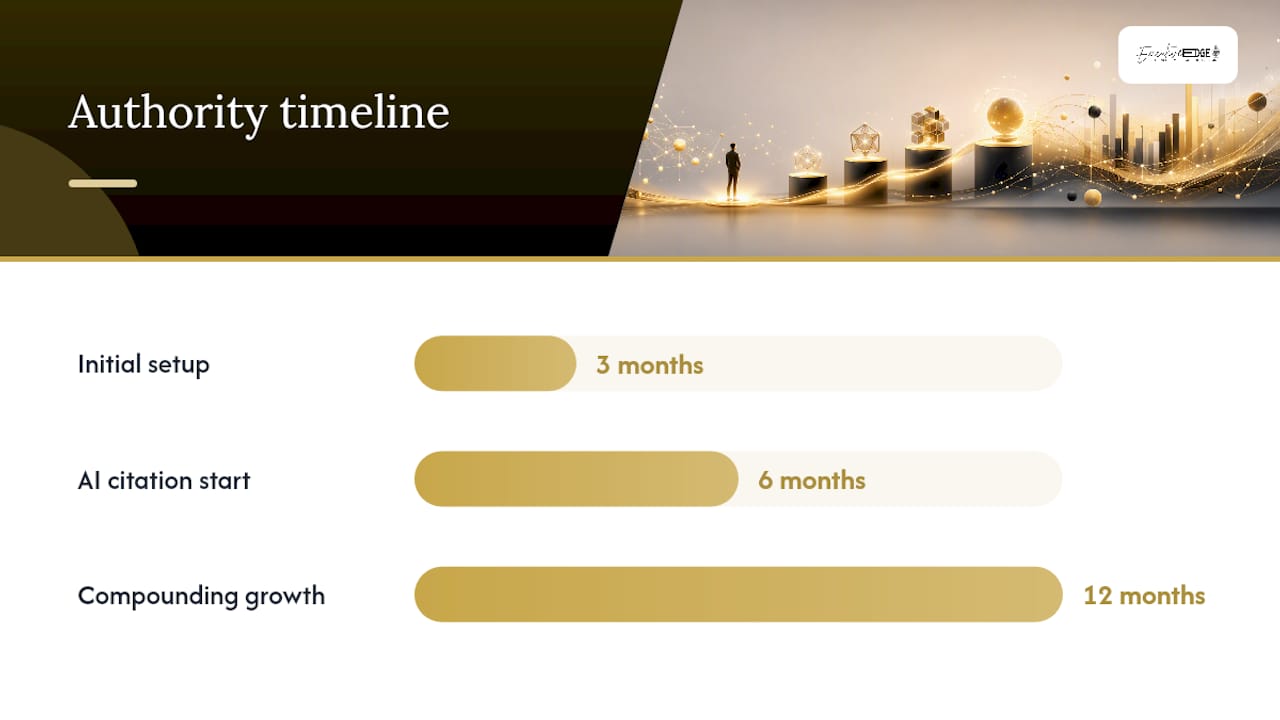
By the three-month mark, expect your entity data cleaned up, your pillar page live, and maybe one earned media placement in progress. By six months, AI citation checks should start showing your brand appearing for at least a handful of core queries, and branded search volume typically ticks upward. By twelve months, a consistent quarterly cadence tends to produce compounding visibility across AI answers, SERP features, and organic branded traffic together.
Track these KPIs on a monthly or quarterly basis:
- Manual AI citation checks across ChatGPT, Perplexity, and Google AI Overviews for your core topics
- Count of earned editorial mentions and their domain quality
- Topic visibility across your full cluster, not just the pillar page
- Branded-query volume lift in Google Search Console
- Share of SERP features (featured snippets, People Also Ask, AI Overview) you occupy
AI citations disproportionately favor domains with strong editorial coverage, which is why earned media probability directly affects how often you get cited rather than just how often you rank.
What Kills Digital Authority Once You've Built It
Authority decays quietly, and most of the damage comes from neglect rather than a single mistake.
Orphan pages happen when cluster content gets published, then never linked from the pillar page or from each other. Practitioner audits consistently find clusters decaying once internal links break or new pages sit unlinked for months. Fix it by auditing internal links quarterly and reconnecting anything that's drifted loose.
Synonym drift occurs when your team calls the same service three different names across the site, confusing both readers and machines trying to match entity references. Standardize terminology once, then enforce it in every content brief going forward.
Link-only focus ignores everything else that builds trust, leaving a site with plenty of backlinks and zero earned media or entity clarity. Stale citations pile up when old press mentions and directory listings never get updated with current information.
- Run a quarterly link and citation audit
- Refresh core pillar content at least twice a year
- Recheck NAP consistency every time you update a service or address
Pro Tip: Set a recurring calendar reminder for the first week of each quarter labeled "authority audit." Programs that skip this step are the ones that quietly go invisible.
How a Managed Program Executes This Playbook
Executive Edge Authority Engine runs this exact sequence on behalf of clients who don't have the internal bandwidth to do it themselves. The audit, pillar build, earned-media outreach, entity wiring, and AEO/GEO formatting map directly onto a managed production calendar rather than a one-time project.
- Weekly podcast production feeds both earned-media outreach and cluster content simultaneously
- AI voice cloning scales founder-voiced content without founder hours
- Reporting cycles mirror the quarterly cadence: audit, new assets, placement tracking
- Consistent publishing cadence prevents the orphan-page and stale-citation decay covered above
Client case studies and specific placement results are available on request during a consultation.
Executive Edge Partner Group Turns This Playbook Into a Managed System
Executive Edge Partner Group is the alternative to hiring a PR firm, an SEO agency, and a content team separately for business owners who want one accountable partner running the whole authority program instead of three vendors pointing fingers at each other.
A typical engagement combines a weekly podcast episode, a supporting pillar page with linked cluster content, short-form social clips pulled from that same recording, and distribution across YouTube, blogs, and AI-indexed platforms. This is the thought leadership content format approach applied on a recurring monthly retainer, so nothing gets published once and forgotten.
If you're a consultant, attorney, contractor, or executive who wants to stop guessing whether your content strategy is actually building citable authority, visit Executive Edge Partner Group to request an audit of your current entity data and citation footprint, and see exactly where the gaps are before you spend another quarter guessing.
Why Leaders Can't Treat Authority as Optional Anymore
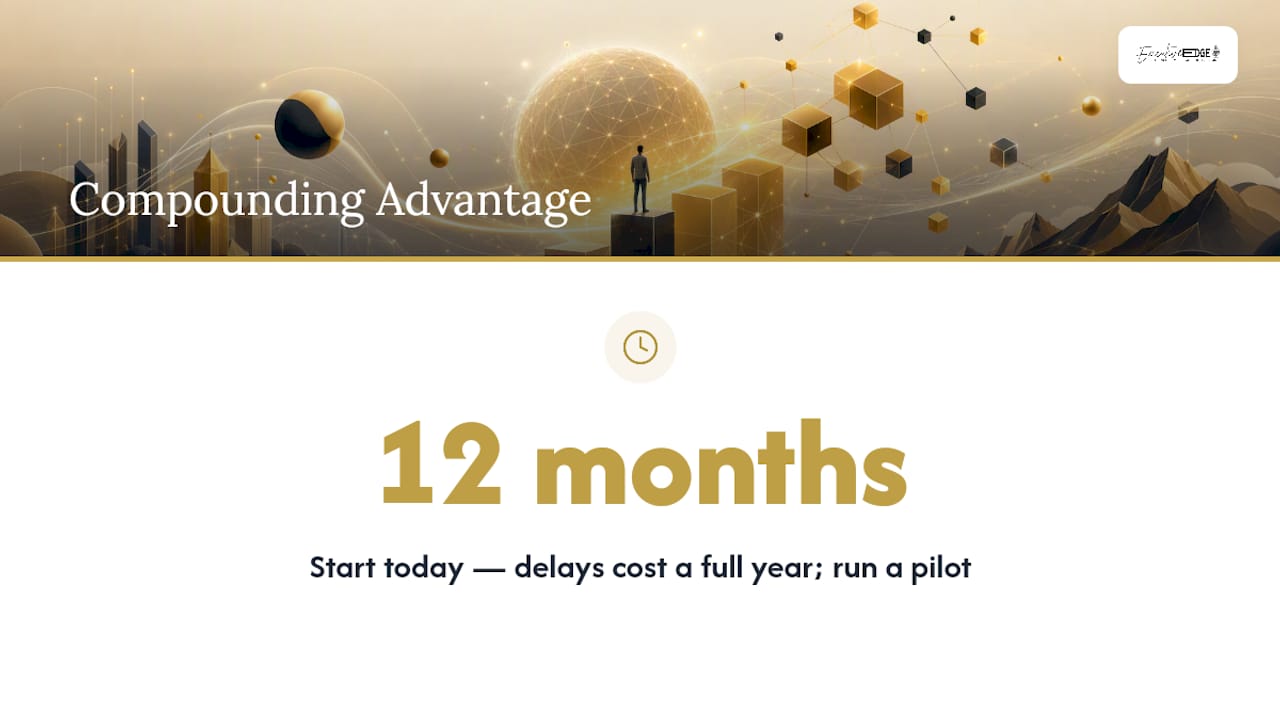
Authority compounds. The brand that starts today has a twelve-month head start over the one that waits. We see this constantly with East Texas businesses that delayed the audit and lost a year to preventable gaps. Run a small pilot now.
Sources
- Entity-Based Authority: Why Five Pages Beat One Strong Page in AI Search
- Data shows AIO expanding above the fold (Search Engine Journal)
FAQ
How do you build authority?
You build authority by combining demonstrated expertise (E-E-A-T), connected topical content, earned media placements, consistent entity data, and content formatted for AI extraction, then repeating that cycle quarterly.
What does domain authority do?
Domain authority measures link equity, not whether AI engines or editorial sources trust you enough to cite you by name. It's one input among several, not a complete authority score.
What does authority marketing mean?
Authority marketing means positioning your expertise through educational content, media placements, and consistent credibility signals so prospects trust you before they ever contact you, rather than through direct advertising alone.
How do you build domain authority?
Domain authority rises mainly through earned backlinks from reputable sites, which typically follow from original data assets, case studies, and press coverage rather than link-building tactics alone.
What is digital authority building in practice?
In practice, digital authority building means running an audit, publishing a pillar-and-cluster content structure, earning Tier-1 media mentions, wiring your entity data consistently, and formatting content so AI answer engines can cite it directly. Executive Edge Partner Group runs this exact sequence as a managed service for clients who want the outcome without building the internal team to execute it.