

The fastest path to more organic patient bookings is a three-part combination: a fully optimized Google Business Profile, specialty-specific local landing pages, and medically reviewed content that earns Google's trust. Most practices should start there before touching anything else. If your team has the bandwidth, the DIY roadmap below gives you a ranked checklist and a month-by-month plan. If you'd rather hand it off, Executive Edge Partner Group's Authority Engine runs the entire program for you.
Your next 7–30 days, in order of impact:
- Claim and fully complete your Google Business Profile (photos, services, appointment link, hours)
- Set up Google Search Console and GA4 with HIPAA-safe configuration to establish a baseline
- Publish or update your top three specialty pages with local keywords and a named clinician byline
- Launch a review request workflow for every discharged or post-visit patient
- Run a PageSpeed Insights audit and fix the top two mobile speed issues
Table of Contents
- What does SEO success actually look like for a medical practice?
- The high-impact checklist every practice needs right now
- Month-by-month implementation plan
- What does medical SEO actually cost?
- Which tools should your practice actually use?
- How to measure and report SEO results to leadership
- Compliance, YMYL, and patient safety in medical content
- What real results look like across specialties
- Why a managed authority system beats a piecemeal approach
- The Authority Engine: hands-off medical SEO that runs every week
- Sources
- FAQ
What does SEO success actually look like for a medical practice?
Set the right targets before you spend a dollar. The KPIs that matter most for a medical practice are calls from organic search, booked appointments attributed to organic sources, Google Business Profile views and direction requests, and organic sessions on your local landing pages. Secondary metrics worth tracking include keyword rankings for specialty-plus-city combinations, review count growth, and how often your content gets cited in AI Overviews.
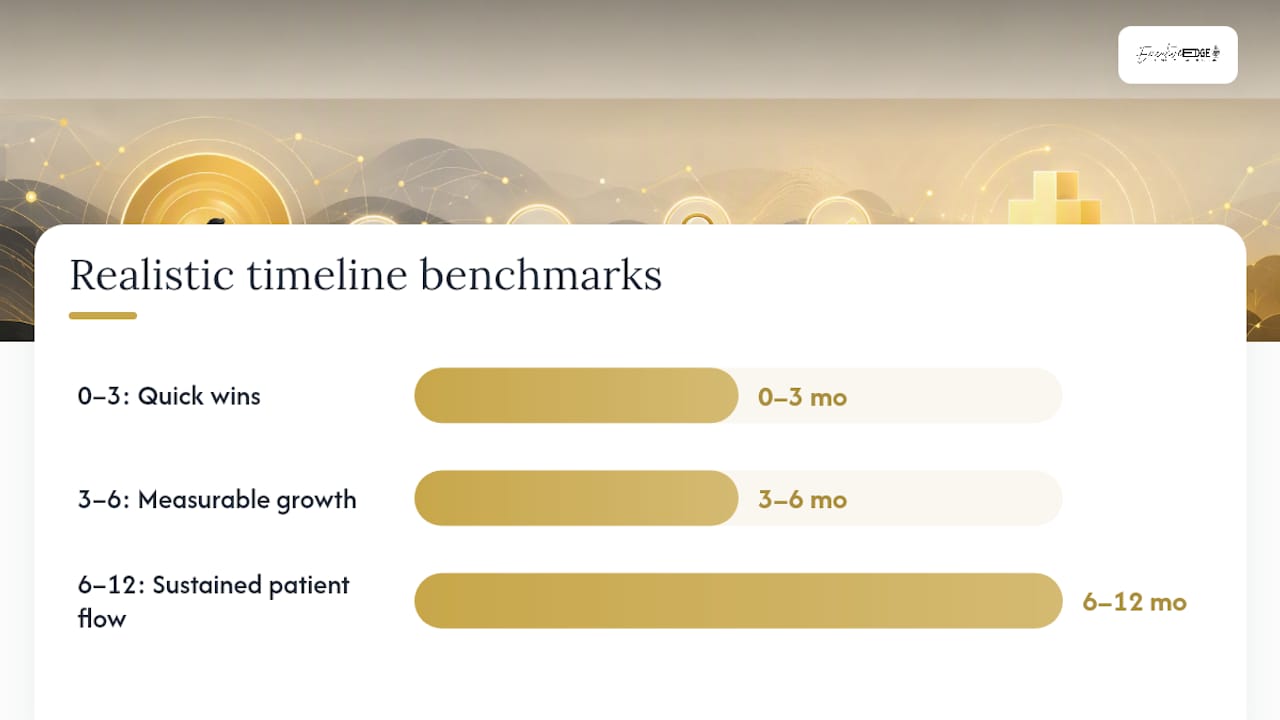
Realistic timeline benchmarks:
- Months 0–3 (quick wins): GBP impressions rise, call volume from map-pack ticks up, baseline rankings established for 10–20 target keywords
- Months 3–6 (measurable growth): Organic sessions increase on specialty pages, review count grows, first page rankings appear for mid-competition local terms
- Months 6–12 (sustained patient flow): Consistent appointment growth from organic, AI citation appearances for clinical FAQ queries, cost-per-acquisition from organic falls below paid channels
Benchmark to keep in mind: Healthcare-specific GBP guidance identifies weekly posts, fresh photos, and prompt review responses as the signals most correlated with local 3-pack placement — often producing measurable call increases within a few months of consistent activity.
Conversion rate on your booking page is the number that ties everything together. Organic traffic that never converts is just vanity. Track it from day one.
The high-impact checklist every practice needs right now
Rank these by what moves the needle fastest, not by what feels most technical.
Google Business Profile
- Verify the profile under Google's official business representation guidelines — use the exact legal practice name, no keyword stuffing
- Select the most specific primary category (e.g., "Cardiologist," not just "Doctor")
- Upload at least 10 photos: exterior, interior, staff, equipment
- Add services, insurance accepted, and a direct appointment link
- Post once per week (health tips, hours updates, seasonal notices)
- Respond to every review within 48 hours using HIPAA-safe language (never confirm a reviewer is a patient)
Local keyword targeting and on-page priorities
- Build dedicated pages for each specialty and each location (e.g., "knee replacement surgeon in [city]")
- Map intent variants: "cost of," "does insurance cover," "telehealth [specialty]" — these convert at higher rates than generic terms
- Use geo-optimized content frameworks to structure each location page consistently
E-E-A-T and medical content trust signals
- Every clinical page needs a named author with credentials and a "medically reviewed by" line
- Link to peer-reviewed sources and .gov pages where you make clinical claims — research confirms that the quality and presentation of online health information directly shapes patient trust and decision-making
- Display a visible "last reviewed" date on every clinical article
Technical checklist
- HTTPS on every page, no mixed-content warnings
- Mobile-first layout with tap targets sized for older patients
- Core Web Vitals: Largest Contentful Paint under 2.5 seconds, Cumulative Layout Shift under 0.1
- Schema types to implement:
MedicalOrganization,Physician,MedicalWebPage,FAQPage
Conversion optimization
- Click-to-call button visible above the fold on mobile
- Online booking widget integrated directly into specialty pages (not buried in a "Contact" tab)
- Dedicated landing pages for each service with a single, clear CTA
Pro Tip: Add your accepted insurance plans to both your GBP profile and your website's service pages. "Does [doctor] accept [insurance]" is one of the highest-converting search queries in healthcare, and most practices leave it unoptimized.
Month-by-month implementation plan
Months 0–3: Foundation
- Complete and verify Google Business Profile; set up practice-level and, where appropriate, provider-level profiles per Google's guidelines
- Install GA4 with conversion events for calls and form submissions; configure to exclude PHI from data streams
- Add Google Search Console; submit sitemap; identify crawl errors
- Publish your top five specialty-plus-location pages with clinician bylines and schema markup
- Fix urgent technical issues: HTTPS, redirect chains, mobile speed (use PageSpeed Insights as your baseline)
- Launch a post-visit review request workflow via SMS or email
Measurement milestone: By month 3, you should have baseline data for organic sessions, GBP calls, and at least 10 new reviews.
Months 3–6: Content and authority
- Publish a medically reviewed content series (2–4 articles per month) targeting FAQ-style queries your patients actually ask
- Build local citations on health directories (Healthgrades, Zocdoc, Vitals) with consistent NAP data
- Implement
FAQPageschema on your top-performing clinical pages to improve AI citation eligibility - A/B test your booking CTA placement and button copy
- Begin outreach to local health publishers and hospital blogs for backlinks
Measurement milestone: Organic sessions on specialty pages up from baseline; GBP direction requests trending upward; booking conversion rate established.
Ongoing: Reputation, content, and AEO
- Monthly content calendar with at least two medically reviewed posts
- Weekly GBP post and photo update
- Quarterly schema and FAQ refresh to stay current with AI Overview formatting preferences
- Monthly review of local SEO best practices to catch algorithm shifts early
- Backlink outreach to local media and health organizations
Ownership split: Practice staff can own GBP posts, photo uploads, and review responses. Content production, technical SEO, schema, and reporting are best delegated to a specialist or a managed service.
What does medical SEO actually cost?
Pricing varies widely based on scope, competition, and whether you're doing it in-house or hiring out.
Timeline to first measurable lift: Most practices see GBP call increases within 60–90 days of consistent activity. Organic ranking improvements for competitive specialty terms typically take 4–6 months. ROI that exceeds paid search costs usually appears in the 9–12 month window.
Red flags when vetting an agency:
- Guarantees a specific ranking position (no one can guarantee Google rankings)
- Cannot explain how they handle HIPAA-compliant tracking
- Proposes a one-size-fits-all content plan with no clinician review process
- Locks you into a 12-month contract with no performance benchmarks
- Cannot show anonymized case results from other medical clients
Vetting questions worth asking: "How do you configure GA4 to exclude PHI?" and "Who writes and reviews your clinical content?" The answers tell you everything.
Which tools should your practice actually use?
Core stack for any U.S. medical practice
- Google Business Profile: Free; the single highest-ROI local tool available
- Google Search Console: Free; monitors indexing, crawl errors, and keyword performance
- PageSpeed Insights and web.dev: Free; diagnose Core Web Vitals and accessibility issues that affect both SEO and older patient experience
- GA4: Free; requires HIPAA-safe configuration (disable Google Signals, exclude appointment-related URL parameters from data collection)
- WordPress: The recommended CMS for most practices — its plugin ecosystem supports schema markup, speed optimization, and secure form integrations; Wordpress offers managed hosting options with stronger security defaults
Plugins and integrations
- Schema plugins (e.g., Yoast SEO, Rank Math) for structured data output
- Speed plugins (e.g., WP Rocket, LiteSpeed Cache) for Core Web Vitals
- HIPAA-compliant form tools with Business Associate Agreements (BAAs) — standard contact form plugins are not sufficient for appointment data
- Booking widgets that support BAAs (confirm with the vendor before deploying)
HIPAA caution: Standard analytics pixels can capture PHI if appointment confirmation pages include patient identifiers in the URL. Always configure GA4 to redact or exclude those parameters, and get a BAA from any vendor that processes appointment data.
Pro Tip: AEO guidance for healthcare shows that FAQPage and Medical schema are among the highest-ROI technical steps for getting cited by AI Overviews — and they take less than a day to implement on an existing WordPress site.
Single-location clinics can run effectively on GBP, Search Console, PageSpeed Insights, GA4, and WordPress with one or two plugins. Multi-location groups add call-tracking software, a local citation management tool, and a centralized reporting dashboard.
How to measure and report SEO results to leadership
Essential dashboard metrics
- Organic calls (tracked via call-tracking software or GA4 phone-click events)
- Booked appointments attributed to organic search (via booking system UTM integration)
- GBP calls and direction requests (pulled directly from GBP Insights)
- Organic sessions on local landing pages
- Conversion rate: organic visitors to appointment requests
- Cost-per-acquisition equivalent from organic (for comparison against paid search spend)
Reporting cadence
| Frequency | What to Review |
|---|---|
| Weekly | GBP activity, new reviews, call volume |
| Monthly | Organic sessions, rankings, conversion rate, new content published |
| Quarterly | Strategy review, KPI vs. targets, schema/AEO refresh, competitive landscape |
Attribution note: GA4 last-click attribution undercounts organic's contribution for patients who research over multiple sessions. Use assisted conversion reports and call-tracking data together to get a fuller picture. Web.dev's accessibility and performance tools can also surface UX issues that suppress conversion rates before they show up in booking data.
For non-technical leadership: A one-page monthly summary works best. Lead with three numbers: organic calls, booked appointments from organic, and GBP direction requests. Add one chart showing organic session trend and one showing review count growth. Everything else goes in an appendix.
Compliance, YMYL, and patient safety in medical content
Medical content sits in Google's Your Money or Your Life (YMYL) category, which means quality standards are higher and the penalties for thin or misleading content are steeper.
Content rules that protect your rankings and your patients
- Every clinical page needs a named author with credentials, a named reviewer, and a visible "last reviewed" date
- Cite peer-reviewed journals and .gov sources for clinical claims — research published in PMC confirms that how health information is presented shapes patient trust as much as what it says
- Never publish medical advice without a disclaimer that it is general information and not a substitute for professional consultation
- Healthcare YMYL pages that combine clinician bylines, cited peer-reviewed sources, and visible review dates are the pattern both Google quality raters and AI systems reward
HIPAA and tracking
- Configure GA4 to disable Google Signals and exclude PHI-containing URL parameters
- Get BAAs from every vendor that touches appointment or patient data
- Never use standard retargeting pixels on appointment confirmation pages
- Train staff to reply to reviews without confirming that the reviewer is a patient, their diagnosis, or any treatment detail
HIPAA-safe review reply template: "Thank you for sharing your experience. We take all feedback seriously and are committed to providing excellent care. Please contact our office directly so we can address your concerns." Never add specifics — not the appointment date, not the service, not the outcome.
For clinical pages, display the "medically reviewed by" line directly below the article title, include the reviewer's credentials, and link to their bio page. This single formatting choice signals E-E-A-T to both Google and AI answer engines. For practices expanding into telehealth, online consultation marketing adds another layer of content and compliance considerations worth reviewing.
What real results look like across specialties
These are anonymized examples drawn from common medical SEO scenarios.
-
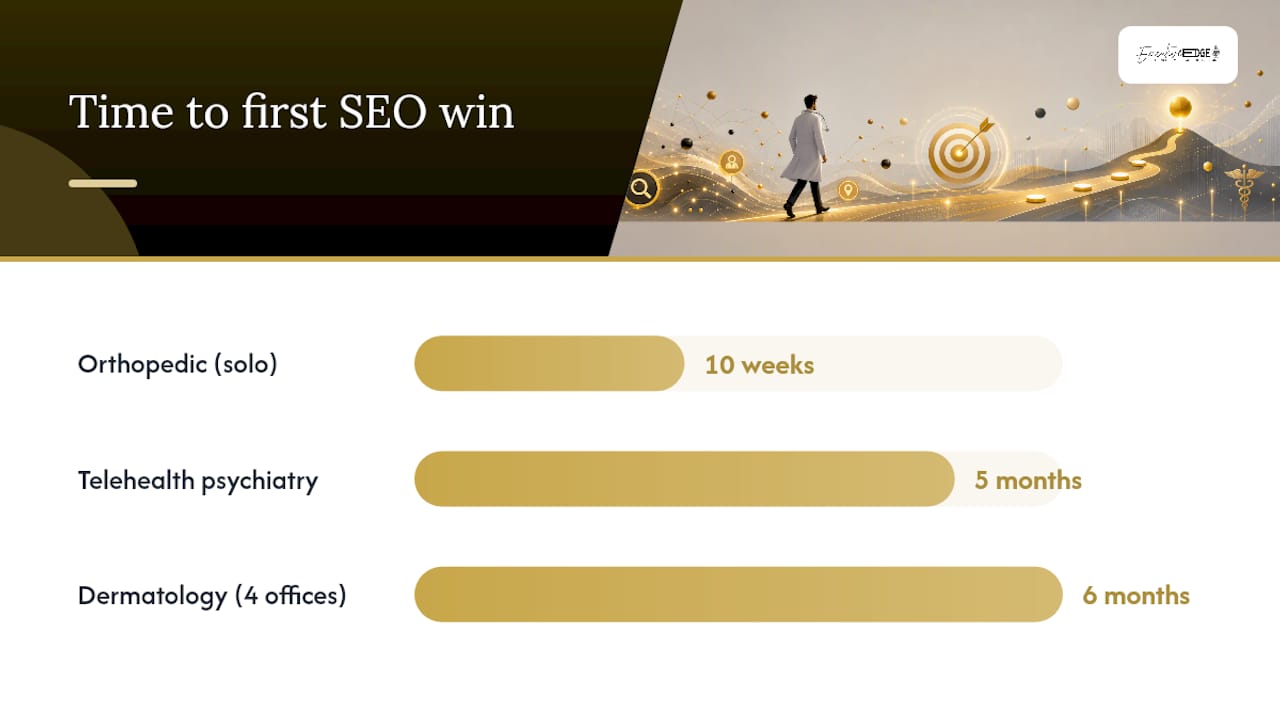
Solo orthopedic surgeon, suburban market: Starting point was zero GBP activity and no specialty pages. After completing the GBP profile, publishing five procedure pages with schema, and launching a review request workflow, the practice saw map-pack appearances for "knee surgeon [city]" within 10 weeks and a measurable increase in new patient calls by month four.
-
Multi-location dermatology group (4 offices): The group had inconsistent NAP data across directories and no medically reviewed content. After standardizing citations, adding clinician bylines to 20 existing pages, and implementing FAQPage schema, AI Overview citations appeared for several high-volume skin condition queries within six months. Organic appointment requests across all locations grew steadily through month nine.
-
New telehealth psychiatry practice: No local presence, no domain authority. The practice prioritized GBP setup (with telehealth service area configured), published 12 FAQ-style articles with Physician schema, and built a structured local content strategy around condition-specific queries. First page rankings for three target terms appeared by month five; the booking calendar reached capacity for new patients by month eight.
The consistent pattern across all three: GBP and technical fixes deliver early wins; medically reviewed content and schema drive the longer-term ranking and AI citation gains.
Why a managed authority system beats a piecemeal approach
Medical SEO is not standard local SEO with a HIPAA disclaimer bolted on. It sits at the intersection of clinical credibility, local patient acquisition, and AI-era content structure — three disciplines that most generalist agencies handle separately, if at all. The practices that get results fastest are the ones that treat authority-building as a system, not a project.
The YMYL standard means a single thin or uncited page can drag down an entire domain's trust signals. The HIPAA dimension means a misconfigured analytics pixel is not just an SEO problem. And the AEO layer means content that was perfectly optimized two years ago may not surface in AI Overviews today without FAQPage schema and answer-first formatting. Running all of that in parallel, consistently, while seeing patients, is genuinely hard. The practices that try to manage it with a part-time staff member and a monthly blog post rarely get past the quick-win phase.
This is something we see consistently with medical professionals across markets, including doctors in Tyler and East Texas, who have the clinical expertise but not the bandwidth to build a content and authority program from scratch. A systemized, done-for-you approach closes that gap without pulling clinicians away from patient care.
The Authority Engine: hands-off medical SEO that runs every week
Executive Edge Partner Group built the Authority Engine specifically for busy professionals who need consistent, compliant content production without managing a team of freelancers.

For medical practices, that means weekly blog articles written to YMYL standards, GBP management and posting, FAQPage and Medical schema implementation, AEO-optimized content formatted for AI citation, HIPAA-aware analytics configuration, and a monthly performance report your leadership team can actually read. The system runs on a recurring retainer, so your content calendar never goes dark and your GBP never goes stale.
It's the right fit for solo specialists who want predictable new-patient flow, multi-location groups that need consistent output across locations, and practices moving into telehealth that need a compliant content foundation fast. Eepartnergroup to see whether the Authority Engine fits your practice's goals.
Sources
- PMC6169945
- Guidelines for representing your business on Google - Google Business Profile Help
- Pagespeed
FAQ
How long does SEO take to work for a medical practice?
Most practices see GBP call increases within 60–90 days of consistent activity. Organic ranking improvements for competitive specialty terms typically take 4–6 months, with sustained patient-flow growth appearing in the 6–12 month window.
What schema markup should doctors use on their websites?
The highest-priority schema types for medical practices are MedicalOrganization, Physician, MedicalWebPage, and FAQPage. FAQPage and Medical schema also improve the chance of being cited in AI Overviews for clinical queries.
Is Google Analytics HIPAA compliant for medical practices?
GA4 is not HIPAA compliant by default. You must disable Google Signals, exclude PHI-containing URL parameters from data collection, and obtain a Business Associate Agreement from any vendor that processes appointment or patient data.
What is the difference between SEO and AEO for doctors?
SEO targets traditional search rankings on Google; AEO (Answer Engine Optimization) targets AI-generated answers in tools like Google's AI Overviews, ChatGPT, and Perplexity. For medical practices, FAQPage schema, answer-first content structure, and clinician bylines serve both goals simultaneously.
Can Executive Edge Partner Group handle medical SEO for my practice?
Yes. Executive Edge Partner Group's Authority Engine includes HIPAA-aware analytics configuration, medically reviewed content production, GBP management, schema implementation, and monthly reporting — all on a managed retainer designed for busy medical professionals.