

The jobs on the rise are concentrated in healthcare, computer and mathematical fields, renewable energy, and information security, but percent growth and absolute job openings tell different stories. Wind turbine service technicians and solar photovoltaic installers top the Bureau of Labor Statistics' percent-growth rankings for 2024 to 2034, yet together they add fewer than 20,000 jobs nationally. Nurse practitioners, data scientists, and information security analysts show up on both the fast-growth list and the high-volume list, which makes them a safer bet for most employers building a hiring plan.
Computer and mathematical occupations are projected to grow 10.1% over the decade, and healthcare support roles are projected to climb 12.4%. That gap between "fastest growing" and "most new jobs" matters more than most hiring plans account for.
- Healthcare: nurse practitioners, physician assistants, home health and personal care aides
- Computer and mathematical: data scientists, information security analysts, software developers
- Renewable energy: solar photovoltaic installers, wind turbine service technicians
- Management: medical and health services managers
Quick fact: Wind turbine technicians and solar installers rank among the fastest-growing occupations by percentage, but their combined job growth is smaller than the number of home health aide openings projected in a single year.
Table of Contents
- Top On-The-Rise Jobs Employers Should Watch
- Reading Growth Projections the Right Way
- How to Hire and Keep People in High-Demand Roles
- Turning Job-Trend Data Into Recruitment Content
- What "On The Rise" Actually Means for Hiring Plans
- Where Growth Concentrates by Region and Industry
- Will Automation Change These Occupations?
- Career Paths Inside These Growing Fields
- Training and Education Paths Worth Knowing
- Barriers Candidates Still Face Entering These Fields
- Sources
- FAQ
Top On-The-Rise Jobs Employers Should Watch
Some of these roles need a recruiting sprint. Others need a multi-year pipeline built with a local community college. Here's the practical breakdown, organized by what a hiring manager actually needs to know before opening a requisition.
1. Wind Turbine Service Technicians
This role sits at the top of the BLS fastest-growing occupations table by percentage, but the total pool of jobs stays modest. If you're staffing a wind energy operation, look for technical school graduates with electrical and mechanical coursework rather than four-year degree holders. Regional trade programs near wind farm corridors are your best sourcing channel.
2. Solar Photovoltaic Installers
Paired with wind techs as the two fastest-growing roles by percentage, solar installer demand tracks state-level incentive programs and utility contracts. Hiring tip: partner directly with solar panel manufacturers' training pipelines instead of posting generic job board listings, since certification programs (NABCEP is the recognized credential) move faster than open-market recruiting.
3. Nurse Practitioners
Median pay sits well above the median for all occupations, and growth is driven by an aging population and a persistent shortage of primary care physicians. Nurse practitioners appear on both the fastest-growing list and the highest-volume list, a rare combination that makes this one of the safest long-term hires in healthcare staffing. Build relationships with regional nursing schools offering Doctor of Nursing Practice or Master of Science in Nursing tracks; the pipeline takes years, so start now if you're a healthcare system or multi-site clinic.
4. Data Scientists
Growth here rides the same wave pushing computer and mathematical occupations to a projected 10.1% increase. Demand outpaces the supply of candidates with both statistical training and domain expertise. Hiring tip: stop requiring a specific degree pedigree and start screening for portfolio work, Kaggle competition history, or applied project experience. Bootcamp graduates with strong applied projects often outperform traditional candidates in practical screening.
5. Information Security Analysts
Every industry needs this role now, not just tech companies. Growth is steady rather than explosive, but absolute demand is high because breach costs keep rising and compliance requirements keep expanding. Look for CompTIA Security+ or CISSP credentials as a baseline filter, and consider apprenticeship-style entry paths for candidates without a traditional computer science background.
6. Medical and Health Services Managers
This is the management layer riding on top of healthcare's broader expansion. As clinics, hospitals, and outpatient centers add staff, they need administrators who understand both operations and regulatory compliance. A Master of Health Administration is common but not universal. Internal promotion from clinical or billing roles is a legitimate pipeline many hospital systems overlook.
7. Physical Therapist Assistants
Demand tracks the same demographic trend driving nurse practitioner growth: an aging population needing more musculoskeletal and rehabilitation care. Associate degree programs at community colleges are the standard entry point, which means the training pipeline is shorter and cheaper to build than most healthcare roles.
8. Physician Assistants
Physician assistants show strong growth for similar reasons as nurse practitioners: primary care capacity is stretched thin, and PAs fill the gap at a lower training cost than physicians. Median pay is competitive with many specialist nursing roles. Recruiting tip: PA programs are limited in number and highly competitive, so building a relationship with two or three regional programs beats a scattershot national search.
9. Home Health and Personal Care Aides
Here's where the percent-versus-volume distinction really shows up. Growth percentage is moderate, but this occupation adds enormous numbers of jobs in raw terms because the existing workforce is so large. If you run a home care agency, your challenge isn't awareness. It's retention and wage competitiveness in a role with historically high turnover.
10. Software Developers
Software developers remain one of the largest sources of new jobs in absolute terms even though the percentage growth rate looks modest next to wind techs or solar installers. AI-adjacent titles inside this category (AI engineers, machine learning engineers) are rising especially fast in real hiring signals, according to LinkedIn data reported by Business Insider. Traditional computer science degrees still matter, but coding bootcamp graduates with strong project portfolios increasingly compete for the same roles.
11. AI Strategists and Data Annotators
These newer titles don't yet have a long BLS track record, but employer postings show them climbing fast. If your organization is deploying AI tools internally, these roles often get filled first by internal transfers or contractors before a formal job requisition ever gets written.
Reading Growth Projections the Right Way
Percent growth and absolute job growth answer different questions, and mixing them up leads to bad hiring bets. Wind turbine technicians grow fast by percentage but add a small number of total positions. Home health aides grow more slowly by percentage but add far more total jobs because the base workforce is already massive.
- Use percent growth to spot emerging roles worth a long-term pipeline investment.
- Use absolute job growth to size your recruiting budget and timeline realistically.
- Remember that BLS projections also separate growth-driven openings from replacement-driven openings; a role can have flat growth and still need constant hiring due to turnover.
Pro Tip: If a role shows high percent growth but low absolute openings, skip the expensive ad campaign. Build a tight apprenticeship or referral pipeline instead, because the talent pool is small and word of mouth beats a job board every time.
Treat 2024 to 2034 projections as directional, not a guarantee. Healthcare demand is structurally driven by demographics and tends to hold steady regardless of the economy. Tech hiring, by contrast, is more sensitive to corporate investment cycles and can slow when budgets tighten, even if the ten-year trend line points up.
How to Hire and Keep People in High-Demand Roles
Winning the roles above requires more than a job posting. Here's a sequence that works across healthcare, tech, and skilled trade roles alike.
- Build sourcing partnerships before you need to hire. Community colleges, trade schools, and university health programs will prioritize employers who show up consistently, not just during a hiring crunch.
- Write job ads around competencies, not credentials. A candidate with a strong applied portfolio in data science or a NABCEP solar certification often outperforms someone with a generic four-year degree and no hands-on experience.
- Recognize micro-certifications. CompTIA Security+, NABCEP, and specialized nursing certifications signal real readiness even without a matching resume history.
- Benchmark pay against BLS median figures, not against what your last hire accepted three years ago. Wages in nurse practitioner, data science, and information security roles have moved quickly, and stale pay bands lose candidates before the interview stage.
- Design a visible career ladder. Physical therapist assistants who see a path toward a doctorate, or home health aides who see a path into licensed nursing, stay longer than those who don't.
- Offer flexible scheduling where the role allows it. This matters enormously in home health and healthcare support roles, where turnover is chronically high.
- Invest in upskilling current staff. Promoting an internal candidate into a medical and health services manager role is often faster and cheaper than an external search, and it signals to your whole team that growth is possible.
Pro Tip: Retention costs less than recruiting. A modest wage bump for a home health aide is almost always cheaper than the cost of repeatedly training a replacement.
Turning Job-Trend Data Into Recruitment Content
Publishing what you know about these growth trends does double duty: it attracts candidates and builds your organization's authority in your field. Role guides, career-path landing pages, and short "day in the life" videos convert curious browsers into applicants far better than a static job posting ever will.
- Role-specific landing pages that answer the exact questions a nurse practitioner or data scientist candidate is searching for
- Short video content showing what a shift actually looks like in a growing role
- Microlearning content (short explainer videos, one-page guides) that helps unqualified-but-interested candidates see a training path
- Data-backed blog content citing BLS figures as trust signals, which also helps your pages surface in AI-driven search results
The organizations that win the talent war in fast-growing fields aren't just posting jobs. They're publishing the career guide, the pay benchmark, and the training roadmap before a competitor thinks to.
This is exactly the gap Executive Edge Authority Engine exists to close for teams that recognize the opportunity but don't have a content team to execute it. Done-for-you production means the role guides, videos, and search-optimized pages get built and distributed without pulling your recruiters off their actual jobs. For more on structuring this kind of content, see audience-targeted content strategies for marketers.
What "On The Rise" Actually Means for Hiring Plans
"On the rise" gets used loosely, and that loose usage causes real hiring mistakes. In BLS terms, it splits into two distinct measurements: percent growth (the rate at which an occupation is expanding relative to its current size) and numeric job growth (the actual count of new positions added).
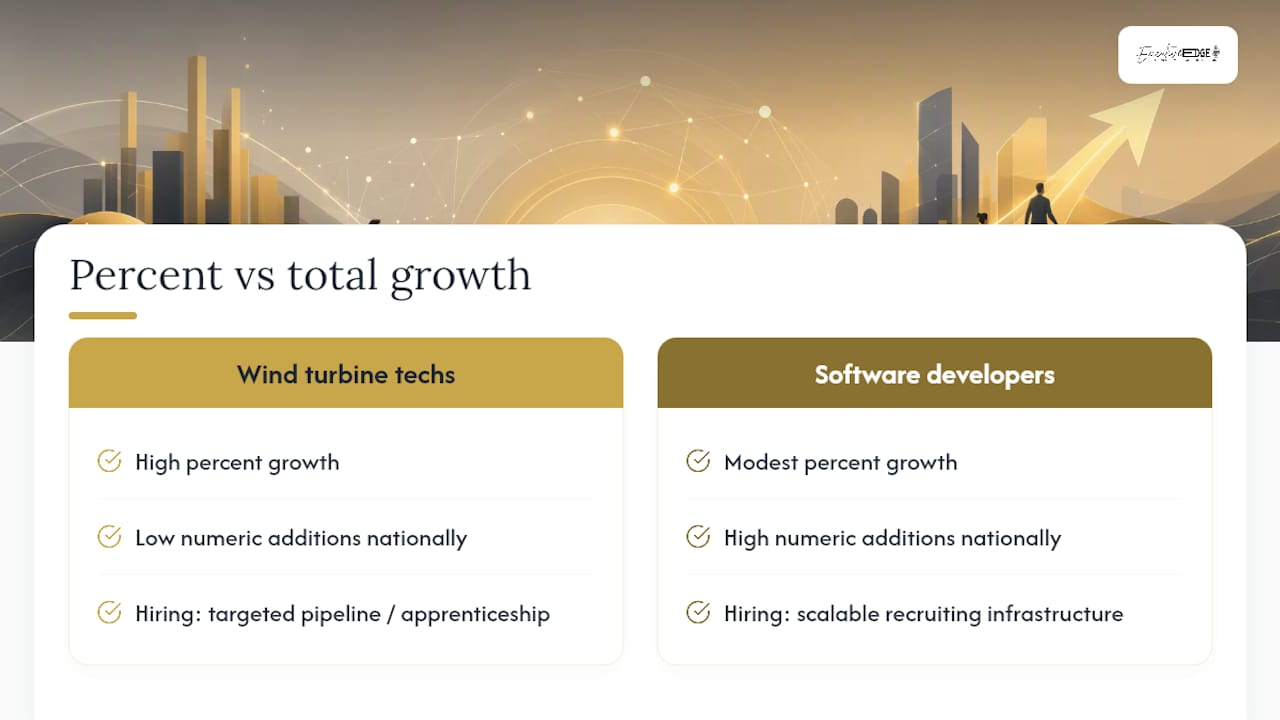
A role can rank near the top of the percent-growth list, like wind turbine technicians, while adding a small total number of jobs nationally. A role can rank lower on the percent-growth list, like software developers, while adding a much larger number of total positions because the existing workforce is so large. The BLS maintains separate tables for each measurement specifically because conflating them leads to bad conclusions.
For a hiring manager, this distinction changes strategy. A high-percent, low-volume role signals a niche market worth a targeted pipeline, maybe an apprenticeship program or a single strong school partnership. A high-volume role, even with modest percent growth, signals you need scalable recruiting infrastructure: a steady pipeline, not a one-time hiring push.
There's also a third factor worth tracking: replacement need. Some occupations show flat growth but constant churn from retirements and turnover, meaning steady hiring demand exists even without expansion. Home health aide roles show this pattern clearly, growing in raw numbers partly because turnover is already high in the existing workforce.
Where Growth Concentrates by Region and Industry
Growth in these occupations doesn't spread evenly across the country. Renewable energy roles cluster where policy incentives and infrastructure investment concentrate: wind corridors in the Great Plains and Texas, solar buildout in the Southwest and Southeast. Healthcare growth, by contrast, tracks population density and aging demographics almost everywhere, which makes it a more geographically distributed opportunity than tech or energy roles.
Information security and data science roles concentrate around existing tech employment hubs, but remote work has loosened that geography considerably compared to a decade ago. A mid-size company outside a major tech corridor can now realistically compete for a data scientist who would have required relocation in the past.
Industry matters as much as geography. Healthcare and social assistance is projected to be the fastest-growing broad industry sector, which means hospital systems, outpatient clinics, and home care agencies are all competing for the same shrinking pool of nurse practitioners and physician assistants simultaneously. That competition drives wages up faster than national averages suggest, so regional pay benchmarking beats relying on a single national median figure.
For employers outside major metro areas, this creates both a challenge and an opening. Fewer competitors chase the same candidate pool locally, but the training infrastructure (nursing schools, technical colleges, apprenticeship programs) may be thinner too, which makes early partnership building even more valuable.
Will Automation Change These Occupations?
Automation and AI reshape these roles rather than eliminate them outright, at least based on current hiring signals. Software development is a useful example: AI coding assistants speed up routine work, but demand for developers who can architect systems, review AI-generated code, and handle complex integration keeps climbing.
Information security shows the same pattern in reverse. AI creates new attack surfaces and new defensive tools simultaneously, so demand for skilled analysts who understand both grows rather than shrinks. Data science itself sits at the center of this shift. Much of the AI boom driving 10.1% growth in computer and mathematical occupations depends on people who can build, train, and audit the models doing the automating.
Healthcare and skilled trades face a different kind of automation exposure. A nurse practitioner's clinical judgment, a wind turbine technician's physical repair work, and a home health aide's caregiving simply resist full automation in ways that routine data entry or basic customer service don't. That's part of why healthcare and renewable energy roles show up so consistently on long-range growth projections. The work requires physical presence or human judgment that current technology can't replicate.
The practical implication for hiring managers: don't assume a growing role today stays static in job description. Build flexibility into role definitions and expect the skill mix, especially for tech-adjacent roles, to shift within a few years of hire.
Career Paths Inside These Growing Fields
Most of these occupations aren't dead-end roles. They function as entry points into longer career ladders that smart employers can use as retention tools.
A home health aide can move toward a licensed practical nurse credential, then toward a registered nurse degree, then potentially toward a nurse practitioner role over several years, with each step raising both skill and pay. A physical therapist assistant can pursue a full doctorate in physical therapy. A data scientist can move into machine learning engineering, AI strategy, or technical leadership roles as the field matures.
Solar and wind technicians often advance into site supervision, project management, or specialized technical roles as renewable energy installations scale up regionally. Information security analysts frequently move into architecture roles, compliance leadership, or independent consulting once they've built a track record.
The common thread: these fields reward staying rather than jumping employer to employer. Employers who make the ladder visible, publishing it, discussing it in interviews, tying it to concrete pay increases, retain talent longer than competitors who leave advancement vague.
Training and Education Paths Worth Knowing
Not every growing role requires a four-year degree, and hiring managers who assume otherwise miss qualified candidates. Solar photovoltaic installers typically train through technical certificate programs, often six months to a year, sometimes paired with an employer-sponsored apprenticeship. NABCEP certification is the recognized industry credential.

Wind turbine technicians usually complete a two-year associate degree program at a technical college, several of which partner directly with wind energy companies for guaranteed placement. Physical therapist assistants follow a similar associate degree path, typically two years, making this one of the fastest, most affordable entry points into healthcare.
Nurse practitioners and physician assistants require significantly more education: a master's degree at minimum, often a doctorate for nurse practitioners, plus clinical hours and licensing exams. This is a multi-year investment, which is exactly why employers who want a steady pipeline need to build relationships with training programs years before they need the graduates.
Data scientists and information security analysts show the widest range of entry paths. Traditional computer science degrees remain common, but bootcamps, self-taught portfolios, and industry certifications increasingly carry real weight in hiring decisions, particularly for employers willing to look past resume pedigree toward demonstrated skill.
Barriers Candidates Still Face Entering These Fields
Growth on paper doesn't mean an easy entry. Healthcare roles requiring advanced degrees, nurse practitioners and physician assistants especially, face bottlenecks in program availability. Competitive admission and limited clinical training slots slow down the pipeline regardless of how much employer demand exists.
Renewable energy roles face a different barrier: geographic concentration. A candidate training as a wind technician in a region without active wind farm development faces a real relocation requirement, which not every candidate can absorb financially.
Tech roles carry their own friction. Data science and information security postings sometimes list credential requirements that outpace what's actually needed for the job, screening out capable self-taught or bootcamp-trained candidates. Cost is a barrier across the board. Even a shorter associate degree program carries tuition and lost wages during training, which keeps some capable candidates out of otherwise accessible fields like physical therapy assisting.
Employers who actively remove these barriers, offering paid apprenticeships, tuition assistance, or flexible remote screening, gain a real advantage over competitors still posting rigid credential requirements into a shrinking candidate pool.
A Hiring Manager's Take on Growth Projections
Prioritize roles that match both your growth horizon and your available resources. A niche, fast-growing role with few total openings deserves a tight pipeline investment, not a broad ad spend. A high-volume role deserves scalable recruiting infrastructure built for the long haul.
For mid-size employers in Tyler and East Texas, this often means partnering early with regional nursing programs and technical colleges rather than competing purely on posted wages against larger metro employers. Audit your open roles against these BLS categories this quarter, then pilot one hiring pipeline around whichever role shows the clearest local training path.
A Practical Next Step for Teams Short on Content Capacity
Turning growth data into hiring results takes more than a spreadsheet. It takes content candidates actually find: role guides, pay benchmarks, and career-path pages that show up when someone searches for exactly the job you're trying to fill. Executive Edge Partner Group builds that content as a fully managed system, producing the podcast episodes, videos, and search-optimized pages your recruiting team doesn't have time to write, then distributing it across AI search platforms and traditional channels so it actually gets found.
For a hiring manager juggling open roles and no in-house content team, that's the practical difference: the authority content gets built and published without pulling anyone off their real job. Visit the Executive Edge Partner Group landing page to see how a managed authority-building system fits into your recruiting strategy, and request a plan built around the specific roles you're trying to fill.
Sources
- Employment Projections and Occupational Outlook Handbook News Release - 2024 A01 Results
- LinkedIn: These Are the Fastest-Growing Jobs in the US - Business Insider
FAQ
What does "on the rise" mean in job market data?
It refers to occupations with high projected growth, measured either by percent change or by the total number of new jobs added, and the BLS tracks both measurements separately because they answer different hiring questions.
Which jobs are growing the fastest by percentage?
Wind turbine service technicians and solar photovoltaic installers currently top the BLS fastest-growing occupations list, though their combined job additions stay under 20,000 nationally.
Which occupations add the most total jobs?
Roles like home health aides and software developers add far more total positions than percentage-based leaders because their existing workforce base is much larger.
How far out should employers trust these projections?
BLS projections cover 2024 through 2034 and should be treated as directional guidance, especially for tech roles that are more sensitive to investment cycles than structurally driven fields like healthcare.
Can content marketing help attract candidates for these roles?
Yes. Role guides, career-path pages, and short videos built around real search intent consistently outperform standard job postings, and services like Executive Edge Partner Group's authority-building system can produce and distribute that content for teams without in-house resources.