

Multi channel publishing means creating one core piece of content and adapting it into the formats each platform actually rewards, so a single idea reaches readers on the channels where they already spend time. The aim is not more content. It's more reach per asset, with less rework.
Start here, in this order:
- Pick one core asset you already trust, like a cornerstone blog post, a podcast episode, or a client-facing explainer, and treat it as the source of truth for everything else.
- Map your top three channels based on where your actual audience shows up, not where you feel you're "supposed" to post.
- Choose one automation or scheduling tool to handle distribution before you add a second or third channel.
One distinction matters before you go further: multichannel publishing is about maximizing reach by putting adapted content everywhere your audience might be. Omnichannel is a tighter promise, that the experience feels connected and consistent no matter which channel someone uses to find you. Most teams should master multichannel first.
Table of Contents
- What Is Multi Channel Publishing?
- Core Components And Architecture Behind Multichannel Systems
- Why Teams Adopt Multi Channel Publishing
- How To Implement A Multi Channel Publishing Program Step By Step
- Turning One Asset Into Many: The Content Transformation Matrix
- Tools And Platforms For Multi Channel Publishing
- KPIs And Attribution Across Channels
- Timelines And Cost Considerations For Multichannel Programs
- Real Examples Of Multi Channel Publishing In Action
- A Practical Weekly Workflow For Small Teams
- Common Pitfalls In Multi Channel Publishing (And Quick Fixes)
- What Actually Matters When You're Starting Out
- How A Done For You Service Accelerates Multichannel Publishing
- Sources
- FAQ
What Is Multi Channel Publishing?
Multi channel publishing is the practice of producing content once and distributing adapted versions of it across multiple platforms, print, web, apps, social, and email, so the same core message reaches audiences wherever they consume information. WoodWing's guide to enterprise publishing notes that this practice has become the default for enterprise publishers, not an optional add-on.
The technical foundation behind this is structured content, sometimes called a content model. Instead of writing a blog post as one long formatted document, you break it into modular pieces: a headline, a summary, key statistics, a quote, an image, a call to action. Each piece lives as its own field, tagged with metadata, stored independently of any single layout. This separation of content and formatting is what lets the same paragraph appear as a blog intro, an email subject line, and a video script without three separate writing sessions. Contentstack's research on structured content identifies this modeling work as the single biggest factor in whether a multichannel program scales or collapses under its own maintenance load.
Two terms worth knowing before you go further:
- Content model: the blueprint that defines what fields and components make up a piece of content, independent of how it's displayed.
- COPE (Create Once, Publish Everywhere): a publishing philosophy, popularized in newsroom technology circles, where content is authored once in a structured format and pushed to many outputs through automation rather than manual reformatting.
Multichannel vs. omnichannel, in one line: multichannel is about being present on many platforms with adapted content; omnichannel is about making those platforms feel like one continuous, personalized experience. You can run a strong multichannel program without full omnichannel integration, but you can't run omnichannel without multichannel infrastructure underneath it.
A large share of all web traffic now arrives from phones rather than desktops, according to Statista's tracking of mobile traffic share. That single fact should shape how you write every headline and crop every image, because a channel strategy that assumes desktop reading habits is already out of step with how most people encounter your content.
Core Components And Architecture Behind Multichannel Systems
The architecture behind reliable multichannel publishing has six moving parts, and skipping any one of them is usually why programs stall after the first few months.
- Content model: your structured blueprint (fields, components, relationships) that separates raw content from its eventual layout.
- Headless CMS or CMS-plus-API setup: a system that stores content as data and delivers it to any channel through an application programming interface, rather than baking it into one website template.
- Digital asset management (DAM): a central library for images, video, and audio files, tagged so the right asset gets pulled automatically for the right channel.
- Workflow and orchestration tools: the layer that routes a piece of content through drafting, review, approval, and scheduled release across channels.
- Format-specific templates: pre-built shells for each channel (email template, LinkedIn carousel template, YouTube description template) that pull from the content model automatically.
- Analytics and attribution tracking: the measurement layer that ties channel-level performance back to business outcomes.
Before you build anything, run your content through a model checklist: does each asset have a clearly defined headline field, a summary field capped at a usable length, a metadata block (author, date, topic tags), a media reference, and a relationship link back to related content? If you can't answer yes to all five, your "content model" is really just a folder of Word documents with extra steps.
Picture the flow this way: an editor authors content once inside the structured system. That content gets validated against the model, then a variant-generation step (manual or automated) trims, reframes, or reformats it for each channel. Channel adapters, which might be as simple as a scheduling tool's API connection, push the adapted variant into a publishing queue. Analytics then pulls performance data back into a shared dashboard.
| Component | Owned by | Primary job |
|---|---|---|
| Content model | Content strategist / editor | Define structure once, reuse everywhere |
| DAM | Designer / marketing ops | Store and tag reusable media assets |
| Workflow tool | Editor / project lead | Route drafts through approval stages |
| Templates | Channel owner | Convert structured content into platform-ready output |
| Analytics | Whoever owns reporting | Track performance and feed back into planning |
PublishOne's breakdown of multichannel operations makes a point worth repeating here: centralizing the workflow and DAM is what actually reduces the operational drag most teams blame on "not having enough content."
Why Teams Adopt Multi Channel Publishing
Teams move to multichannel publishing because it multiplies the return on content they're already producing, not because it's trendy. Four outcomes show up repeatedly once a program matures: wider reach, message consistency, real efficiency gains from reuse, and reduced dependency on any single platform's algorithm.
- Reach: adapting one asset for five channels reaches audience segments that never would have found the original format.
- Consistency: a shared content model keeps messaging aligned even when five different people are posting to five different platforms.
- Efficiency through reuse: instead of five separate writing projects, teams produce one deep asset and several lighter adaptations, cutting total production hours.
- Diversified revenue and risk reduction: a platform algorithm change or account suspension doesn't wipe out your entire content pipeline if you're not dependent on one channel.
The mobile-traffic reality mentioned earlier isn't just a design detail, it's a business risk. If most of your audience is scrolling on a phone and your multichannel plan only accounts for desktop-optimized blog posts, you're optimizing for a shrinking slice of your own traffic. HubSpot's research on multi-channel content distribution frames this as a reach problem first: content has to be adapted to the format and habits of each platform, not just copy-pasted across them.
Practically, this shows up as larger addressable audiences (a podcast clip reaches people who'd never read a blog), fewer rework hours (one content model instead of five separate drafts), and more channels generating measurable business value instead of one channel carrying the whole load.
How To Implement A Multi Channel Publishing Program Step By Step
The right sequence is Plan, Model, Build, Publish, then Measure, and skipping straight to "Publish" is the single most common reason programs feel chaotic within a month.
- Plan: Define your audience segments, top three channels, and success metrics. Deliverable: a one-page channel priority brief. Owner: strategist or business owner.
- Model: Build your content model, define fields, tags, and relationships. Deliverable: a documented content model template. Owner: editor or content lead.
- Build: Set up your CMS or content hub, connect your DAM, and build channel-specific templates. Deliverable: a working publishing pipeline for at least two channels. Owner: technical lead or agency partner.
- Publish: Run your first content cycle, one core asset transformed into three to five channel variants. Deliverable: a published multichannel campaign. Owner: whole team.
- Measure: Track engagement and conversion by channel, then adjust cadence and format mix. Deliverable: a first-cycle performance report. Owner: whoever owns analytics.
A realistic first attempt runs 60 to 90 days:
- Weeks 1 to 2: Audience research and channel selection. Lock the top three channels.
- Weeks 3 to 5: Build the content model and templates. This is the slowest phase, and rushing it is the most expensive mistake you can make.
- Weeks 6 to 8: Publish your first two or three core assets and their adaptations. Watch for approval bottlenecks.
- Weeks 9 to 12: Review performance, refine your transformation rules, and decide whether to add a fourth channel.
To choose your top channels, weigh three things: where your specific audience already spends attention, what format your team can realistically produce on a recurring basis, and which channel has the lowest cost of experimentation. A consulting firm targeting other businesses might prioritize LinkedIn and email over TikTok. A local service business might prioritize YouTube and Google Business Profile content over a podcast. There's no universal ranking, only the ranking that fits your actual audience.
Turning One Asset Into Many: The Content Transformation Matrix
A transformation matrix is the single most useful tool in a multichannel program, because it forces you to decide in advance exactly how a core asset becomes five different things instead of improvising each time.
| Channel | Recommended format | Target length | Primary CTA | Adaptation notes |
|---|---|---|---|---|
| Blog / website | Long-form article | around 1,800 words | Read related post / subscribe | Keep structure and depth; this is usually your source of truth |
| Email newsletter | Summary with one key insight | 200 words | Click through to full article | Lead with the single most useful takeaway, not a recap |
| Carousel or text post | five slides | Comment or connect | Reframe as a numbered insight, not a summary | |
| Instagram / short video platforms | 30 to 60 second video clip | Under 60 seconds | Watch full episode / visit link in bio | Pull the single most quotable or surprising moment |
| Podcast | Full episode or clipped segment | 15 to 45 minutes | Subscribe / listen to full episode | Often the source asset itself, not the adaptation |
The rule for what to keep verbatim versus what to rewrite is straightforward: statistics, direct quotes, and specific numbers should never change between channels, because inconsistency there damages credibility. Everything else, tone, length, structure, framing, should be rebuilt around what that platform's audience expects.
Three worked examples show how this plays out:
- A 1,800 word article on hiring mistakes becomes a 200 word email summary highlighting the single costliest mistake, which becomes a LinkedIn carousel breaking down all five mistakes as separate slides, which becomes a 45 second video clip of the founder explaining mistake number one on camera.
- A client case study becomes a one-paragraph email testimonial, a before-and-after Instagram post, and a podcast segment where the founder walks through the project in their own words.
- A podcast episode about local market trends becomes a blog transcript with added statistics, a short audiogram clip for social, and a newsletter recap sent to past clients. Guidance on repurposing pillar content into channel-specific assets covers this exact pattern in more depth.
Tools And Platforms For Multi Channel Publishing
The right tool stack depends on your scale, but every stack falls into the same handful of categories: a place to store structured content, a place to store media, a way to route approvals, a way to schedule and publish, and a way to measure results.
- Headless CMS: stores content as structured data and delivers it via API to any channel, ideal for teams that need real flexibility across many endpoints.
- Multichannel CMS: a purpose-built system designed specifically for print-plus-digital or app-plus-web publishing workflows, common in media and enterprise publishing.
- Digital asset management (DAM): central storage and tagging for images, video, and audio.
- Workflow and orchestration tools: manage drafts, approvals, and scheduled releases across a team.
- Social schedulers: queue and publish social content across multiple platforms from one dashboard.
- Analytics and attribution platforms: track performance and tie it back to pipeline or revenue.
- Repurposing and AI tools: automatically generate variant drafts (summaries, clips, captions) from a core asset.
On the required vendors readers should know by name:
- Contentstack is a headless CMS built specifically around structured content and API delivery, and its own case work on multichannel strategy cites brands like the Miami Heat using structured content to push consistent messaging across app, web, and in-arena channels.
- MadCap Flare is best known in technical documentation circles for single-source publishing, ideal if your multichannel need is manuals, help centers, and knowledge bases rather than marketing content.
- WoodWing built its reputation in enterprise print-to-digital publishing, particularly for media companies that still run physical magazines alongside web and app editions.
- HubSpot works well as an all-in-one option for smaller teams that want content management, email, and basic social scheduling without stitching together separate tools.
Selection should come down to five practical questions: how much content volume you're actually producing, how many systems you need this to integrate with, what your budget realistically allows, what skills your team already has, and how fast you need to see a working pipeline. A lean team doesn't need a full headless CMS. A standard CMS paired with a scheduling tool and a documented content model checklist can produce genuine multichannel results well before a purpose-built platform becomes worth the investment.
KPIs And Attribution Across Channels
Three metrics matter before any others: reach and engagement by channel, conversion funnel contribution from each channel, and cost per conversion or attribution-weighted pipeline value. Everything else is detail work layered on top of those three.
Attribution gets complicated fast because a reader might see a LinkedIn post, click through from an email two weeks later, and convert after finding you organically on Google. Three models handle this differently:
- Last-touch attribution gives full credit to the final channel before conversion. Simple to set up, but it systematically undervalues awareness-stage channels like social and podcast content.
- Multi-touch attribution splits credit across every touchpoint in the journey. More accurate, but requires connected tracking across channels, which many small teams don't have set up yet.
- Algorithmic attribution uses statistical modeling to weight each touchpoint by its actual contribution to conversion. Most valuable at scale, largely impractical for a small team without dedicated analytics support.
Most individuals and small teams should start with last-touch tracking for simplicity, then graduate to multi-touch once they have enough volume across channels for the data to mean something.
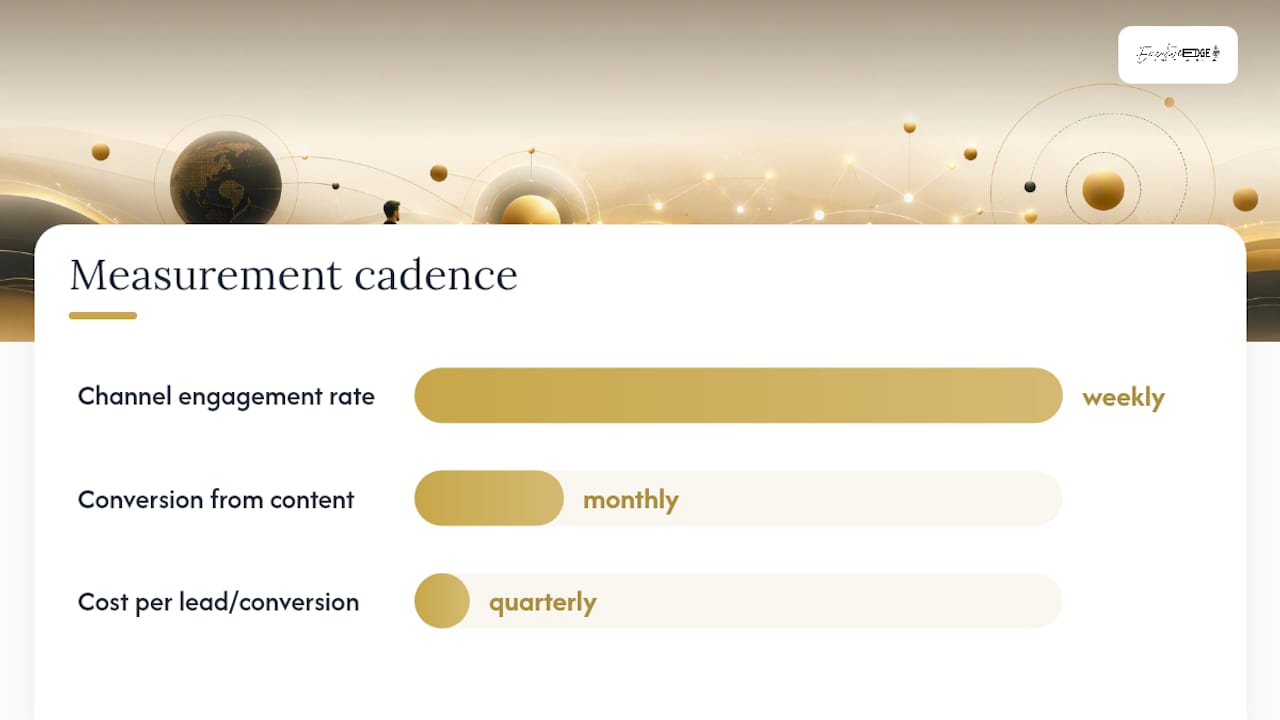
A working measurement checklist: track engagement rate per channel weekly, track conversion rate from content to lead monthly, track cost per lead or cost per conversion by channel quarterly, and review which channel-format combinations are underperforming enough to cut. Run this as a simple cycle: form a hypothesis about what might improve a channel's performance, test one change at a time, and iterate based on what the data actually shows rather than what you assumed going in.
Timelines And Cost Considerations For Multichannel Programs
Plan for about one to three months to reach your initial multichannel publishing milestone, with ongoing monthly costs depending on team size and the complexity of tools used.
| Phase | Weeks | Key deliverable |
|---|---|---|
| Plan | 1 to 2 | Channel priority brief, audience segments defined |
| Model | 2 to 4 | Documented content model, field structure, tagging system |
| Build | 3 to 5 | Working CMS/DAM setup, at least two channel templates |
| Pilot | 2 to 3 | First core asset published across three to five channels |
| Scale | Ongoing | Additional channels added based on pilot performance |
Where to spend and where to save matters more than the total budget figure. Invest real time and money in the content model and DAM setup, because those two pieces are what let every future channel addition go faster instead of slower. Save on templates in the early stage, a simple, clean template beats an elaborate custom-built one you'll redesign after the first few publishing cycles anyway. Most costs in a lean setup go toward people's time (content creation, editing, technical setup) rather than software licenses, especially before you scale past a handful of channels.
Real Examples Of Multi Channel Publishing In Action
A regional publisher facing declining print subscriptions shifted its reporting team to a structured content model, converting each story into web, app, and email newsletter formats from a single draft. The multichannel approach opened a new digital subscription revenue stream that hadn't existed under the print-only model. WoodWing's enterprise publishing guide notes that unlocking archival print content for digital reuse is a common early win, though it usually requires upfront investment in tagging or markup work before the payoff shows up.
A B2B consulting firm relying entirely on referrals started publishing one long-form insight article per month, then adapting it into a LinkedIn carousel, an email to past clients, and a short video clip of a partner explaining the core idea. Within two quarters, inbound inquiries citing specific published content became a measurable share of new business conversations, a channel that hadn't existed before.
A local home services business posting inconsistently on one social platform restructured around a weekly core asset, a short video answering one common customer question, then repurposed it into a blog post, an email tip, and a Google Business Profile update. Engagement on their local social content increased noticeably once the format matched what that specific platform's audience actually engaged with, rather than reposting the same static graphic everywhere.

The lesson that carries across all three: the structural investment (a content model, a repeatable transformation process) pays off before the channel count does. Add channels after the system works, not before.
A Practical Weekly Workflow For Small Teams
A one to three person team can run a real multichannel program on a weekly cadence without hiring a content department. Here's what that actually looks like in practice.
Monday, the team lead drafts or records the core asset, an article, a podcast segment, or a video, based on the week's topic. Tuesday, that core asset gets broken into its structured components: headline, key stat, quote, summary. Wednesday, a designer or the same person using templates converts those components into channel-specific drafts, the email version, the social carousel, the short video clip. Thursday, everything gets reviewed against the content model checklist and scheduled through a publishing tool. Friday, the team checks the prior week's performance data and adjusts the following week's topic or format mix accordingly.
Pro Tip: Build your content in reusable blocks from the start, a standalone stat, a standalone quote, a standalone summary, rather than one solid paragraph. When something needs updating later, you edit one block instead of rewriting five separate channel versions from scratch.
Executive Edge Partner Group works inside exactly this gap. A small team can handle drafting and platform posting on its own, but most owners run out of time or expertise for the parts that make a program actually compound: the content modeling, the AI-assisted repurposing across formats, the consistent publishing cadence across five or more channels, and the performance tracking that tells you what's working. That's the specific piece a done-for-you system is built to carry.
Common Pitfalls In Multi Channel Publishing (And Quick Fixes)
Most multichannel programs don't fail because of a bad idea. They fail because of a handful of predictable operational mistakes.
- Pitfall: no content model, just formatted documents. Fix: build a basic structured template (headline, summary, stat, quote, media) before publishing your next piece.
- Pitfall: adding too many channels too soon. Fix: prove the system works on two or three channels before adding a fourth.
- Pitfall: siloed approvals where each channel owner works independently. Fix: route every piece through one shared review step before it's adapted for any channel.
- Pitfall: poor or missing metadata and tagging. Fix: require at minimum a topic tag, a date, and an author field on every asset before it enters the queue.
- Pitfall: treating every channel adaptation as a fresh writing project. Fix: use the transformation matrix so adaptation is a defined process, not a blank page every time.
A short pre-launch readiness check: do you have a documented content model, a defined top three channels, an assigned owner for approvals, and a baseline metric you'll check after 30 days? If any answer is no, fix that before your first publish, not after.
What Actually Matters When You're Starting Out
The mistake I see most often isn't picking the wrong channels, it's building channel-specific habits before building the structural foundation underneath them. Teams jump straight to "we need a TikTok strategy" without first deciding what their core content actually is and how it gets broken into reusable pieces. That's backwards. Get the content model right, even a simple one, before you worry about which platform's algorithm you're chasing this quarter.
This is something we see consistently with business owners around Tyler and East Texas: the ones who succeed at multichannel publishing usually start narrow, often just two or three channels that fit how their actual customers search and scroll, rather than trying to be everywhere at once from day one. A contractor doesn't need a podcast and a newsletter and a TikTok presence simultaneously. They need one solid core asset a week and a repeatable way to adapt it.
If you're starting from zero, run one pilot: pick one asset, adapt it for three channels, measure what happens after 30 days, then decide what to add next.
How A Done For You Service Accelerates Multichannel Publishing
Building the content model, the templates, and the publishing cadence described throughout this guide takes real time, and most business owners don't have a spare 10 to 15 hours a week to run it themselves on top of running their actual business. A done-for-you system closes that gap by handling the structural and production work while you stay focused on the expertise that makes the content worth publishing in the first place.

Executive Edge Partner Group's Authority Engine is built around exactly the workflow this article walks through, minus the part where you have to build it yourself. The service typically includes:
- Weekly content production, from podcast episodes to blog articles, built around your actual expertise.
- Format-specific repurposing into short-form video, social posts, and email content from each core asset.
- Publishing orchestration across multiple channels on a consistent schedule.
- SEO, generative engine optimization, and answer engine optimization work so content surfaces in both traditional and AI-driven search.
- Ongoing performance tracking so you know which channels and formats are actually earning attention.
For business owners in Tyler and East Texas who'd rather hand off the production and publishing mechanics than build them in-house, Executive Edge Partner Group's service page is the place to see how the done-for-you model works and get a sense of what a first 90-day rollout would look like for your business.
Sources
- Multi-channel content distribution: How to scale content reach in the era of Loop Marketing
- Multichannel publishing: Strategies, best practices and the role of structured content
- Multichannel publishing explained – what, why, and how to do it right
- Share of website traffic coming from mobile devices
FAQ
What is an example of multichannel marketing?
A company publishing the same product launch as a blog post, an email announcement, a LinkedIn carousel, and a short video clip is running multichannel marketing, adapting one message across several platforms rather than posting identical content everywhere.
What does "multi channel" mean?
Multi channel means reaching an audience through more than one platform or format, such as web, email, social media, and video, using content adapted to fit each one rather than a single identical piece pushed everywhere.
What are the benefits of multichannel publishing?
The core benefits are wider audience reach, more consistent messaging across platforms, greater efficiency from reusing one core asset, and reduced risk from depending on a single channel or algorithm.
What is multi-channel marketing?
Multi-channel marketing is the strategic use of several distribution channels, like email, social platforms, search, and content marketing, to reach and engage an audience, with each channel carrying content adapted to that platform's format and audience habits.
How do I know which channels to prioritize first?
Start with where your specific audience already spends attention and what format your team can realistically produce on a recurring basis; most individuals and small teams do best focusing on two or three channels before expanding further.