

LLM SEO means structuring content so AI systems like ChatGPT, Perplexity, and Google's AI Overviews can find it, extract it, and cite it as a source in generated answers. The highest-leverage move is writing self-contained, front-loaded passages while ensuring AI crawlers can reach your pages. Everything else, from schema markup to publishing cadence, builds on that foundation.
Table of Contents
- What Is LLM SEO, and How Is It Different From Traditional SEO?
- How Do LLMs Decide What to Cite?
- Priority Tactics to Earn AI Citations
- Technical Requirements: Is Your Site Even Eligible?
- How Do You Measure Whether LLM SEO Is Working?
- How an Authority Content System Puts This Into Practice
- The Citation-First Mindset Most Teams Get Wrong
- Get Cited Faster With a Done-For-You Authority System
- Where to Go Deeper
- Sources
- FAQ
What Is LLM SEO, and How Is It Different From Traditional SEO?
LLM SEO goes by a few names: Generative Engine Optimization (GEO) and Answer Engine Optimization (AEO) both describe the same underlying shift. Instead of optimizing for a ranked list of blue links, you're optimizing to be the source an AI model pulls from when it writes an answer. Search Engine Land's GEO framework reframes success around citations and mentions inside AI-generated answers, not clicks or rank position.
The unit of value has changed too. Traditional SEO optimizes the page. LLM SEO optimizes the passage, sometimes a single sentence or a 60-word block that answers one specific question cleanly enough to lift out of context.
That difference dictates format. Content built for extraction tends to share a few traits:
- Short, self-contained paragraphs that make sense without the surrounding article
- Front-loaded claims, where the answer comes in the first sentence, not the third paragraph
- Lists and tables that break comparisons into discrete, quotable units
- Descriptive headings phrased as the questions readers actually type
None of this replaces keyword research or backlinks. It sits on top of them, targeting a retrieval system instead of a ranking algorithm.
How Do LLMs Decide What to Cite?
Most AI search tools rely on retrieval-augmented generation, or RAG: the model searches an index, pulls the most relevant passages, and synthesizes an answer from those fragments. Google's own generative AI guidance confirms the search index functions as the retrieval layer, meaning a page has to be indexed and technically eligible before it can ever be considered.

Once a page clears that bar, extractability decides whether it gets pulled. A paragraph that states a fact, defines a term, or answers a question in isolation, without requiring the reader to have absorbed three prior paragraphs, is far easier for a model to lift cleanly. Comparison tables and structured lists perform especially well here, since they already exist as discrete, citable units.
Engines don't behave identically, though. A multi-engine citation benchmark from LoudFace found owned company pages account for roughly half of all citations, but the remaining share splits differently by platform: ChatGPT pulls more from user-generated sources like Reddit, Perplexity leans toward editorial and journalistic content, and Google AI Overviews skews most heavily toward corporate and brand-owned pages. If you're only optimizing for one engine's preferences, you're leaving citation share on the table for the other two.
Priority Tactics to Earn AI Citations
Not every tactic here carries equal weight. Some move the needle fast; others are longer plays that compound. Here's the order that tends to produce results first.
- Write extractable answer blocks. Aim for 40 to 80 words that fully answer one question, placed directly under a heading phrased the way someone would ask it out loud.
- Publish original data. Research from RampIQ found original research and first-party data can lift citation likelihood by 30 to 40 percent, because a model has nowhere else to pull a unique statistic from except the source that generated it.
- Build entity clarity. Keep your brand name, author names, and organizational details consistent everywhere: your About page, your schema markup, your bylines. Inconsistent naming confuses the disambiguation process models rely on.
- Pursue earned mentions. Getting cited in trade publications, forums, and documentation sites feeds the same UGC and editorial pools that Perplexity and ChatGPT draw from heavily.
- Structure comparisons for extraction. If you're writing a listicle or head-to-head comparison, use consistent formatting across entries: a stat, a differentiator, a caveat. That consistency helps a model pull individual entries without losing context.
- Publish on a predictable cadence. Freshness signals matter to retrieval systems the same way they matter to traditional crawlers. A blog that goes quiet for six months looks less authoritative than one publishing weekly.
Pro Tip: Before writing a new article, audit your three highest-traffic existing pages first. Restructuring proven content for passage retrieval usually beats writing net-new content, since you're not starting from zero on backlinks or domain trust.
The through line across all six tactics is specificity. Vague, generalized paragraphs don't get cited because they don't answer anything precisely enough to lift. A sentence that names a number, a method, or a named standard will beat three paragraphs of context every time.
Technical Requirements: Is Your Site Even Eligible?
Before any of the content tactics above matter, your site has to be reachable and readable by AI crawlers in the first place. This is the part teams skip, and it's the part that silently disqualifies otherwise excellent content.
Start with the basics that Google explicitly ties to generative AI eligibility. Its own AI optimization guidance states plainly that pages must meet core indexing and crawlability requirements before they're even considered for generative features, and it specifically warns against chasing mechanical shortcuts instead of technical accessibility.
Run through this list before touching content strategy:
- Confirm your
robots.txtisn't accidentally blocking AI crawlers like GPTBot, PerplexityBot, or Google-Extended. - Check server logs for AI crawler hits. A pattern of visits from these user agents tells you a page has entered the retrieval candidate pool.
- Implement Article, Organization, Author, and FAQ schema using Schema vocabulary, then validate with Google's Rich Results Test.
- Consider an
llms.txtfile as an optional mapping convenience. It's not an enforced standard yet, and Google's guidance treats it as one option among many, not a requirement. - Keep core performance fundamentals solid: page speed, mobile usability, and HTTPS. None of this is AI-specific, but a slow or broken page won't get crawled reliably by anything.
How Do You Measure Whether LLM SEO Is Working?
Traditional analytics don't capture citations well, so measurement has to lean on a different set of signals, and being honest about what you can and can't track matters here.
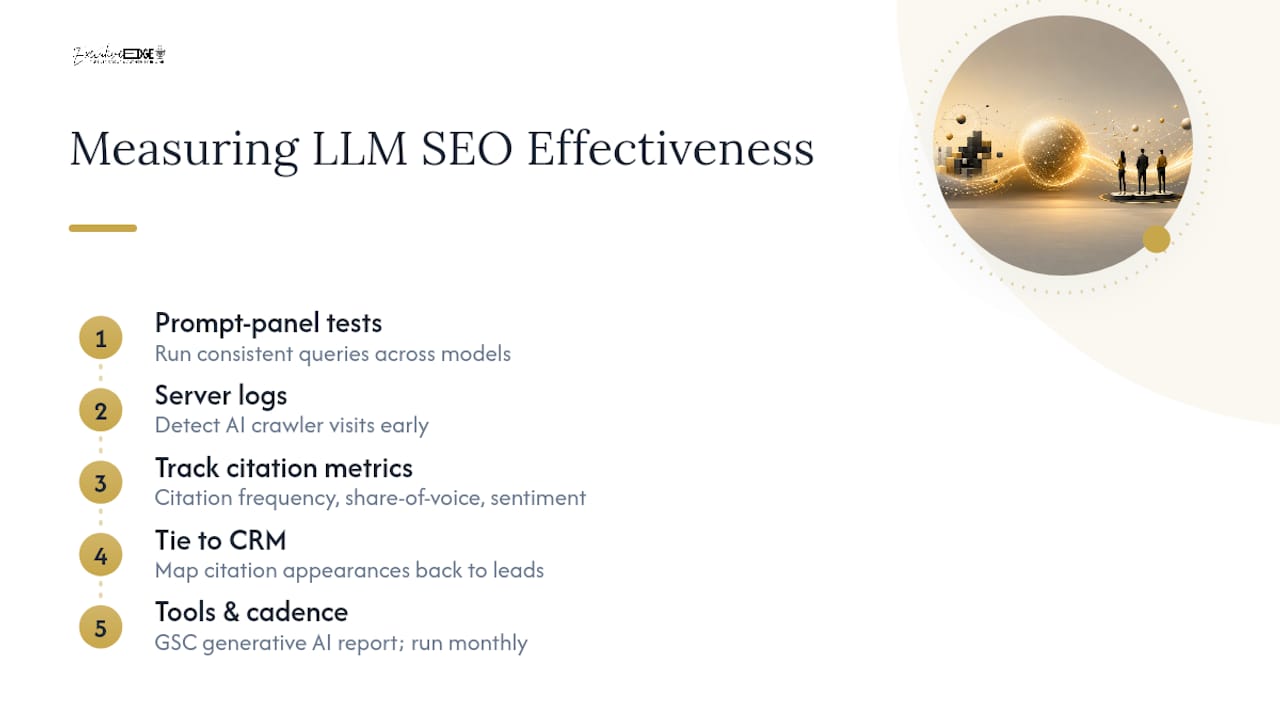
Start with prompt-panel testing: run a consistent set of questions across ChatGPT, Perplexity, and Google AI Overviews on a regular schedule, logging which sources get cited and how often your domain appears. Build a simple spreadsheet template so the comparison is apples to apples over time.
Server logs remain the earliest, highest-fidelity signal. If AI crawler visits show up in your logs, a page has entered the candidate pool for citation, well before you'd see it reflected in any prompt test. From there, track citation frequency and share-of-voice against competitors mentioned in the same answers, along with basic sentiment (is the AI describing you accurately?). Where possible, tie citation appearances back to CRM-tracked leads to see if visibility is translating into pipeline.
For tooling, Google Search Console's generative AI report is a starting point, supplemented by dedicated AI visibility platforms built specifically for prompt tracking. Run this measurement monthly at minimum. Teams building out a fuller framework can reference this guide to AI search optimization for a more detailed measurement cadence.
How an Authority Content System Puts This Into Practice
Most businesses read a checklist like the one above and immediately hit a wall: who actually writes and publishes this every week? That's the operational gap Executive Edge Partner Group's Authority Content System is built to close.
The model starts with a single recording session. A business owner or executive sits down once, and that session gets transformed, using voice cloning technology, into a full week of content across podcast, video, blog, and social formats. Every output carries consistent entity signals: the same author name, the same organizational details, structured with named-author bylines that feed directly into the entity clarity search engines and AI models both reward.
That weekly cadence solves the freshness problem outlined earlier, and the structured, multi-format output naturally produces the extractable passages, headings, and comparison-ready content LLMs favor. It's a direct operational answer to a strategy that otherwise demands a full content team.
The Citation-First Mindset Most Teams Get Wrong
Most advice on this topic treats LLM SEO like a bag of tricks: sprinkle in an llms.txt file, add some schema, hope for the best. That framing misses the point entirely. The research is consistent on this: extractability and technical eligibility matter more than any single tactic, and Google's own guidance explicitly warns against chasing shortcuts instead of fixing the fundamentals.
The bigger mistake I see is treating LLM SEO as separate from everything else a content team already does. It isn't. It's traditional SEO with a sharper focus on passage-level clarity and a new set of signals to track, server logs, prompt-panel results, citation frequency, instead of pretending click-through rate tells the whole story anymore.
If you're prioritizing one thing first, prioritize structure over volume. A single well-structured page that answers a specific question in 60 words will outperform ten sprawling articles that never quite state anything cleanly. Fix your top three pages before you write a fourth.
— David Domm
Get Cited Faster With a Done-For-You Authority System
A done-for-you authority content system can be an alternative to hiring an in-house content team or a traditional agency retainer for LLM SEO: one recording session becomes a full week of citation-ready content across every channel, without you writing, filming, or recording anything else. The Authority Content System handles the podcast episodes, blog articles, YouTube videos, and social clips that extractability and entity clarity both depend on, built around consistent author and organization signals from day one.

This is something we see consistently with business owners across East Texas. The strategy isn't the hard part, the weekly execution is. If you're a consultant, attorney, contractor, or local business owner in Tyler or anywhere else who wants to show up in AI-generated answers without becoming a full-time content producer, visit the Authority Content System landing page to see how the onboarding process works and whether it fits your situation.
Where to Go Deeper
Start with Google's AI optimization guide and Schema.org's documentation for technical grounding. For structured-data validation workflows, Seerm's guide to testing tools is a solid next step.
Sources
- How Search works with generative AI / AI optimization guide — Google Developers
- Schema
- B2B SaaS AI-Citation benchmark — LoudFace
FAQ
What Is LLM in SEO?
LLM in SEO refers to large language models, the AI systems behind ChatGPT, Perplexity, and Google AI Overviews, that retrieve and cite web content when generating answers. LLM SEO is the practice of structuring content so those systems can find and quote it.
What Is the Difference Between Traditional SEO and LLM SEO?
Traditional SEO optimizes whole pages to rank in a list of links; LLM SEO optimizes individual passages to be extracted and cited inside an AI-generated answer. They share technical foundations like crawlability and schema, but measure success differently: rankings and clicks versus citations and share-of-voice.
Which LLM Is Best for SEO?
No single engine is "best," since each favors different sources: benchmarks show ChatGPT pulls more from user-generated content like Reddit, Perplexity favors editorial sources, and Google AI Overviews leans most heavily on corporate-owned pages. A strong LLM SEO strategy targets extractability broadly rather than optimizing for just one platform.
Is SEO Going Away Because of AI?
No. Google's own guidance confirms its search index still functions as the retrieval layer behind generative AI features, meaning pages must meet core SEO fundamentals, crawlability, indexing, technical accessibility, before they're even eligible to be cited. LLM SEO extends traditional SEO rather than replacing it.