

An AI search readiness audit tests whether your site's technical setup, content structure, and existing citation footprint let large language models find, trust, and quote you. It scores three pillars, visibility, technical access, and content extractability, into a prioritized fix list. Most sites need only hours for the quick wins. For business owners in Tyler and East Texas, that usually means starting with a robots.txt check and adding FAQ schema before touching anything else.
Table of Contents
- What Should an AI Visibility Audit Actually Measure?
- Is Your Robots.txt File Blocking AI Crawlers?
- Why Do LLMs Ignore Well-Written Pages?
- How Do You Score AI Search Readiness?
- What Should You Fix First, and What Can Wait?
- When Does a Managed Authority System Make Sense?
- Is Your Data Actually Ready for AI to Cite?
- What Privacy Rules Apply to AI Search Visibility?
- Which AI Search Platforms Can You Actually Integrate With?
- Does Your Content Actually Answer What People Are Asking?
- Who Should Own Each Part of the Audit?
- The Real Lesson From Running These Audits
- Ready to Move Beyond the DIY Checklist?
- Sources
- FAQ
What Should an AI Visibility Audit Actually Measure?
Citations are the currency of AI search. Every time ChatGPT, Perplexity, or Gemini names your brand or links your page in an answer, that's a citation, and counting them is step one of any real audit.
But raw citation count is a weak metric on its own. Position matters more. A source cited first in an AI answer carries roughly full weight, a source cited second carries about half, and by the third or fourth mention the value drops off fast. That's why serious audits use position-weighted visibility instead of a flat count: rank 1 scores 100%, rank 2 scores 50%, and so on down the list. Share of voice, your weighted visibility divided by the total category visibility across all cited competitors, tells you where you actually stand.
Sentiment is the piece most teams skip, and it's the one that can bite you. A data-backed readiness framework from Trakkr shows that crawler access, extractable content, and entity clarity drive citation success, but citation volume without sentiment review can mask a real problem. If AI engines are citing you next to negative framing, more citations just means more exposure to the wrong narrative.
Here's the manual check you can run today:
- Pick 10 prompts a real customer would type into an AI assistant about your category
- Run each one across ChatGPT, Perplexity, and Gemini
- Record the first three sources cited in each response
- Note whether your brand's mention reads positive, neutral, or negative
Is Your Robots.txt File Blocking AI Crawlers?
This is the single most common failure point, and it's almost always an accident. A Trakkr analysis found that blocking AI-specific crawlers like GPTBot, PerplexityBot, and ClaudeBot in robots.txt ranks among the most frequent, and most fixable, issues on first audit. Security plugins often ship with a default rule like User-agent: * Disallow: / that blanket-blocks everything, including the bots you want visiting.
Run through this sequence:
- Pull up yoursite.com/robots.txt and check for blanket disallow rules or bot-specific blocks
- Decide which crawlers you want indexing versus training on your content: allow OAI-SearchBot and PerplexityBot for live retrieval, and weigh whether GPTBot's training-data use fits your content strategy
- Load your key pages with JavaScript disabled to confirm the content that matters actually renders without it
- Check your XML sitemap for completeness and accurate last-modified dates
- Open Google Search Console and verify your priority pages are indexed and snippet-eligible, since Google's own documentation confirms AI Overviews and AI Mode eligibility depends on the same indexing and snippet standards as regular Search
Most of these fixes take hours, not weeks. A blocked crawler rule can be reversed in minutes; sitemap resubmission and re-crawling typically show up in Search Console within a few days.
Pro Tip: Test your robots.txt from an incognito browser or a plain text fetch, not through your CMS preview. Some page builders serve a different robots file to logged-in sessions than they do to real crawlers, and you won't catch the block until it's already cost you visibility.
Why Do LLMs Ignore Well-Written Pages?
Because the answer isn't at the top. Analysis from Scale Theory shows large language models extract disproportionately from roughly the first 30% of a page's text, which means a well-researched page that opens with three paragraphs of background before answering the question loses to a thinner page that answers in sentence one.
The first-30% effect is the single biggest lever most content teams aren't pulling. Rewrite your most important pages so the opening one to three sentences directly answer the implied question, then follow with supporting detail, sourcing, and nuance.
Structured data reinforces what the answer-first text already says. Prioritize:
- Organization schema so entity details are unambiguous
- Article schema with clear author and date fields
- FAQPage schema on any page answering direct questions
- HowTo schema for process content
Validate every schema block with Google's Rich Results Test, and make sure the marked-up text also appears visibly on the page. Schema that contradicts visible content is a trust signal AI engines penalize.
Entity clarity closes the loop: use the same business name, the same author name with a real bio, and consistent in-text citations to authoritative sources on every page. A traditional paragraph might read, "Our team has helped many clients improve their online presence over the years." An extractable version reads: "Executive Edge Partner Group's clients typically see AI citation gains within weeks of implementing answer-first content, according to internal tracking following GEO best practices." One is a vague claim. The other is a claim with evidence attached, which is exactly what an LLM needs to quote you with confidence.
How Do You Score AI Search Readiness?
Build your checklist in three buckets, technical, content, and off-site, and score every item as missing, partial, or complete.
Technical checks:
- Robots.txt allows AI crawlers you want indexing your content
- Key pages render fully with JavaScript disabled
- Sitemap is current and submitted in Search Console
- Priority pages show as indexed with snippet eligibility
Content checks:
- Top pages answer the core question in the first three sentences
- Organization, Article, and FAQPage schema are implemented and validated
- Author bios and publish dates appear on every article
Off-site checks:
- Brand appears in at least a handful of the citation sources AI engines already reference
- Sentiment in existing AI mentions reads neutral or positive
Convert your scores into a readiness percentage: count complete items as full credit, partial as half credit, missing as zero, then divide by total items. Under 40% means start with the technical bucket immediately, since the Trakkr framework notes many sites land below that threshold on first audit.
To baseline citation behavior, sample 10 to 25 prompts covering your core services and record which sources get cited across engines and how retrieval actually works. Repeat that same prompt set monthly to track movement.
What Should You Fix First, and What Can Wait?
Quick wins first, always. Unblocking crawlers, adding FAQ and Organization schema, front-loading your top five pages with direct answers, and resubmitting your sitemap are all changes you can ship in a single sprint. Trakkr's research indicates these quick wins often show measurable visibility changes within days to weeks, which makes them the obvious starting point over any longer campaign.
Medium-term work runs 30 to 90 days: rebuild your cornerstone pages around answer-first structure, add real author bios with credentials, and tighten internal linking so authority flows to the pages you most want cited. This is also where E‑E‑A‑T signal work pays off.
Long-term investment is the compounding layer: outreach for brand mentions on pages AI engines already cite heavily, a recurring content cadence instead of one-off pushes, and tracking whether branded search queries climb as a downstream signal of AI-driven awareness.
- Track weighted visibility and share of voice weekly for the first month
- Watch AI-referred sessions in analytics as a leading indicator
- Review sentiment monthly, not just citation count
Pro Tip: Don't wait for a perfect content calendar before fixing the technical layer. A blocked crawler makes even your best content invisible, so sequence fixes by dependency, not by what feels more exciting to build.
When Does a Managed Authority System Make Sense?
Most marketing teams can run the technical checklist above in an afternoon. What they can't sustain is the weekly content cadence GEO actually rewards, consistent entity messaging across a dozen channels, recurring publishing, distribution to the sites that already get cited.
That gap is where a managed system earns its cost. If your team has the bandwidth for a one-time audit but not for the recurring production that keeps citation signals fresh, a done-for-you approach closes that distance faster than hiring and training an in-house team.
The audit tells you what's broken. The harder problem is staying disciplined enough to keep producing answer-first, entity-consistent content every week for months, because that's the actual mechanism behind sustained AI visibility, not a one-time fix.
A practical example of this model is a system that uses a single recording session and guided intake to produce weekly podcast, video, blog, and social content under a cloned voice, without ongoing recording demands from the client.
— David Domm
Is Your Data Actually Ready for AI to Cite?
An audit isn't complete until you've looked at data quality, not just page structure. AI engines pull from structured feeds, product catalogs, review data, and business listings just as often as they pull from blog content, and inconsistent data across those sources undermines everything else you fix.
Start by checking whether your business name, address, and phone number match exactly across your website, Google Business Profile, and any directory listings. Small variations, "St." versus "Street," a missing suite number, confuse entity resolution and can cause an AI engine to treat you as two different businesses or skip you entirely in favor of a cleaner-looking competitor.
Next, audit your structured data for completeness rather than just presence. A FAQPage schema block with only two questions when your page answers six is a partial signal, not a complete one. Product or service schema missing price, availability, or review data gives an AI engine less to work with than a competitor's fully populated feed.
Freshness matters here too. Stale publish dates, outdated pricing, or discontinued services still listed as current all erode the confidence signals AI systems use when deciding what to surface. A quarterly data hygiene pass, checking for duplicate listings, broken schema fields, and outdated claims, does more for long-term readiness than a single burst of content production. Treat dataset readiness as ongoing maintenance, not a one-time checklist item.
What Privacy Rules Apply to AI Search Visibility?
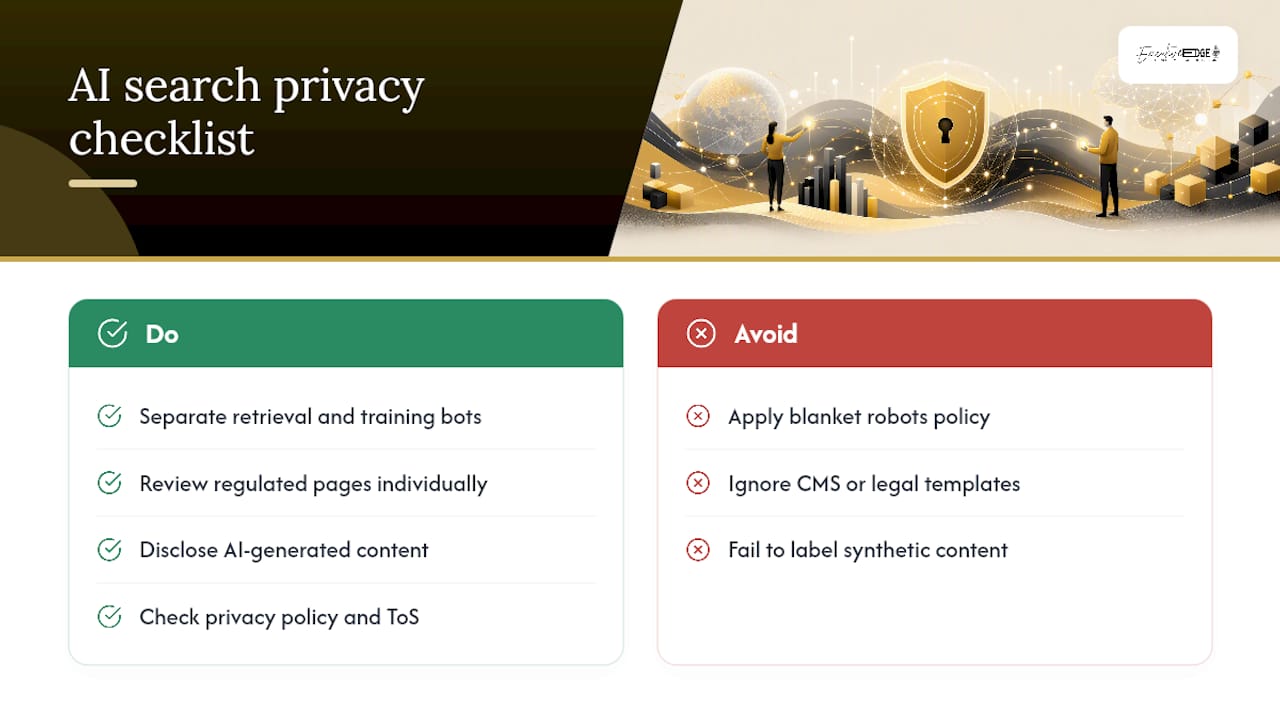
AI search introduces a privacy wrinkle traditional SEO never had to deal with: your content isn't just being indexed, it's potentially being used to train models or generate synthesized answers that mix your text with other sources. That distinction matters for how you handle crawler permissions.
Robots.txt directives let you separate retrieval bots, the ones fetching your content live to answer a specific user query, from training bots that ingest content to build future model capabilities. If your business handles regulated information, health details, financial data, legal specifics, review those pages individually rather than applying a blanket policy across your whole domain. A blog post about general industry trends carries different risk than a page listing client outcomes or case specifics.
Compliance considerations extend to how you disclose AI-generated or AI-assisted content. If your published material is voice-cloned, AI-drafted, or synthetically produced in any way, transparency about that process protects both your credibility with readers and your standing with platforms that increasingly flag undisclosed synthetic content. This isn't optional housekeeping, it's becoming a baseline expectation as AI-generated content floods every channel.
Finally, check your existing privacy policy and terms of service for language that either explicitly permits or restricts AI crawling and content reuse. Some CMS platforms and legal templates default to broad restriction language that inadvertently blocks the exact bots your GEO strategy depends on. A five-minute policy review can undo weeks of technical optimization if the fine print contradicts your robots.txt settings.
Which AI Search Platforms Can You Actually Integrate With?
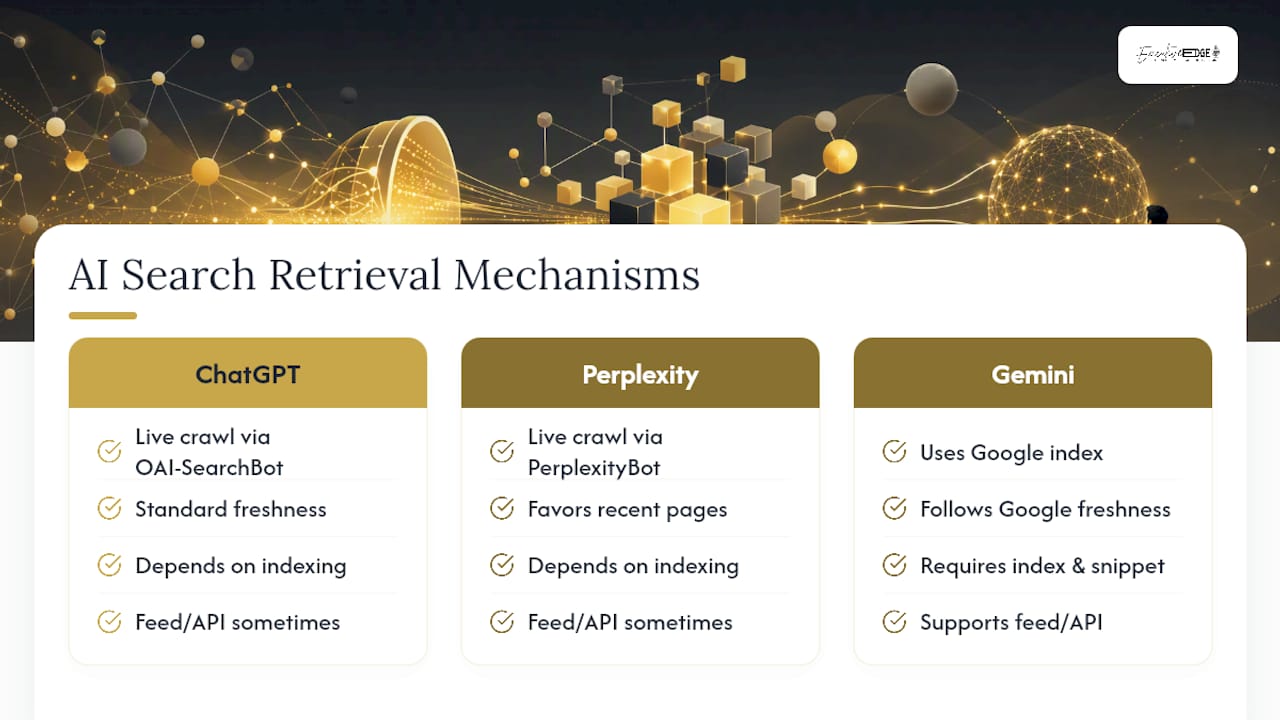
Integration capability varies wildly by platform, and knowing the difference shapes where you invest effort. ChatGPT's browsing and retrieval features rely on OAI-SearchBot crawling your live pages, which means standard technical SEO, clean robots.txt rules, fast rendering, current sitemaps, directly affects whether it can pull your content at query time.
Perplexity operates similarly through PerplexityBot, but it also weighs freshness more heavily than some competitors, favoring recently updated pages when multiple sources cover the same topic. Gemini draws on Google's existing index, which is why the same indexing and snippet eligibility standards that govern traditional Search results also govern AI Overviews and AI Mode. If a page isn't indexed or snippet-eligible in standard Search, it has no path into Gemini's AI features either.
Beyond crawler access, some platforms support structured feed submissions or API-level integrations for business data, product catalogs, and local listings, similar in spirit to how Google Business Profile feeds local search results. Where those integration paths exist, submitting clean, structured data directly tends to outperform hoping a crawler interprets your HTML correctly.
The practical takeaway: don't treat "AI search" as one target. Audit crawler access and content structure with each platform's actual retrieval mechanism in mind, and expect your visibility to differ meaningfully from ChatGPT to Perplexity to Gemini even when your underlying content is identical.
Does Your Content Actually Answer What People Are Asking?
Technical access means nothing if the content underneath doesn't match what people are actually asking AI engines. This is where a content gap analysis earns its place in the audit, separate from the answer-first formatting work covered earlier.
Start with the same prompt set you used for citation baselining, but this time evaluate whether your existing pages substantively answer each prompt, or whether they only tangentially relate to it. A services page that describes what you offer in general terms won't satisfy a prompt asking for specific pricing ranges, typical timelines, or a comparison against alternatives. AI engines favor sources that resolve the actual question, not sources that are merely topically adjacent.
Map your prompt list against your existing content inventory and flag three categories: prompts you answer well, prompts you partially answer, and prompts you have no content addressing at all. That third category is your content roadmap. Forrester's analysis of the shift from keyword-based to context-based search frames this exact gap as the opportunity: businesses that build content around specific answerable questions, rather than broad keyword themes, are the ones AI engines end up citing.
Prioritize gaps where competitors are already getting cited and you aren't. Those prompts tell you exactly what content to build next, and they carry more weight than gaps where no one, including competitors, has good coverage yet.
Who Should Own Each Part of the Audit?
An AI search readiness audit touches more departments than most people expect, and unclear ownership is why audits stall after the first week of enthusiasm.
Marketing or SEO leads should own the visibility snapshot and prompt-based citation tracking, since that work requires ongoing monitoring rather than a one-time check. IT or web development needs to own the technical layer, robots.txt changes, rendering fixes, sitemap updates, because those changes touch server configuration and deployment pipelines that marketing teams typically can't access directly. Content teams own the answer-first rewrites and schema implementation, working from the gap analysis marketing produces.
For any regulated business, legal or compliance staff should sign off on privacy and disclosure questions before crawler permissions change, particularly if the site includes client data, health information, or financial specifics.
Set a simple communication cadence rather than an elaborate project plan: a kickoff meeting to assign the buckets above, a one-week check-in after quick wins ship, and a monthly review of visibility metrics for the following quarter. Keep the reporting format consistent, readiness percentage, weighted visibility trend, and outstanding action items, so stakeholders across departments can track progress without re-explaining the framework every time. Most audit failures aren't technical. They're communication breakdowns where the person who could fix robots.txt never knew it needed fixing.
The Real Lesson From Running These Audits
Most GEO advice online oversells complexity. Marketers read about entity graphs, knowledge panels, and multi-platform citation strategies, and they assume readiness requires a six-month roadmap before anything moves. It doesn't. The evidence points the other way: Trakkr's own research shows quick technical wins produce visibility changes within days to weeks, not quarters.
The conventional advice fails by treating GEO as a separate discipline from the work you already know. It isn't. GEO research consistently treats standard SEO as table stakes, then layers extractability and entity consistency on top. Skip the fundamentals, indexing, sitemap health, snippet eligibility, and no amount of schema markup saves you.
Here's what actually deserves your first hour: check robots.txt, run ten prompts across three AI engines, and rewrite your top three pages to answer first. That's it. That's the audit that matters before you commit budget to anything recurring. Everything else on this list is real, and worth doing, but it's sequenced correctly only when the fast stuff comes first.
— David Domm
Ready to Move Beyond the DIY Checklist?
Running the audit above gets you a clear picture of where you stand. Turning that picture into sustained citation growth is the part most internal teams struggle to sustain, week after week, across podcast, video, blog, and social simultaneously. A managed content system closes that gap: one recording session and a guided intake feed a voice-cloned production pipeline that outputs consistent, answer-first, entity-clear content across multiple channels often flagged as underdeveloped by audits.

If your readiness score came back low on the content and off-site buckets, and your team doesn't have the weekly bandwidth to fix that on its own, a managed program is the faster path. It's also worth pairing with the right distribution channel, voice-driven content in particular is becoming a meaningful part of how brands get discovered outside of text-based search. Visit the Authority Content System to see how the intake process works and request a walkthrough of what a managed build looks like for your business.
Sources
- AI Features and Your Website | Google Search Central
- AI Search Readiness Audit: A Data-Backed Framework for Getting Cited by AI | Trakkr
- Why Your SEO Isn’t Translating Into AI Visibility | Scale Theory
FAQ
What Does an AI Search Readiness Audit Require?
It requires checking three things: whether AI crawlers can access your site, whether your content is structured for extraction, and how you currently perform in citation tests across engines like ChatGPT and Perplexity. Most audits start with a robots.txt check since blocked crawlers are one of the most common and fixable issues.
Can ChatGPT Do an SEO Audit?
ChatGPT can review your page content and flag obvious structural issues like missing headers or unclear answers, but it can't crawl your live site, check your actual robots.txt file, or verify indexing status in Search Console. Treat it as a drafting assistant for the content review, not a substitute for the technical checks covered in this audit.
How Do You Check Your AI Search Visibility?
Run a set of 10 to 25 prompts a real customer would ask across ChatGPT, Perplexity, and Gemini, then record which sources get cited and in what position. Position-weighted scoring, where a first-position citation counts far more than a fourth-position mention, gives a more accurate picture than counting raw citations.
What Does an AI Readiness Assessment Look Like in Practice?
It looks like a scored checklist across technical, content, and off-site categories, each item marked missing, partial, or complete, rolled up into a single readiness percentage. This same three-pillar structure—technical access, content extractability, and visibility tracking—is commonly built into readiness reviews behind authority content systems.
How Long Does It Take to See Results From an AI Search Audit?
Technical fixes like unblocking crawlers or adding schema often show measurable visibility movement within days to weeks, based on Trakkr's tracking of quick-win implementations. Content and off-site work, cornerstone page rebuilds, brand mention outreach, typically takes 30 to 90 days to show a meaningful citation lift.