

An omnichannel content strategy is modular, context-tagged content paired with unified customer data, so one content source delivers consistent, personalized experiences across channels. The single most important ingredient is structure: content built as reusable components rather than one-off pages, matched to a customer data layer that recognizes the same person everywhere. Done right, it produces content that's cheaper to maintain, easier to personalize, and measurable enough to defend the budget behind it.
Table of Contents
- What Is an Omnichannel Content Strategy, and Why Does It Matter Now?
- Core Principles: Modular Content, Context Tags, and Journey-First Planning
- How Do You Roll Out Omnichannel Content Step by Step?
- What KPIs Actually Prove Omnichannel Content Works?
- Choosing a CMS, CDP, and PIM That Won't Fight Your Content Model
- Building the Content Model: Components, Fields, and Reuse Patterns
- Governance, Roles, and the 90-Day Rhythm That Keeps Programs Alive
- Making Offline and Online Channels Work as One System
- Personalizing Content Without Guessing at What Customers Want
- Where Omnichannel Content Programs Actually Break Down
- What I've Learned Building Omnichannel Programs for Service Businesses
- Let a Done-For-You System Handle the Content Your Team Can't Keep Up With
- Sources
- FAQ
What Is an Omnichannel Content Strategy, and Why Does It Matter Now?
Brands that manage the customer experience as a connected whole, rather than a set of disconnected channels, tend to see stronger revenue outcomes than those running parallel, siloed campaigns. The gap comes down to integration. Multichannel marketing puts a brand on every platform. Omnichannel makes those platforms aware of each other, so a customer who reads a blog post, gets an email, and later calls a sales line experiences one continuous conversation instead of three separate ones.
Statistic Callout: Omnichannel-integrated brands consistently outperform multichannel-only competitors on customer retention and lifetime value, largely because a unified customer view eliminates the redundant, contradictory messaging that fragmented systems produce.
This is something we see consistently with East Texas businesses. A contractor or clinic in Tyler running a blog, a podcast, and social content without a shared content model ends up repeating the same story badly instead of telling it once, well, across formats.
Core Principles: Modular Content, Context Tags, and Journey-First Planning
Most content programs fail at scale because they build "blob" content, long pages that mix headline, narrative, and call to action into one inseparable block. That works for a single webpage. It breaks the moment you need the same idea as a podcast intro, a social carousel, and an email subject line. Modular content separates the message from its presentation, so each piece, a headline, a stat, a quote, a CTA, exists as its own reusable unit.
Three rules make modular content actually work in practice:
- Tag every component by persona, funnel stage, and tone so systems (and humans) know when to reuse it.
- Keep taxonomy shallow at first. Three or four fields beat a 40-field schema nobody fills out correctly.
- Pick two or three priority customer journeys before touching architecture. Trying to model every possible path on day one guarantees the project stalls.
A practical example: a single customer success story gets modeled as a headline, three quote blocks, one data point, and a CTA. That one asset becomes a blog post, a LinkedIn carousel, a podcast talking point, and a sales one-pager without anyone rewriting it four times.
Pro Tip: Before you tag a single piece of content, write down your two or three highest-value customer journeys on a whiteboard. If a tag doesn't help move someone along one of those journeys, don't build it yet.
How Do You Roll Out Omnichannel Content Step by Step?
Teams that try to implement omnichannel content all at once usually stall around month two. A phased sequence works better:
- Define outcomes and pick your journeys. Choose two or three customer journeys (say, first-time buyer and renewal) that matter most to revenue.
- Audit existing content and data. Inventory what you have, flag duplicates, and identify where customer data lives in disconnected systems.
- Build a content model prototype. Draft your components and metadata fields, then apply them to one journey only.
- Pilot before scaling. Run the model against real content for that single journey and fix what breaks before expanding.
- Choose your architecture. Decide between headless and hybrid CMS based on how your editors actually work, not on what's trendy.
- Stand up governance. Assign ownership, set an approval workflow, and commit to a 90-day review rhythm.
The pilot step matters more than most teams give it credit for. Validating the content model on one high-value journey before expanding catches structural mistakes while they're cheap to fix, not after you've tagged 3,000 assets the wrong way.
What KPIs Actually Prove Omnichannel Content Works?
Reach and pageviews tell you content got seen. They don't tell you whether it moved anyone toward a purchase. The Content Marketing Institute's five-stage measurement framework, see, connect, trust, choose, champion, maps content's contribution at each stage of the relationship instead of treating all engagement as equal.
For omnichannel programs specifically, four KPIs matter most:
- Cross-touchpoint customer lifetime value (CLV), measuring revenue attributed to customers who engage across multiple channels versus one.
- Blended cost per acquisition (CPA), which accounts for the combined cost of all channels touching a single conversion.
- Cross-channel conversion rate, tracking conversions that involve more than one touchpoint before close.
- Retention rate, segmented by whether the customer's journey was single-channel or multichannel.
Statistic Callout: A unified customer data platform is required to calculate these KPIs accurately; without identity resolution, the same customer gets counted multiple times across channels, inflating both reach numbers and acquisition costs.
Report to executives in outcome language, not channel language: show revenue and retention lift tied to the customer journey, not a scoreboard of likes and impressions per platform.
Choosing a CMS, CDP, and PIM That Won't Fight Your Content Model
A headless CMS separates content storage from presentation, letting the same content feed a website, an app, and a kiosk without rebuilding it three times. A hybrid CMS keeps a visual editing layer while still exposing content through APIs, which tends to suit teams with less technical editorial staff. Neither is universally better. The right choice depends on how much control your writers need over layout versus how many channels your content needs to reach.
- A customer data platform (CDP) should function as the single source of truth for identity resolution, tying anonymous web visits to known customers across every channel.
- Use a product information management (PIM) system when product data, specs, pricing, variants, needs to sync across catalogs, ads, and storefronts.
- Use a digital asset management (DAM) system to store and tag images, video, and audio so the same asset gets found and reused instead of recreated.
- Prioritize real-time event streaming over batch updates wherever personalization or attribution depends on knowing what a customer just did, not what they did last week.
Enterprise-scale omnichannel programs that mix platforms like Sitecore, Adobe Experience Manager, or SharePoint tend to succeed only when governance and data integration get equal investment to the tooling itself.
Building the Content Model: Components, Fields, and Reuse Patterns
A workable content model starts with a short list of components: headline, summary, body chunk, CTA block, image with alt text, and a metadata block. Each component carries its own required fields, so a headline component always has a character limit and a tone tag, no exceptions.
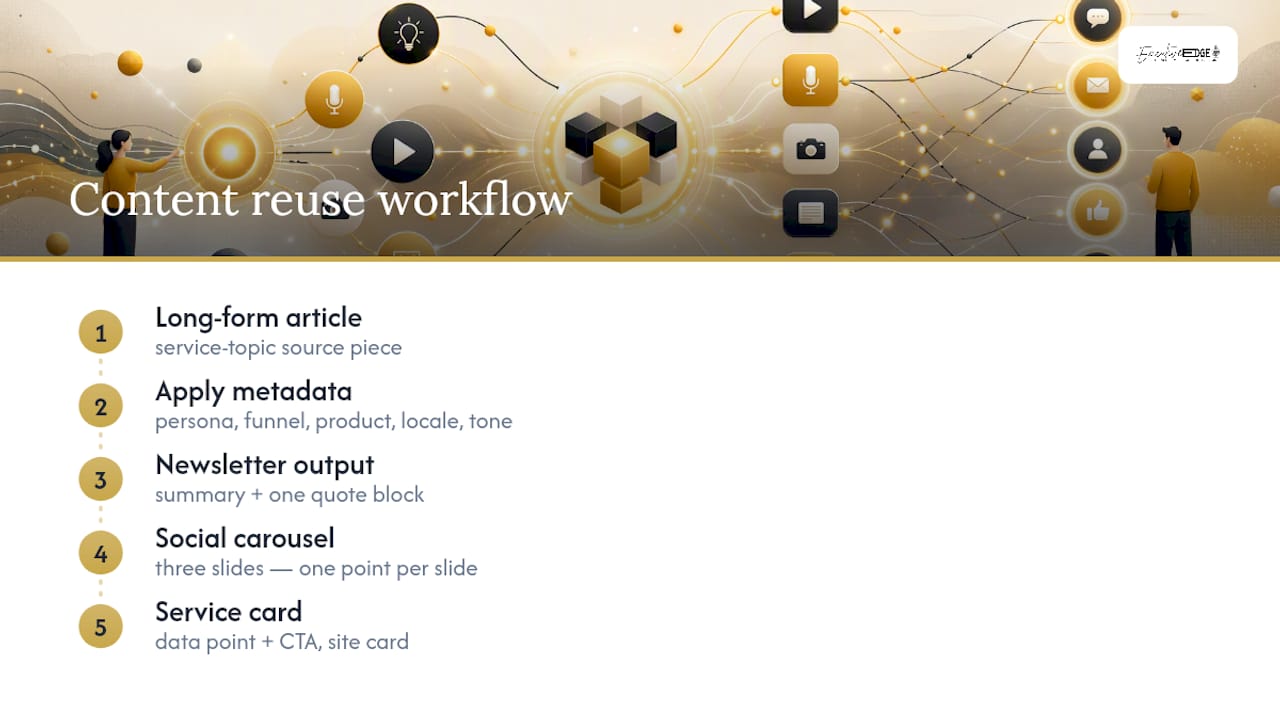
Suggested taxonomy for tagging: persona, funnel stage, product line, locale, and tone. Five fields, no more, at least until the first pilot proves the model holds up.
Here's the reuse pattern in practice. Take one long-form article on a service topic. Pull its summary and one quote block for a newsletter. Break its three main points into a social carousel, one point per slide. Extract its data point and CTA for a product or service card on the site. One authoring pass, three channel outputs, and no rewriting from scratch.
Pro Tip: Build your metadata schema before you build a single piece of content. Retrofitting tags onto an existing content library is the single most time-consuming mistake teams make in year one.
Governance, Roles, and the 90-Day Rhythm That Keeps Programs Alive
Omnichannel programs stall without clear ownership. Governance and workflow controls are one of the four pillars of a working system, alongside a centralized repository, channel-agnostic architecture, and unified customer data.
A minimum viable roster: a content strategist owning the model and taxonomy, a data or marketing operations lead owning the CDP and attribution, channel owners responsible for local adaptation, and one governance lead who approves exceptions to brand standards.
- Set an approval workflow that separates brand compliance checks from local market or channel adaptation, so regional teams can adjust tone without waiting on corporate sign-off for every post.
- Run a 90-day review cycle: audit content performance against your KPIs, retire what isn't working, and expand the model to a new journey only after the current one is stable.
- Revisit taxonomy every cycle. Tags that seemed useful in month one often turn out to be noise by month three.
Making Offline and Online Channels Work as One System
A customer who walks into a physical office after reading three blog posts shouldn't have to explain their situation from scratch. That's the practical test of offline and online integration: does information travel with the customer, or does it die at the channel boundary?
The fix isn't complicated in concept, though it takes real work to build. In-store staff, call centers, and field reps need access to the same unified customer profile that powers your website and email campaigns. If a customer downloaded a pricing guide online, the person answering the phone should see that before picking up. Amazon Ads frames this as a holistic approach, where real-time data sync keeps every touchpoint, digital or physical, working off the same information.
QR codes, printed with campaign-specific tracking, are a low-effort bridge that many teams skip. A direct mail piece or an in-store sign that routes to a tracked landing page ties offline exposure back into your attribution model instead of leaving it invisible.
Event-driven content matters here too. A service reminder generated by an in-store visit should trigger a follow-up email, not sit in a separate system nobody checks. The same logic applies to loyalty programs: points earned in person should show up instantly in the app, not after an overnight batch sync.
The businesses that get this right usually start small: one offline touchpoint (a call center script, a checkout receipt) wired into the same customer data platform driving digital personalization. Trying to unify every offline process on day one is how these projects die before they ship.
Personalizing Content Without Guessing at What Customers Want
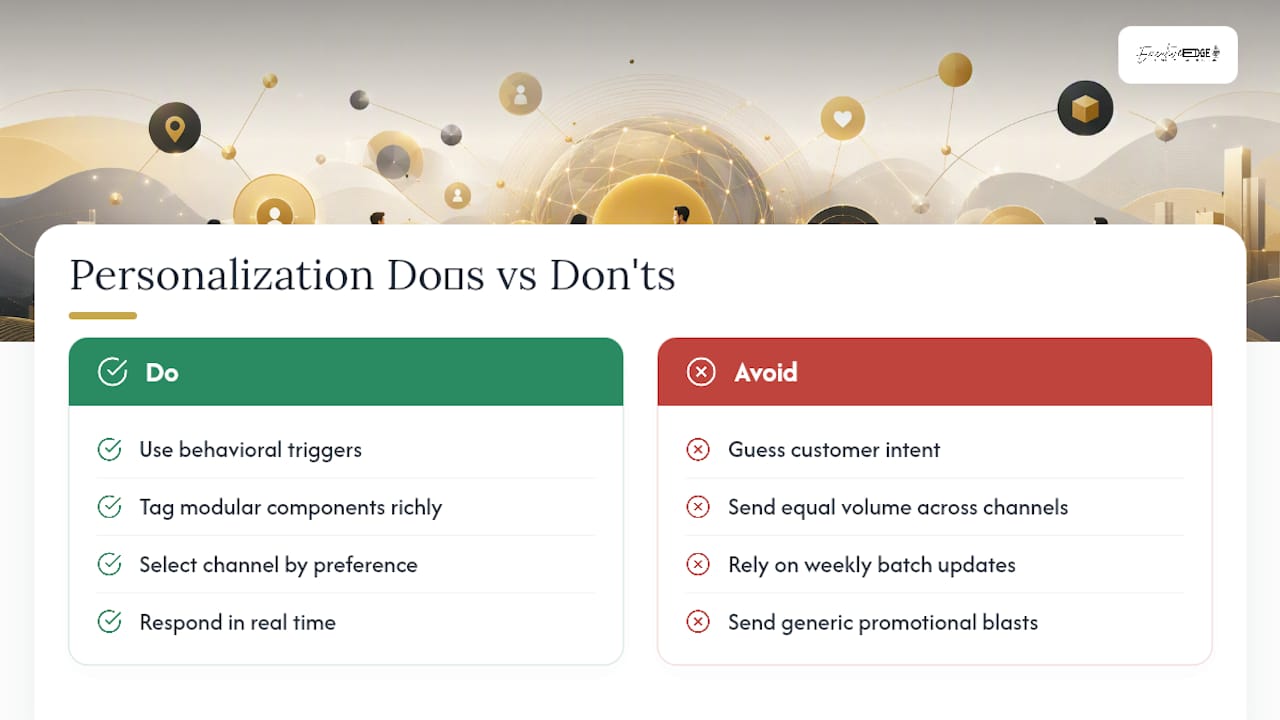
Personalization across channels works only when it's built on actual behavior, not assumptions about who a persona is supposed to be. A customer who abandoned a cart, opened three emails about a specific product line, and searched a support article about installation has told you exactly what they care about. The content model's job is to surface the right modular component in response.
Behavioral triggers do the heavy lifting. Browsing history should inform which product card shows up in an email. Past purchase data should determine which follow-up content plays after a transaction. Support ticket history should shape the tone of the next outbound message, empathetic and solution-focused, not another generic promotional blast.
The channel matters as much as the message. A customer who prefers SMS for shipping updates but email for content shouldn't get both at equal volume; that's a fast way to trigger unsubscribes. Preference data, tracked explicitly where possible and inferred from behavior where not, should govern channel selection as tightly as it governs content selection.
Real-time responsiveness separates strong personalization from theoretical personalization. A customer browsing a product category right now is a better signal than what they clicked two weeks ago. Programs that rely on weekly batch updates to their customer data miss that window entirely, sending yesterday's relevance to today's intent.
None of this requires guessing. It requires a content model with enough modular components tagged by persona, funnel stage, and product line that the right piece can be assembled and served the moment the data calls for it. Guesswork is what happens when the tagging system doesn't exist yet.
Where Omnichannel Content Programs Actually Break Down
The most common failure isn't a bad idea. It's scope. Teams try to model every journey, every persona, and every channel simultaneously, and six months in, nothing has shipped because the taxonomy meeting is still ongoing. Starting with two or three priority journeys isn't a shortcut; it's the only way these programs survive contact with reality.
Data silos are the second failure point. Marketing, sales, and customer service often run separate systems that don't talk to each other, which means the "unified" customer view is unified in name only. Breaking down those silos requires connecting systems, not just agreeing in a meeting that they should talk to each other, and that integration work is usually underestimated in both time and cost.
Governance gaps cause a quieter kind of damage. Without clear approval workflows, local teams either wait too long for sign-off (killing responsiveness) or skip the process entirely (killing brand consistency). Both outcomes undo the point of building a unified system in the first place.
Attribution confusion is the fourth trap. Teams without a proper CDP or identity resolution routinely double-count conversions across channels, which inflates reported performance and misdirects future budget toward channels that look better than they are.
Last, there's the tagging trap: overbuilding metadata before anyone has proven the model works. A 40-field taxonomy sounds thorough. In practice, it means nobody tags content correctly, and the "structured" content library ends up just as inconsistent as the blob content it replaced.
What I've Learned Building Omnichannel Programs for Service Businesses
Two lessons keep showing up across implementations. First, the content model always matters more than the platform. Teams spend months debating CMS vendors while their actual content, unstructured, untagged, unreusable, would break any system they chose. Fix the model first.
Second, momentum dies without a managed cadence. Even well-designed pilots stall when nobody owns the 90-day review. That's the gap a structured, done-for-you production and distribution system can close, keeping the content pipeline moving even when internal bandwidth doesn't. This is something seen often with business owners across Tyler and East Texas: the strategy is sound, but execution needs a dedicated engine behind it.
— David Domm
Let a Done-For-You System Handle the Content Your Team Can't Keep Up With
Some done-for-you systems solve the problem this article just walked through: building modular, tagged, reusable content across channels without needing a full internal content team to maintain it, leveraging platforms like Sona that help find proven ideas and write in your voice. Instead of hiring for the roles listed in the governance section above, such services handle weekly podcast production, blog articles, short-form social content, and AI-driven distribution as one coordinated system, built around your expertise rather than generic industry content.

If you're weighing whether to build this in-house or hand it to a managed service, ask three questions: Do you have someone who can own the content model and taxonomy full time? Can your team sustain a 90-day production and review rhythm without burning out? Is your priority visibility across search, YouTube, and AI-driven discovery platforms, or just one channel? If the honest answer to any of those is no, a managed system solves the gap faster than a hiring plan does.
For business owners in Tyler and East Texas who want authority content running across every channel without becoming full-time content producers themselves, start a conversation with Executive Edge Partner Group about what a done-for-you rollout looks like for your business.
Sources
- Content measurement framework - Content Marketing Institute
- 5 Omnichannel KPIs to Measure Marketing Efforts - Netcore Cloud
- The no-fluff guide to crafting omnichannel content - Hygraph
- Omnichannel Content Management: Strategy, Architecture and Implementation Guide | WordPress VIP
FAQ
What Is an Omnichannel Content Strategy?
It's a plan for delivering modular, context-tagged content from a single source, matched to unified customer data, so every channel, email, social, in-store, web, reflects a consistent, personalized experience rather than disconnected campaigns.
What Are the Four Pillars of Omnichannel Content Management?
A centralized content repository, channel-agnostic architecture, unified customer data, and governance and workflow controls form the foundation most successful programs share.
What Is an Example of an Omnichannel Strategy?
A customer browses a product online, receives a personalized email based on that browsing behavior, then walks into a physical store where staff can see the same activity history, and every touchpoint reflects one continuous relationship instead of three separate interactions.
What Are the Four C's Often Associated With Omnichannel Marketing?
Definitions vary across sources, and there's no single agreed-upon "four C's" framework backed by consistent industry consensus. Rather than force one, focus on the four pillars, repository, architecture, data, governance, since those have clearer, sourced backing.
Do I Need a CDP to Run an Omnichannel Content Strategy?
Effectively, yes. Without a customer data platform for identity resolution, you can't accurately measure cross-channel KPIs or avoid counting the same customer multiple times across systems.