

For small businesses launching a podcast in 2026, the five platforms worth your serious attention are Transistor (best overall for business use), Buzzsprout (fastest onboarding), Captivate (best for growth and sponsorship readiness), Podbean (best built-in monetization), and Anchor/Spotify for Podcasters (best free option). The podcast hosting market now exceeds $40 billion, and As of late 2025, Anchor (now Spotify for Podcasters) hosts roughly 56% of all active shows, with Buzzsprout around 7% and other hosts in lower single digits — but market share and the right fit for a business are two different things.
- Transistor — unlimited shows under one account, private feeds, and team permissions make it the cleanest fit for businesses running more than one show or managing internal and external content
- Buzzsprout — the simplest upload-to-publish workflow available; ideal for solo owners who want to record and go
- Captivate — download-based pricing and growth tools built for businesses planning to pitch sponsors
- Podbean — built-in ad marketplace, patronage tools, and subscription support without needing third-party add-ons
- Anchor (Spotify for Podcasters) — free hosting with native Spotify distribution; the trade-offs on analytics and content rights matter more for businesses than for hobbyists
Edison Research's Infinite Dial® remains the industry benchmark for audience measurement, and hosts that provide IAB v2-certified analytics give you the credibility to back up listener claims when you approach sponsors. That distinction separates a business-grade host from a free one faster than any other single feature.
Table of Contents
- How the top podcast hosting platforms compare for small businesses
- 1. Transistor — best overall for small businesses running multiple shows
- 2. Buzzsprout — the fastest path from recording to published
- 3. Captivate — best for businesses planning to pitch sponsors
- 4. Anchor (Spotify for Podcasters) — free entry with real trade-offs for businesses
- 5. Libsyn — reliable hosting with a long track record
- 6. Podbean — built-in monetization without third-party add-ons
- 7. Castos — the right call if you run WordPress
- 8. Blubrry — advanced control for technically capable teams
- 9. Simplecast — enterprise-grade analytics for scaling brands
- 10. RSS.com — no-friction hosting for a single business show
- 11. RedCircle — creator monetization and cross-promotion tools
- 12. Megaphone — enterprise ad infrastructure, not built for most small businesses
- 13. The rest of the field: Spreaker, Podcast.co, Acast, Ausha, Alitu, CoHost, and Riverside
- How to choose the right podcast host for your small business
- Why your hosting choice shapes real business outcomes
- What we see working with business podcasts
- When a done-for-you podcast service makes more sense than self-serve hosting
- Sources
- FAQ
How the top podcast hosting platforms compare for small businesses
The table below covers the 12 platforms most relevant to small-business buyers. Columns explained: DAI = dynamic ad insertion (ads swapped into existing episodes automatically); Private feeds = password-protected RSS for internal or paid audiences; IAB v2 = analytics certified to the Interactive Advertising Bureau's v2 standard, the floor advertisers expect.
Pro Tip: Before you commit to any plan, confirm whether DAI is included at your tier. DAI availability varies by platform and plan level — some hosts advertise it as a feature but gate it behind higher-priced tiers.
1. Transistor — best overall for small businesses running multiple shows
Transistor is the clearest fit for a business that treats podcasting as a real content channel rather than a side experiment. One account supports unlimited shows, which means you can run a customer-facing show, an internal team podcast, and a private client feed without paying for three separate subscriptions.
Standout features for small businesses:
- Unlimited shows and team member seats on every plan
- Private, password-protected RSS feeds for internal communications or paid audiences
- Clean, embeddable players that drop into any website without custom code
- IAB v2-certified analytics with per-episode download breakdowns
- Distribution to Apple Podcasts, Spotify, Google, Amazon, and more in one submission step
Starter plans begin around $19/month. The 14-day free trial gives you enough time to upload a real episode and test the workflow before committing. The main limitation: no native DAI, so if programmatic ad revenue is your primary monetization goal, you'll need a third-party ad network on top.
Pros: Clean multi-show management, strong team permissions, private feeds included, excellent analytics. Cons: No built-in ad marketplace; pricing scales with download volume on higher tiers.
2. Buzzsprout — the fastest path from recording to published
Buzzsprout is the host that gets out of your way. The dashboard is genuinely simple: upload an audio file, add episode details, hit publish. For a solo business owner who records interviews or solo episodes and wants them live the same day, nothing else comes close on ease of use.
Key features:
- Drag-and-drop upload with automatic audio optimization
- Embeddable players with customizable colors to match your brand
- Basic IAB v2 analytics and listener location data
- Free plan available (episodes expire after 90 days on the free tier)
- Magic Mastering audio enhancement tool (paid add-on)
Paid plans start at $12/month for 3 hours of upload per month. That covers roughly 6–8 standard episodes, which fits most small-business publishing schedules. The 90-day episode expiration on the free tier is a real limitation for businesses that want a permanent archive, so treat the free plan as a trial, not a long-term solution.
Pros: Fastest onboarding of any host on this list, clean UI, solid beginner support. Cons: Upload limits by hours (not downloads), no multi-show support, no DAI.
3. Captivate — best for businesses planning to pitch sponsors
Captivate prices by monthly downloads rather than upload hours, which is a meaningful structural difference. As your audience grows, you pay more, but you're never penalized for publishing longer episodes or higher-quality audio files. That model aligns with a business that's actively building an audience and expects to monetize it.
Features that matter for growth-focused businesses:
- Download-based pricing tiers (not upload-hour caps)
- Built-in calls-to-action and subscribe buttons for audience conversion
- IAB v2-certified analytics with export capability
- Unlimited shows and team members on all plans
- Podcast website included with every account
Starter plans run around $17/month for up to 12,000 downloads. The 7-day trial is short but enough to test the workflow. Captivate doesn't include native DAI, so ad monetization still requires a third-party network, but the analytics export makes sponsor conversations straightforward.
Pros: Download-based pricing rewards quality over quantity, unlimited shows, strong marketing tools. Cons: No DAI, short trial period, cost rises with audience growth.
4. Anchor (Spotify for Podcasters) — free entry with real trade-offs for businesses
Anchor, now rebranded as Spotify for Podcasters, is free. Full stop. For a business testing whether podcasting fits its content strategy before committing budget, that's a legitimate starting point. Anchor hosts roughly 55–56% of all active podcasts, which tells you how attractive the free tier is.
What you get:
- Free hosting with no episode limits
- Native Spotify distribution (your show appears on Spotify automatically)
- Basic analytics dashboard
- Built-in recording tools for mobile recording
- Distribution to Apple Podcasts and other directories
The business-specific caveats matter here. Anchor's analytics are not IAB v2-certified at the same level as paid hosts, which creates friction when you try to present listener data to a potential sponsor. Content rights and platform dependency are also worth reading carefully in the terms of service before you build a library of 50+ episodes on a free platform you don't control.
Pro Tip: Use Anchor to validate your concept and build your first 10 episodes. Once you have consistent listener numbers and want to approach sponsors, migrate to a host with certified analytics. Most paid hosts make RSS migration straightforward.
Pros: Zero cost, instant Spotify distribution, no episode limits. Cons: Limited analytics certification, platform dependency risk, no private feeds, no team accounts.
5. Libsyn — reliable hosting with a long track record
Libsyn has been in the podcast hosting business longer than most of its competitors have existed. That longevity translates into proven uptime, a wide range of legacy integrations, and a publishing workflow that serious producers trust. It's not the flashiest option, but for a business that values stability over novelty, it holds up.
Features relevant to small businesses:
- Storage-based pricing model (pay for what you upload, not downloads)
- IAB v2 analytics with detailed geographic and app-level data
- DAI available on higher-tier plans
- Private feeds and password-protected episodes
- Distribution to all major directories plus Amazon Alexa
Starter plans begin at approximately $7/month for 162 MB of monthly storage, which covers roughly 3–4 standard episodes. The interface feels dated compared to Transistor or Captivate, and onboarding is less guided for newcomers. But if you're migrating from another host or need enterprise-level reliability, Libsyn's track record is hard to dismiss.
Pros: Long-standing reliability, DAI on higher tiers, granular publishing controls, private feeds. Cons: Older interface, limited beginner support, DAI gated behind higher plans.
6. Podbean — built-in monetization without third-party add-ons
Podbean is the host that takes monetization seriously from day one. The platform includes a native ad marketplace, a patronage system (listeners pay directly), and subscription support, all without requiring you to connect external tools. For a small business that wants to turn its podcast into a revenue line quickly, that integrated stack saves real setup time.
Monetization and hosting features:
- Podbean Ad Marketplace for direct sponsor connections
- Patron program for listener-supported revenue
- Premium subscription episodes (paid content behind a paywall)
- Dynamic ad insertion available on paid plans
- Embeddable players and a free podcast website
Paid plans start at $9/month. A free tier exists but limits storage and monetization access. The analytics are IAB v2-certified, which matters when you're presenting listener data to advertisers. The trade-off: Podbean's multi-show support is limited compared to Transistor or Captivate, so it fits a single-show business better than an agency or multi-brand operation.
Pros: Native ad marketplace, patronage tools, DAI included, competitive pricing. Cons: Multi-show management is weaker than Transistor or Captivate; free tier is quite limited.
7. Castos — the right call if you run WordPress
Castos is purpose-built for businesses that run their website on WordPress. The integration with the Seriously Simple Podcasting plugin means your episodes publish directly to your WordPress site without manual RSS juggling. For a business that already manages blog content, service pages, and SEO through WordPress, adding a podcast to the same workflow is genuinely frictionless.
Features for WordPress-first businesses:
- Native Seriously Simple Podcasting plugin integration
- Private feeds for members-only or internal content
- IAB v2-certified analytics with export
- Unlimited shows and team members on all plans
- Automatic distribution to Apple, Spotify, Google, and others
Plans start at $19/month with a 14-day trial. Castos also offers a podcast migration service, which matters if you're moving an existing show from another host. The main limitation: if you don't run WordPress, Castos loses most of its differentiation and you'd be better served by Transistor or Captivate.
Pros: Best WordPress integration available, private feeds, unlimited shows, clean analytics. Cons: Advantage disappears entirely if you're not on WordPress; no native DAI.
8. Blubrry — advanced control for technically capable teams
Blubrry suits a specific type of business: one with a developer or technically confident team member who wants granular control over hosting, publishing, and analytics. The PowerPress WordPress plugin is the most feature-rich free podcast plugin available, and Blubrry's hosting options include both managed hosting and FTP-based self-managed setups.
Features for technical teams:
- PowerPress plugin (free, widely used, deeply configurable)
- Choice between managed hosting and self-managed FTP hosting
- IAB v2 analytics with detailed export options
- Distribution to all major directories
- Integration with WordPress and custom RSS configurations
Managed hosting starts around $12/month. The learning curve is steeper than Buzzsprout or Transistor, and the interface reflects a product built for power users rather than first-timers. If your team has the technical appetite, Blubrry gives you more configuration options than almost any other host on this list.
Pros: PowerPress plugin is best-in-class, flexible hosting models, strong analytics export. Cons: Steeper learning curve, less polished UI, not beginner-friendly.
9. Simplecast — enterprise-grade analytics for scaling brands
Simplecast positions itself at the upper end of the market, and its analytics reflect that. The platform provides detailed per-episode and per-listener data, team account management, and API access for businesses that want to pipe podcast data into their own dashboards or CRM systems.
Features for scaling businesses:
- Advanced analytics with IAB v2 certification and export
- Team accounts with role-based permissions
- API access for custom integrations
- Unlimited shows on all plans
- Distribution to all major directories
Starter plans begin at $15/month with a 14-day trial. Simplecast doesn't include native DAI, so programmatic ad revenue still requires a third-party network. The platform shines for businesses that treat their podcast as a data asset and need the numbers to back up audience claims in sales conversations or investor decks.
Pros: Best-in-class analytics, API access, team permissions, unlimited shows. Cons: No DAI, higher cost at scale, fewer built-in monetization tools.
10. RSS.com — no-friction hosting for a single business show
RSS.com does exactly what the name suggests: it generates and manages your RSS feed reliably, distributes to all major directories, and provides a clean embeddable player. There's no multi-show complexity, no advanced analytics dashboard to learn, and no monetization system to configure. For a business that publishes one show and wants a dependable, low-maintenance host, Rss covers the basics well.
Plans start at $8.25/month (billed annually). IAB v2 analytics are included. The platform lacks DAI and advanced monetization tools, which means it's not the right call for businesses with aggressive revenue goals, but for a professional services firm or local business using a podcast primarily for authority building and SEO, it's a clean, affordable option.
Pros: Simple setup, reliable RSS management, IAB v2 analytics, easy embeds. Cons: No DAI, no multi-show support, limited monetization options.
11. RedCircle — creator monetization and cross-promotion tools
RedCircle takes a creator-first approach to monetization. The platform's free tier includes access to an ad marketplace, cross-promotion tools that let you swap promos with other shows, and direct listener support options. For a small business that wants to build an audience and monetize it without paying upfront hosting fees, RedCircle's model is worth understanding.
Monetization and growth features:
- Free hosting with no episode limits
- Ad marketplace with DAI support
- Cross-promotion network for audience growth
- Listener donation and subscription support
- IAB v2 analytics
RedCircle takes a revenue share on monetization rather than charging a flat monthly fee. That model works well when your show is generating revenue, but the revenue share can become expensive at scale compared to a flat-rate host with a third-party ad network. Best suited for businesses in the early monetization phase that want to test revenue streams before committing to a paid hosting plan.
Pros: Free hosting, DAI included, cross-promotion network, no upfront cost. Cons: Revenue share model, less control than paid hosts, limited advanced features.
12. Megaphone — enterprise ad infrastructure, not built for most small businesses
Megaphone is Spotify's enterprise podcast hosting and advertising platform. It powers large media companies and high-volume publishers that need programmatic ad insertion at scale, advanced audience targeting, and direct access to Spotify's ad network. The platform is not publicly priced and requires a direct sales conversation to onboard.
What Megaphone offers:
- Programmatic DAI at enterprise scale
- Direct integration with Spotify's ad marketplace
- Advanced audience segmentation for advertisers
- Enterprise SLAs and dedicated support
- Detailed advertiser-facing analytics
Most small businesses will never need Megaphone's infrastructure. The platform is designed for publishers generating millions of downloads per month. If you're evaluating it at the small-business stage, the onboarding requirements and custom pricing will likely redirect you toward Podbean, RedCircle, or a host with a built-in ad marketplace that doesn't require an enterprise contract.
Pros: Best-in-class programmatic ad infrastructure, Spotify ad network access. Cons: Not priced or designed for small businesses; requires enterprise-level volume to justify.
13. The rest of the field: Spreaker, Podcast.co, Acast, Ausha, Alitu, CoHost, and Riverside
Several other platforms deserve a mention for specific use cases:
Spreaker offers DAI and an ad marketplace on paid plans, with a free tier for testing. It suits small businesses that want monetization access without committing to a premium host.
Podcast.co focuses on simplicity and team collaboration, with a clean interface and basic analytics. It's a reasonable option for small teams that want a polished, managed experience.
Acast runs one of the larger independent podcast ad networks and offers hosting alongside marketplace access. For businesses focused on ad revenue, Acast's network reach is a genuine differentiator.
Ausha is a French-origin platform with strong marketing tools, social media scheduling, and newsletter integration. It suits businesses that want to manage podcast promotion and distribution from a single dashboard.
Alitu is a podcast production tool first and a host second. It handles audio cleanup, episode building, and publishing in one workflow, which makes it attractive for business owners who record raw audio and want the editing handled automatically.
CoHost provides B2B-focused analytics, including company-level listener data that identifies which businesses are listening to your show. For B2B companies using a podcast for account-based marketing, that data is genuinely useful.
Riverside is primarily a remote recording studio, not a traditional host. It captures studio-quality audio and video from remote guests, then exports to your host of choice. If interview quality is a priority, Riverside pairs well with any host on this list.
How to choose the right podcast host for your small business
The short answer: prioritize distribution reach, IAB v2-certified analytics, and monetization options that match your actual business goals. Everything else is secondary.
Decision criteria
- Pricing model match — Buzzsprout charges by upload hours; Captivate charges by downloads; Transistor charges a flat fee for unlimited shows. Match the model to your publishing frequency and episode length before you commit.
- Analytics certification — If you plan to approach sponsors, IAB v2 certification is the floor. Edison Research's Infinite Dial® is the industry benchmark advertisers reference; your host's analytics need to hold up in that context.
- DAI availability — DAI lets you monetize your back catalog by swapping ads into older episodes. Confirm whether it's included at your plan level before assuming it's available.
- Private feeds — If you want to publish internal communications, member-only content, or paid episodes, confirm private feed support is included, not an add-on.
- Multi-show support — Running more than one show? Transistor and Captivate include unlimited shows. Most other hosts charge per show.
- WordPress integration — Castos and Blubrry are the clear leaders here. If your site runs on WordPress and SEO is a priority, this matters more than most buyers realize.
- Embeddable players — Every host on this list offers an embeddable player, but quality varies. Test the player on your actual website before committing.
Red flags to watch for
- Unclear analytics — If a host can't confirm IAB v2 certification, assume the numbers won't satisfy an advertiser.
- Host-owned content rights — Read the terms of service. A few platforms include language that grants the host a license to your content; that's a problem for businesses with proprietary material.
- No data export — If you can't export your listener data, you're locked in. Always confirm CSV or API export before signing up.
- No team permissions — Solo founders often overlook this until they hire a producer or VA. Confirm team seat availability at your target plan level.
Timeline and cost expectations
- Month 1 (launch): Budget $15–$20/month for a starter plan plus a one-time microphone investment ($100–$200 for a USB condenser mic covers most business use cases). Total first-month cost: $115–$220.
- Months 2–6 (growth phase): Hosting costs stay flat unless you exceed plan limits. Add a recording tool like Riverside ($15–$25/month) if you're doing remote interviews.
- Month 6+ (monetization phase): Small podcasters with under 5,000 downloads per episode typically earn under $500/month from ads and $100–$300/month from listener support. Niche B2B shows can command higher sponsor rates, but plan conservatively.
Pro Tip: Before you migrate hosts, export your RSS feed and subscriber data. Most hosts support RSS migration, but the process is smoother when you have a clean export from day one. Check your host's distribution and migration documentation before you publish your first episode.
Why your hosting choice shapes real business outcomes
Choosing a podcast host isn't a technical decision. It's a business decision that affects lead generation, sponsor negotiations, team workflows, and how your show performs in search.
Where hosting choice changes outcomes:
- Lead generation — Hosts with embeddable players and website integration (Castos, Transistor, Captivate) make it easier to capture listeners directly on your site rather than sending them to a third-party app. That keeps your audience in your ecosystem. Podcast hosting builds professional expertise when the content is discoverable and attributed to your brand.
- Sponsor negotiations — An advertiser will ask for your download numbers and analytics certification. A host without IAB v2 data puts you at a disadvantage before the conversation starts.
- Customer education — Professional services firms, medical practices, and attorneys use podcasts to answer common client questions at scale. Private feeds let you deliver that content to existing clients without making it public.
- Internal communications — Transistor's private feed feature is used by businesses to distribute internal updates, training content, and leadership messages to employees without a public RSS feed.
- B2B account-based marketing — CoHost's company-level listener data tells you which businesses are listening to your show, which is a prospecting tool most business owners haven't considered.
Pro Tip: Align your host choice to your content calendar before you launch. A business publishing two episodes per week needs a different pricing model than one publishing twice a month. Map your expected publishing frequency against each host's pricing tier before you sign up. A thought leader podcast strategy built around consistent publishing is only sustainable if the hosting cost scales predictably.
What we see working with business podcasts
The businesses that get the most out of podcasting treat it as a distribution channel, not a content format. The host is infrastructure, and infrastructure decisions made in month one tend to stick for years.
One pattern that shows up consistently: businesses choose a free or low-cost host to get started, build 20–30 episodes, then realize they can't export their analytics cleanly or their embeddable player doesn't match their site. Migration is possible, but it costs time and sometimes listener subscriptions. Choosing a host with clean data export and IAB v2 analytics from the start avoids that entirely.
For business owners in Tyler, Texas and East Texas, the local market context matters too. A professional services firm or contractor using a podcast for local authority building needs a host that makes it easy to embed episodes on a local SEO-optimized website, not one that keeps listeners inside a third-party app. That's a practical reason to prioritize hosts like Transistor, Castos, or Captivate over free options with limited site integration.

The businesses that skip the self-serve hosting decision entirely, and hand production and distribution to a managed service, tend to publish more consistently. Consistency is the variable that actually drives audience growth, and it's the one most business owners underestimate.
When a done-for-you podcast service makes more sense than self-serve hosting
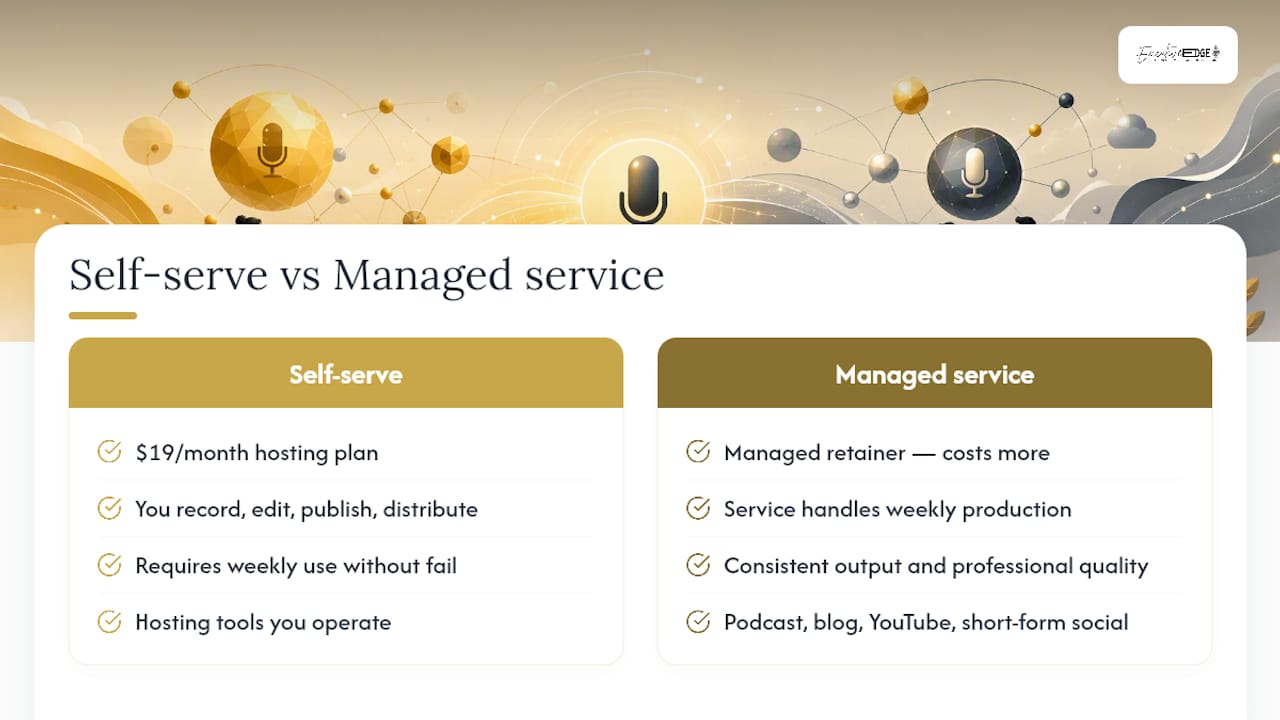
Self-serve hosting works well when you have time to record, edit, publish, and distribute consistently. Most business owners don't. The platforms above are excellent tools, but tools require someone to use them every week without fail.

Executive Edge Partner Group's Authority Engine is built for business owners who want the authority and visibility a podcast creates without becoming a full-time content producer. The service handles weekly podcast production, blog articles, YouTube videos, short-form social content, and multi-platform distribution under one managed retainer. SEO, GEO (Generative Engine Optimization), and AEO (Answer Engine Optimization) are built into the distribution workflow, so your content surfaces across Google, YouTube, and AI-driven search platforms, not just podcast directories.
The trade-off is straightforward: a managed retainer costs more than a $19/month hosting plan. What you get in return is consistent output, professional production quality, and a content system that compounds over time. For a business owner billing $200–$500/hour, the math on spending 10 hours a month on podcast production rarely works in favor of DIY.
If you want to see whether the done-for-you model fits your business, start with a discovery call at Executive Edge Partner Group and get a clear picture of what managed production and distribution looks like for your specific situation.
Sources
These are the primary sources used in this article, each worth bookmarking for ongoing reference:
- Podcastnewsdaily
- Podcast Hosting Market Statistics 2026: Platform Share and Industry Growth - PodRewind Blog
- The Infinite Dial® — Edison Research
- How much do podcasters make? — Backstage
- Best Podcast Hosting Platforms in 2026: Buzzsprout vs Captivate vs Transistor - RateTheTool - Software Reviews
- Rss
FAQ
What platform do most podcasters use?
Anchor (Spotify for Podcasters) hosts roughly 55–56% of all active podcasts, making it the dominant host by volume. That dominance is driven by its free tier, not by it being the best fit for business use.
What are the best podcast hosting platforms for small businesses?
Transistor, Buzzsprout, Captivate, Podbean, and Castos consistently rank as the top podcast hosting platforms for small businesses in 2026, each serving a different use case from multi-show management to WordPress integration and direct monetization.
How much can a small business podcast earn from ads?
Small podcasters with under 5,000 downloads per episode typically earn under $500/month from advertising and $100–$300/month from listener support. Niche B2B shows with engaged audiences can command higher sponsor rates regardless of raw download volume.
Do I need IAB v2 analytics to get podcast sponsors?
IAB v2 certification isn't legally required, but most advertisers treat it as the minimum standard for verifying listener data. Hosts without it put you at a disadvantage in sponsor negotiations; Edison Research's Infinite Dial® is the broader benchmark advertisers reference when evaluating podcast audiences.
Is dynamic ad insertion available on all hosting plans?
No. DAI availability varies by platform and by plan tier, and several hosts advertise it as a feature while restricting it to higher-priced plans. Always confirm DAI access at your specific plan level before choosing a host based on monetization potential.