

Video cloning technology is defined as an AI-driven process that builds a photorealistic digital replica of a person, then generates new video content from that replica using nothing but a text script. Platforms like HeyGen, Subreels, and Kling Motion Control have moved this capability from research labs into everyday marketing workflows, making it possible to produce on-brand video at a fraction of traditional production cost. For content creators, marketers, and business owners in Tyler, Texas and beyond, understanding the video cloning process is no longer optional. It is the foundation of how competitive video production will work for the next decade.
How video cloning technology works: the core technical components
AI video cloning uses Neural Radiance Fields (NeRF) and Generative Adversarial Networks (GANs) to construct digital doubles that carry both facial landmarks and vocal characteristics, enabling text-driven animation. This combination is what separates modern video replication technology from older, simpler deepfake methods. NeRF builds a three-dimensional facial mesh from your training footage, capturing depth, texture, and lighting response. GANs then use that mesh to synthesize new frames that look consistent with the original subject under any lighting condition or camera angle.
Voice cloning runs as a parallel process. The system analyzes your recorded speech to extract pitch, cadence, accent, and micro-pauses, then fine-tunes a text-to-speech model on those characteristics. The result is a synthetic voice that sounds like you reading a script you never recorded. Lip-sync synthesis ties the two systems together, mapping generated phonemes to the facial mesh so mouth movements match the audio with natural timing. Without accurate lip-sync, even a technically impressive clone reads as artificial immediately.
Motion transfer is the fourth pillar of the technology. Kling 3.0 Motion Control analyzes reference clips up to 60 seconds long and copies body, hand, and head movements directly onto a generated subject, with render times of 4 to 8 minutes per clip. This is a meaningful distinction from standard image-to-video models, which infer motion from text prompts with variable fidelity. Motion Control transfers actual motion from a reference video, giving creators precise choreographic control without a camera crew.
- NeRF: Builds the 3D facial geometry from training footage
- GANs: Synthesize photorealistic frames from that geometry
- Voice cloning: Replicates speech patterns for text-to-speech output
- Lip-sync synthesis: Aligns mouth movements to generated audio
- Motion transfer: Copies physical movement from a reference clip to the digital double
Pro Tip: Record your training footage in at least three distinct lighting setups. The NeRF model needs lighting variation to build a mesh that holds up across different generated scenes. Flat, single-source lighting produces clones that look convincing only in one context.
What does the video cloning process look like step by step?
Creating an AI twin requires 2 to 10 minutes of high-quality training footage, with model processing taking 2 to 24 hours and new video generation from a text script taking only minutes. That timeline means the upfront investment is real, but the ongoing production cost drops to near zero after the initial clone is trained. The practical workflow breaks down into four stages.

Stage 1: Data preparation. You record training footage that includes talking, laughing, turning your head, and varying your expression. Clean input data with consistent lighting and varied motion is the single biggest determinant of clone quality. Shaky footage, inconsistent audio levels, or a monotone delivery will produce a clone that looks stiff and unconvincing. Shoot in a quiet room, use a lapel microphone, and record at least three distinct head positions.
Stage 2: Model training. You upload the footage to a platform like HeyGen or Subreels, which processes it through NeRF and GAN pipelines. Processing typically runs overnight. Some enterprise platforms offer expedited processing for an additional fee, but the standard 2 to 24 hour window is the norm for most users.
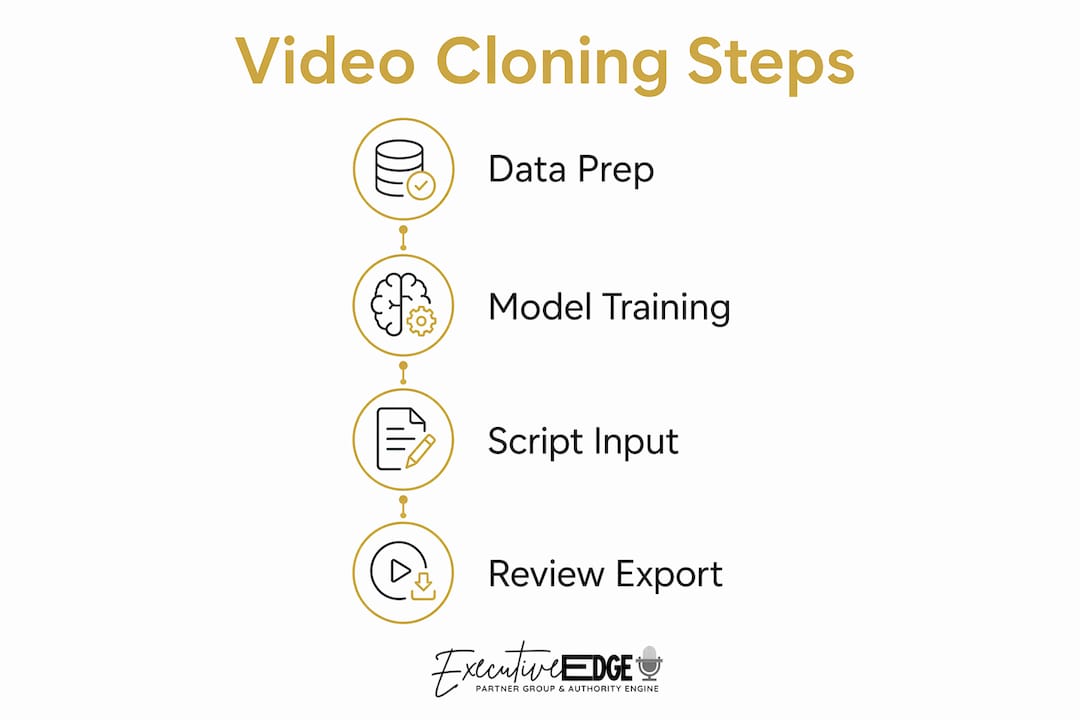
Stage 3: Script input and generation. Once the model is trained, you paste a script into the platform's text field and select your voice clone. The system generates a video of your digital double delivering that script, complete with synchronized lip movement and natural head motion. Generation time is measured in minutes, not hours.
Stage 4: Review and export. You review the output for artifacts, re-render any segments that look off, and export the final file for distribution.
| Factor | Manual video production | AI video cloning |
|---|---|---|
| Setup time | 2 to 4 hours per shoot | 2 to 10 minutes of training footage (one time) |
| Production time per video | 1 to 3 days | Minutes per script |
| Cost per video | High (crew, studio, editing) | Low after initial model training |
| Consistency across videos | Variable (lighting, energy, wardrobe) | Consistent by default |
| Scalability | Limited by human availability | Unlimited script-based generation |
| Motion customization | Requires reshooting | Reference clip swap in Kling Motion Control |
Pro Tip: Keep your training scripts conversational and varied. Reading a formal document for your training footage produces a clone that sounds robotic when generating casual content. Record yourself explaining something you know well, telling a short story, and answering a question off the cuff.
How are viral video formats cloned without copying actual footage?
Cloning viral video formats copies the structural blueprint of a successful video, including hook timing, pacing, and gesture patterns, rather than duplicating actual footage or branding. This distinction is legally and ethically significant. Copying a competitor's video frame-for-frame is copyright infringement. Studying why their hook lands in the first three seconds and replicating that structural logic with your own content is standard creative practice.
The structural elements that define a viral video are measurable and transferable. Hook duration, cut frequency, on-screen text timing, presenter gesture rate, and audio pacing all contribute to engagement. Motion transfer tools like Kling Motion Control make it possible to replicate specific gesture patterns from a reference clip and apply them to your own digital double, giving your content the physical energy of a proven performer without copying their identity.
Here is what you can ethically clone versus what crosses the line:
| Element | Ethical to clone | Not ethical to clone |
|---|---|---|
| Hook structure | Yes (timing and format) | No (exact wording or visuals) |
| Pacing and cut rhythm | Yes | No (identical edit sequence) |
| Gesture patterns | Yes (via motion transfer) | No (direct footage use) |
| On-screen text format | Yes (style and placement) | No (copied text verbatim) |
| Audio style | Yes (tone and energy) | No (same music or voice) |
| Branding | No | Not applicable |
- Study the top 10 videos in your niche and map their hook timing to the second
- Identify the gesture density (how often the presenter moves) in high-performing clips
- Use those structural parameters as your brief when generating scripts for your clone
- Apply motion transfer from a reference clip that matches the energy level you want
- Never use a competitor's actual footage as a motion reference without permission
What are the current challenges and detection methods for video cloning?
Advanced forensic techniques combining perceptual hashing (pHash) and Scale-Invariant Feature Transform (SIFT) detect video frame duplication with 96.5% accuracy, plus or minus 0.4%. That level of precision means platforms can identify cloned or duplicated content at scale with minimal human review. The implication for content creators is direct: submitting near-identical videos to platforms like TikTok or YouTube triggers automated flags before a human ever reviews the content.
The detection architecture is layered. Platforms do not rely on a single hash. They run SHA-256 hashes on raw files, perceptual hashes on visual frames, audio fingerprints on the soundtrack, and metadata scans on the file container. Format changes alone do not evade detection because the system checks multiple independent signals simultaneously. A video that passes the visual hash check may still fail on audio fingerprint.
An active arms race exists between cloning creators and detection platforms that use multi-layered perceptual and metadata fingerprinting. Evasion tactics like micro-cropping, pitch shifting, and metadata stripping require combining multiple techniques because each individual method only defeats one layer of detection. This is not a theoretical concern. Creators who attempt to flood platforms with AI-generated duplicates face account suspension, not just content removal.
- Perceptual hashing (pHash): Converts each frame to a compact hash and compares it against a database of known content
- SIFT feature matching: Identifies distinctive visual features that persist across crops, resizes, and color adjustments
- Audio fingerprinting: Extracts a unique audio signature that survives pitch shifts and format conversions
- Metadata scanning: Checks file creation timestamps, encoding parameters, and GPS data for inconsistencies
- Behavioral analysis: Flags accounts that upload high volumes of structurally similar content in short windows
The ethical path through this detection environment is straightforward: use video cloning to produce genuinely new content from your own digital double, not to mass-produce variations of someone else's work. Platforms reward original content. Detection systems punish duplication. The technology works best when it serves creation, not replication.
Why I think most people are using video cloning technology wrong
Most marketers treat video cloning as a production shortcut. Record once, generate forever. That framing is not wrong, but it misses the more powerful use case. The real value of understanding video cloning is that it decouples your personal availability from your content output. You can train a clone in a weekend, then generate 30 videos from scripts written over the following month, each one calibrated to a specific audience segment or platform format.
What I have seen consistently, working with businesses on their content strategy, is that the quality of the training footage determines everything. Creators who rush the recording session produce clones that look slightly off in ways that are hard to articulate but immediately felt by viewers. The uncanny valley is not a myth. A clone built on 10 minutes of well-lit, expressively varied footage outperforms one built on 30 minutes of flat, monotone recording every time.
The ethical distinction also matters more than most people acknowledge. AI video cloning creates digital doubles for script-based generation. That is categorically different from deepfake misuse, which applies someone's likeness without consent. Businesses that use their own clone to scale their own content are operating in a completely different ethical space than actors who generate fake endorsements. Conflating the two does a disservice to a technology that has genuine, legitimate value for marketers and educators.
My prediction is that motion transfer will become the most competitive differentiator within 18 months. Right now, most clones look similar in terms of facial quality. The gap will open on physical presence, gesture fluency, and the ability to match the energy of proven viral formats. Businesses that invest in understanding motion transfer now will have a structural advantage when the technology matures.
— David Domm
Ready to put video cloning to work for your brand?
Executive Edge Partner Group builds done-for-you content systems that include voice and video cloning technology, strategic script development, and multi-platform publishing. If you are a business owner or professional who wants to scale your video presence without standing in front of a camera every week, this is the system built for that goal.

The video content benefits for local marketing are well-documented, and the barrier to entry has never been lower. Whether you are a consultant, contractor, or service-based business, Executive Edge Partner Group can help you build a digital presence that generates trust and visibility on autopilot. Visit Executive Edge Partner Group to learn how the Authority Engine can integrate video cloning into your content strategy starting this quarter.
FAQ
What is video cloning technology?
Video cloning technology is an AI process that builds a photorealistic digital replica of a person using Neural Radiance Fields and GANs, then generates new video content from that replica using text scripts. It is distinct from deepfakes because it uses the subject's own consented training footage.
How much training footage does a video clone require?
Creating a quality AI clone requires 2 to 10 minutes of high-quality training footage, with model processing taking 2 to 24 hours. After training, new videos generate from scripts in minutes.
Can platforms detect AI-cloned or duplicated video content?
Yes. Forensic techniques combining perceptual hashing and SIFT detect video frame duplication with 96.5% accuracy. Platforms run multiple simultaneous checks including visual, audio, and metadata fingerprinting, making simple format changes insufficient to evade detection.
What is the difference between cloning a video format and copying a video?
Cloning a video format copies structural elements like hook timing, pacing, and gesture patterns without duplicating actual footage, branding, or audio. Copying a video reproduces the original content directly, which constitutes copyright infringement.
What tools are used in the video cloning process?
The primary tools include HeyGen and Subreels for avatar training and script-based generation, and Kling Motion Control for motion transfer from reference clips. Each platform handles different stages of the video replication technology workflow.